Division of Cardiology, Department of Medicine, University of California, 505 Parnassus Avenue, Box 0103, San Francisco, CA 94143, USA.
Int J Cardiovasc Imaging. 2010 Jun;26(5):509-18. doi: 10.1007/s10554-010-9596-1. Epub 2010 Feb 7.
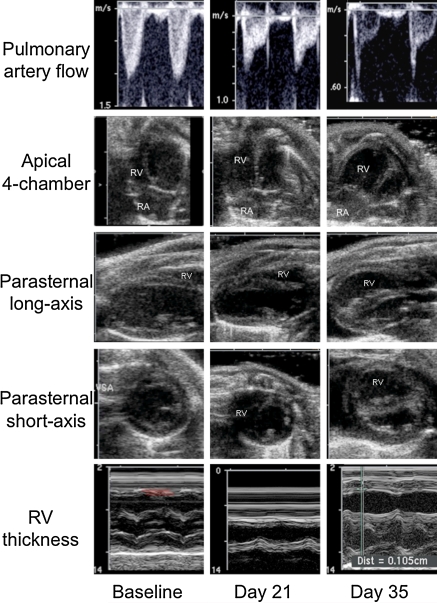
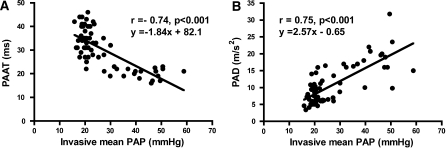
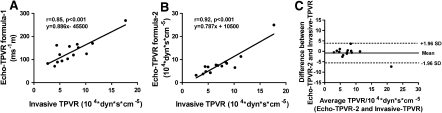
Pulmonary arterial hypertension (PAH) is a life-threatening condition characterized by progressive elevation in pulmonary artery pressure (PAP) and total pulmonary vascular resistance (TPVR). Recent advances in imaging techniques have allowed the development of new echocardiographic parameters to evaluate disease progression. However, there are no reports comparing the diagnostic performance of these non-invasive parameters to each other and to invasive measurements. Therefore, we investigated the diagnostic yield of echocardiographically derived TPVR and Doppler parameters of PAP in screening and measuring the severity of PAH in a rat model. Serial echocardiographic and invasive measurements were performed at baseline, 21 and 35 days after monocrotaline-induction of PAH. The most challenging echocardiographic derived TPVR measurement had good correlation with the invasive measurement (r = 0.92, P < 0.001) but also more simple and novel parameters of TPVR were found to be useful although the non-invasive TPVR measurement was feasible in only 29% of the studies due to lack of sufficient tricuspid valve regurgitation. However, echocardiographic measures of PAP, pulmonary artery flow acceleration time (PAAT) and deceleration (PAD), were measurable in all animals, and correlated with invasive PAP (r = -0.74 and r = 0.75, P < 0.001 for both). Right ventricular thickness and area correlated with invasive PAP (r = 0.59 and r = 0.64, P < 0.001 for both). Observer variability of the invasive and non-invasive parameters was low except in tissue-Doppler derived isovolumetric relaxation time. These non-invasive parameters may be used to replace invasive measurements in detecting successful disease induction and to complement invasive data in the evaluation of PAH severity in a rat model.
肺动脉高压(PAH)是一种危及生命的疾病,其特征是肺动脉压(PAP)和总肺血管阻力(TPVR)逐渐升高。成像技术的最新进展使得开发新的超声心动图参数来评估疾病进展成为可能。然而,目前还没有报告比较这些非侵入性参数彼此之间以及与侵入性测量的诊断性能。因此,我们研究了超声心动图衍生的 TPVR 和 PAP 多普勒参数在筛选和测量大鼠模型中 PAH 严重程度方面的诊断效果。在 PAH 诱导后第 21 天和第 35 天进行了系列超声心动图和侵入性测量。最具挑战性的超声心动图衍生的 TPVR 测量与侵入性测量具有良好的相关性(r = 0.92,P <0.001),但也发现了更简单和新颖的 TPVR 参数有用,尽管由于三尖瓣反流不足,只有 29%的研究能够进行非侵入性的 TPVR 测量。然而,所有动物都可以测量 PAP 的超声心动图指标、肺动脉血流加速时间(PAAT)和减速时间(PAD),并且与侵入性 PAP 相关(r = -0.74 和 r = 0.75,均 P <0.001)。右心室厚度和面积与侵入性 PAP 相关(r = 0.59 和 r = 0.64,均 P <0.001)。除了组织多普勒衍生的等容舒张时间外,侵入性和非侵入性参数的观察者变异性都较低。这些非侵入性参数可用于替代侵入性测量来检测疾病诱导的成功,并在评估大鼠模型中 PAH 严重程度时补充侵入性数据。