Division of Pediatrics, Departments of Leukemia and Stem Cell Transplantation and Cellular Therapy, University of Texas MD Anderson Cancer Center, Houston, Texas 60611, USA.
Clin Cancer Res. 2010 Feb 15;16(4):1149-58. doi: 10.1158/1078-0432.CCR-09-2416. Epub 2010 Feb 9.
Dasatinib is a dual Src/Abl inhibitor recently approved for Bcr-Abl+ leukemias with resistance or intolerance to prior therapy. Because Src kinases contribute to multiple blood cell functions by triggering a variety of signaling pathways, we hypothesized that their molecular targeting might lead to growth inhibition in acute myeloid leukemia (AML).
We studied growth factor-dependent and growth factor-independent leukemic cell lines, including three cell lines expressing mutants of receptor tyrosine kinases (Flt3 or c-Kit) as well as primary AML blasts for responsiveness to dasatinib.
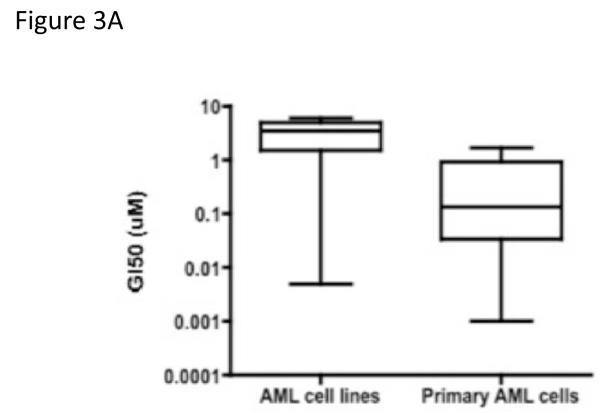
Dasatinib resulted in the inhibition of Src family kinases in all cell lines and blast cells at approximately 1 x 10(-9) mol/L. It also inhibited mutant Flt3 or Kit tyrosine phosphorylation at approximately 1 x 10(-6) mol/L. Mo7e cells expressing the activating mutation (codon 816) of c-Kit were most sensitive to growth inhibition with a GI(50) of 5 x 10(-9) mol/L. Primary AML blast cells exhibited a growth inhibition of <1 x 10(-6) mol/L. Cell lines that showed growth inhibition at approximately 1 x 10(-6) mol/L showed a G(1) cell cycle arrest and correlated with accumulation of p21 and p27 protein. The addition of rapamycin or cytotoxic agents enhanced growth inhibition. Dasatinib also caused the apoptosis of Mo7e cells expressing oncogenic Kit.
Although all of the precise targets for dasatinib are not known, this multikinase inhibitor causes either growth arrest or apoptosis in molecularly heterogeneous AML. The addition of cytotoxic or targeted agents can enhance its effects.
达沙替尼是一种双重Src/Abl 抑制剂,最近被批准用于对先前治疗有耐药性或不耐受的 Bcr-Abl+白血病。由于Src 激酶通过触发多种信号通路来促进多种血细胞功能,我们假设其分子靶向可能导致急性髓系白血病(AML)的生长抑制。
我们研究了依赖生长因子和不依赖生长因子的白血病细胞系,包括三个表达受体酪氨酸激酶(Flt3 或 c-Kit)突变体的细胞系以及对达沙替尼有反应的原发性 AML 原始细胞。
达沙替尼在所有细胞系和原始细胞中以约 1 x 10(-9) mol/L 的浓度抑制 Src 家族激酶。它还以约 1 x 10(-6) mol/L 的浓度抑制突变的 Flt3 或 Kit 酪氨酸磷酸化。表达激活突变(密码子 816)的 c-Kit 的 Mo7e 细胞对生长抑制最敏感,GI(50)为 5 x 10(-9) mol/L。原发性 AML 原始细胞的生长抑制率<1 x 10(-6) mol/L。以约 1 x 10(-6) mol/L 的浓度显示生长抑制的细胞系表现出 G1 细胞周期阻滞,并与 p21 和 p27 蛋白的积累相关。添加雷帕霉素或细胞毒性药物可增强生长抑制作用。达沙替尼还导致表达致癌性 Kit 的 Mo7e 细胞凋亡。
尽管达沙替尼的确切靶点尚不清楚,但这种多激酶抑制剂可导致分子异质性 AML 生长停滞或凋亡。添加细胞毒性或靶向药物可以增强其作用。