Departments of Medicine, Pathology, Pharmacology and Experimental Therapeutics, University of Maryland, School of Medicine, Marlene and Stewart Greenebaum Cancer Center, Baltimore, MD, USA.
Br J Cancer. 2010 Mar 2;102(5):815-26. doi: 10.1038/sj.bjc.6605553. Epub 2010 Feb 9.
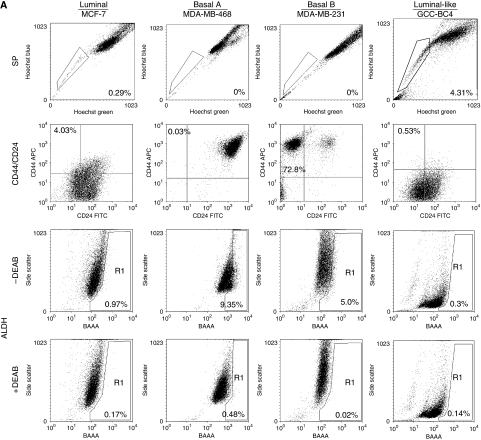
The expression of side-population (SP) cells and their relation to tumour-initiating cells (T-ICs) have been insufficiently studied in breast cancer (BC). We therefore evaluated primary cell cultures derived from patients and a panel of human BC cell lines with luminal- or basal-molecular signatures for the presence of SP and BC stem cell markers.
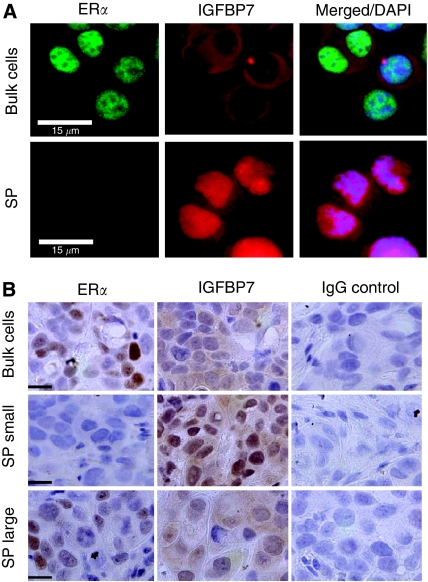
The SPs from luminal-type BC were analysed for BC T-IC characteristics, including human epidermal growth factor receptor 2 (HER2), ERalpha, IGFBP7 expression and their ability to initiate tumours in non-obese diabetic severe combined immunodeficiency (NOD/SCID) mice. Pharmacological modulators were used to assess the effects of HER2 signalling and breast cancer-resistance protein (BCRP) expression on SPs.
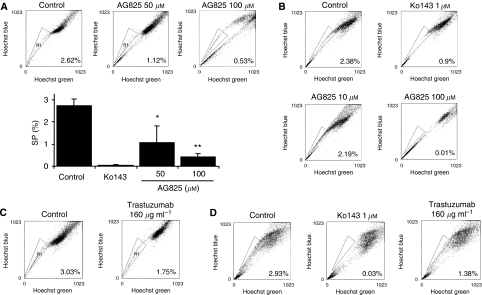
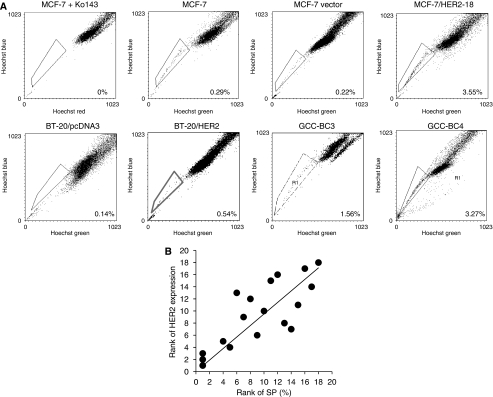
The SP was more prevalent in the luminal subtype of BC compared with the basal subtype. HER2 expression was significantly correlated with the occurrence of an SP (r(2)=0.75, P=0.0003). Disappearance of SP in the presence of Ko143, a specific inhibitor of the ATP-binding cassette transporter BCRP, suggests that BCRP is the predominant transporter expressed in this population. The SP also decreased in the presence of HER2 signalling inhibitors AG825 or trastuzumab, strengthening the notion that HER2 contributed to the SP phenotype, likely through downstream AKT signalling. The SP cells from luminal-type MCF-7 cells with enforced expression of HER2, and primary cells with luminal-like properties from a BC patient, displayed enrichment in cells capable of repopulating tumours in NOD/SCID mice. Engraftment of SP cells was inhibited by pretreatment with AG825 or by in vivo treatment with trastuzumab.
Our findings indicate an important role of HER2 in regulating SP and hence T-ICs in BC, which may account for the poor responsiveness of HER2-positive BCs to chemotherapy, as well as their aggressiveness.
在乳腺癌(BC)中,侧群(SP)细胞的表达及其与肿瘤起始细胞(T-ICs)的关系研究不足。因此,我们评估了源自患者的原代细胞培养物和一组具有腔型或基底分子特征的人 BC 细胞系中 SP 和 BC 干细胞标志物的存在。
分析腔型 BC 的 SP 是否具有 BC T-IC 特征,包括人表皮生长因子受体 2(HER2)、ERalpha、IGFBP7 表达及其在非肥胖糖尿病严重联合免疫缺陷(NOD/SCID)小鼠中引发肿瘤的能力。使用药理调节剂评估 HER2 信号和乳腺癌耐药蛋白(BCRP)表达对 SP 的影响。
与基底亚型相比,SP 在腔型 BC 中更为普遍。HER2 表达与 SP 的发生显著相关(r(2)=0.75,P=0.0003)。在存在特异性 ABC 转运蛋白 BCRP 抑制剂 Ko143 的情况下,SP 消失,表明 BCRP 是该群体中主要表达的转运蛋白。在存在 HER2 信号抑制剂 AG825 或曲妥珠单抗的情况下,SP 也减少,这进一步证实了 HER2 有助于 SP 表型,可能通过下游 AKT 信号传导。从具有 HER2 过表达的腔型 MCF-7 细胞和具有腔型特性的 BC 患者的原代细胞中获得的 SP 细胞显示出对 NOD/SCID 小鼠肿瘤再定植能力增强的细胞富集。用 AG825 预处理或用曲妥珠单抗体内治疗可抑制 SP 细胞的植入。
我们的发现表明 HER2 在调节 BC 中的 SP 及其 T-IC 中起重要作用,这可能解释了 HER2 阳性 BC 对化疗反应不佳以及其侵袭性的原因。