Biological Psychology, VU University, Van der Boechorststraat 1, Amsterdam, The Netherlands.
Behav Genet. 2010 Jul;40(4):480-94. doi: 10.1007/s10519-010-9341-5. Epub 2010 Feb 10.
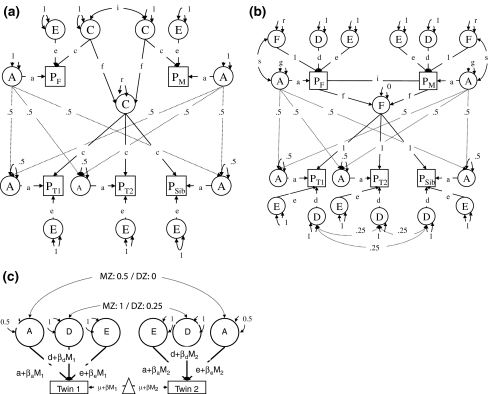
Social isolation and loneliness in humans have been associated with physical and psychological morbidity, as well as mortality. This study aimed to assess the etiology of individual differences in feelings of loneliness. The genetic architecture of loneliness was explored in an extended twin-family design including 8,683 twins, siblings and parents from 3,911 families. In addition, 917 spouses of twins participated. The presence of assortative mating, genetic non-additivity, vertical cultural transmission, genotype-environment (GE) correlation and interaction was modeled. GE interaction was considered for several demographic characteristics. Results showed non-random mating for loneliness. We confirmed that loneliness is moderately heritable, with a significant contribution of non-additive genetic variation. There were no effects of vertical cultural transmission. With respect to demographic characteristics, results indicated that marriage, having offspring, more years of education, and a higher number of siblings are associated with lower levels of loneliness. Interestingly, these effects tended to be stronger for men than women. There was little evidence of changes in genetic architecture as a function of these characteristics. We conclude that the genetic architecture of loneliness points to non-additive genetic influences, suggesting it may be a trait that was not neutral to selection in our evolutionary past. Sociodemographic factors that influence the prevalence of loneliness do not affect its genetic architecture.
社会孤立和孤独与身心健康以及死亡率有关。本研究旨在评估孤独感个体差异的病因。通过包括 3911 个家庭的 8683 对双胞胎、兄弟姐妹和父母在内的扩展双胞胎家庭设计,探讨了孤独感的遗传结构。此外,还对 917 对双胞胎的配偶进行了调查。研究了同型交配、遗传非加性、垂直文化传递、基因型-环境(GE)相关性和相互作用的存在。对几个人口统计学特征考虑了 GE 相互作用。结果表明孤独感存在非随机交配。我们证实孤独感具有中度遗传性,非加性遗传变异有显著贡献。没有垂直文化传递的影响。就人口统计学特征而言,结果表明婚姻、生育子女、受教育年限更长以及兄弟姐妹数量更多与较低的孤独感水平有关。有趣的是,这些影响在男性中比女性中更为明显。几乎没有证据表明遗传结构随这些特征的变化而变化。我们得出结论,孤独感的遗传结构指向非加性遗传影响,这表明它可能是我们进化史上不受选择中性的特征。影响孤独感流行率的社会人口因素并不影响其遗传结构。