Medical Physics, Cross Cancer Institute, Edmonton, AB, Canada.
J Appl Clin Med Phys. 2010 Jan 28;11(1):2961. doi: 10.1120/jacmp.v11i1.2961.
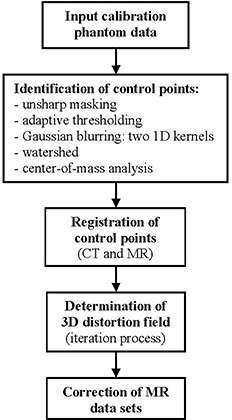
Interest has been growing in recent years in the development of radiation treatment planning (RTP) techniques based solely on Magnetic Resonance (MR) images. However, it is recognized that MR images suffer from scanner-related and object-induced distortions that may lead to an incorrect placement of anatomical structures. This subsequently may result in a reduced accuracy in delivering treatment dose fractions in RTP. To accomplish the precise representation of anatomical targets required by RTP, distortions must be mapped and the images rectified before being used in the clinical process. In this work, we investigate a novel, phantom-based method that determines and corrects for 3D system-related distortions. The algorithm consists of two key components: an adaptive control point identification and registration tool and an iterative method that finds the best estimate of 3D distortion. It was found that the 3D distortions were successfully mapped to within the voxel resolution of the raw data for a 260 x 260 x 240 mm3 volume.
近年来,人们对仅基于磁共振(MR)图像的放射治疗计划(RTP)技术的发展产生了浓厚的兴趣。然而,人们认识到,MR 图像存在与扫描仪相关的和物体引起的变形,这可能导致解剖结构的不正确放置。这可能会导致 RTP 中治疗剂量分数的准确性降低。为了实现 RTP 所需的精确解剖目标表示,在将图像用于临床过程之前,必须对其进行变形映射和校正。在这项工作中,我们研究了一种新颖的、基于体模的方法,该方法确定并校正了与 3D 系统相关的变形。该算法由两个关键组件组成:自适应控制点识别和注册工具以及一种迭代方法,用于找到 3D 变形的最佳估计值。结果发现,对于 260 x 260 x 240 mm3 体积的原始数据的体素分辨率内成功地映射了 3D 变形。