Trivedi Sapna, Greidinger Eric L
Division of Nephrology & Hypertension, University of Miami Miller School of Medicine, FL, USA.
Therapy. 2009 May 1;6(3):433-442. doi: 10.2217/thy.09.2.
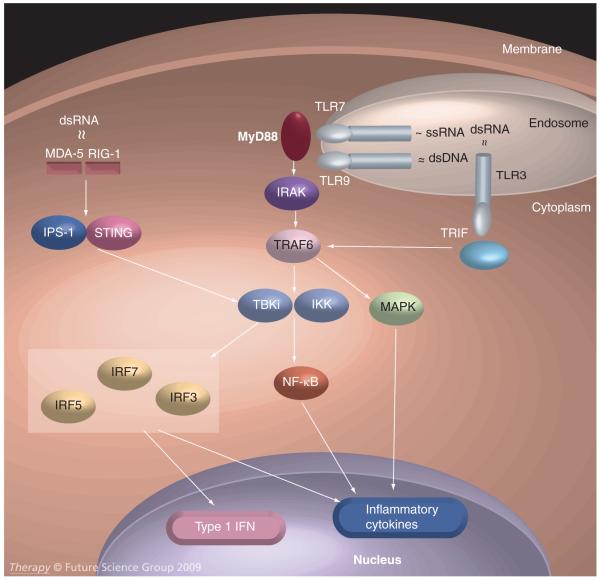
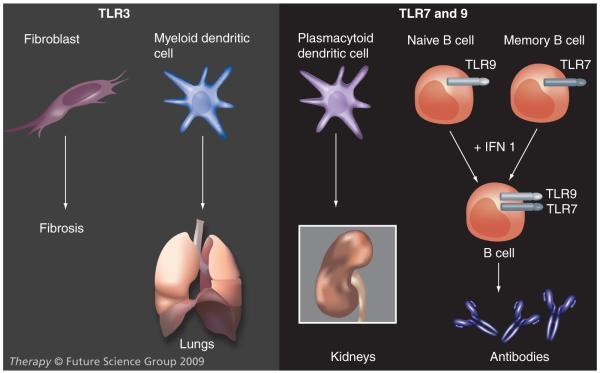
The endosomal Toll-like receptors (TLR3, TLR7 and TLR9) have been implicated in the pathogenesis of autoimmune diseases. Their signaling pathways show remarkable similarities and yet the outcomes following activation of each of these TLRs lead to clinically distinct autoimmune disease phenotypes. This review discusses how differences may arise at a molecular and cellular level to account for this diversity of responses. Understanding the roles of individual TLR pathways and the relationships between them and non-TLR innate immune pathways in the pathogenesis of diseases such as systemic lupus erythematosis highlights potential treatment targets for this spectrum of autoimmune diseases.
内体 Toll 样受体(TLR3、TLR7 和 TLR9)与自身免疫性疾病的发病机制有关。它们的信号通路显示出显著的相似性,但这些 TLR 各自激活后的结果却导致临床上不同的自身免疫性疾病表型。本综述讨论了在分子和细胞水平上如何产生差异以解释这种反应多样性。了解个体 TLR 通路的作用以及它们与系统性红斑狼疮等疾病发病机制中的非 TLR 固有免疫通路之间的关系,突出了针对这一系列自身免疫性疾病的潜在治疗靶点。