Department of Biochemistry and Protein Crystallography Facility, University of Iowa, Iowa City, Iowa, United States of America.
PLoS One. 2010 Feb 9;5(2):e9098. doi: 10.1371/journal.pone.0009098.
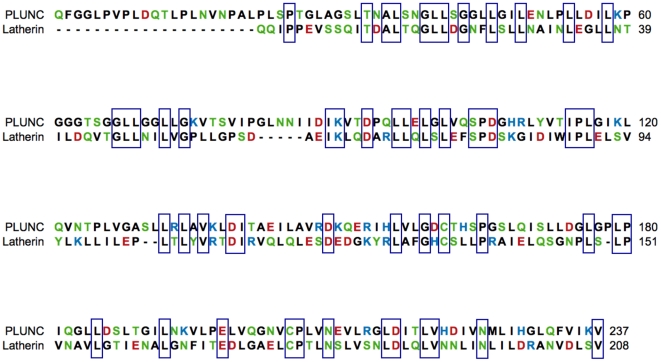
The PLUNC ("Palate, lung, nasal epithelium clone") protein is an abundant secretory product of epithelia present throughout the conducting airways of humans and other mammals, which is evolutionarily related to the lipid transfer/lipopolysaccharide binding protein (LT/LBP) family. Two members of this family--the bactericidal/permeability increasing protein (BPI) and the lipopolysaccharide binding protein (LBP)--are innate immune molecules with recognized roles in sensing and responding to Gram negative bacteria, leading many to propose that PLUNC may play a host defense role in the human airways.
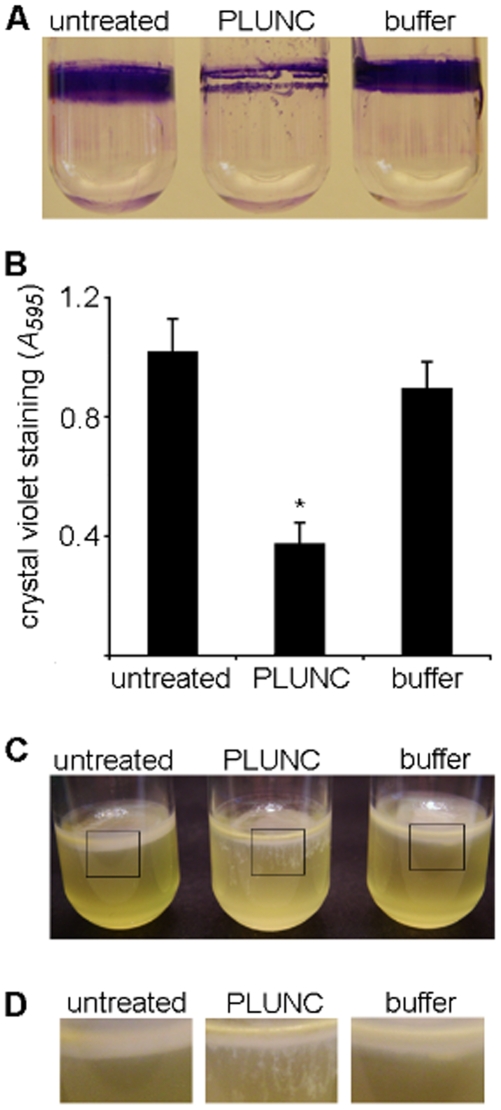
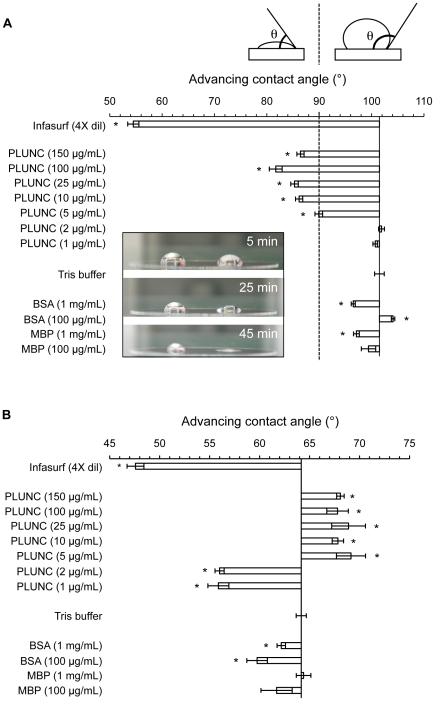
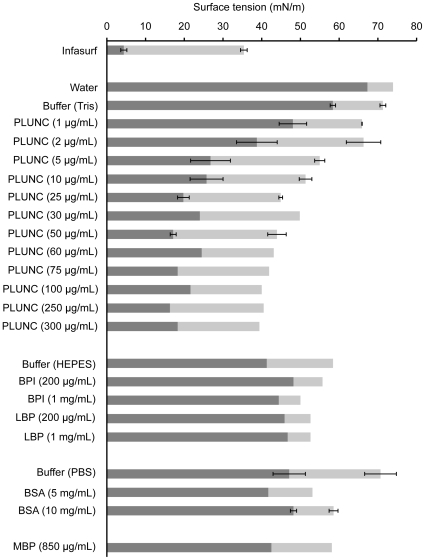
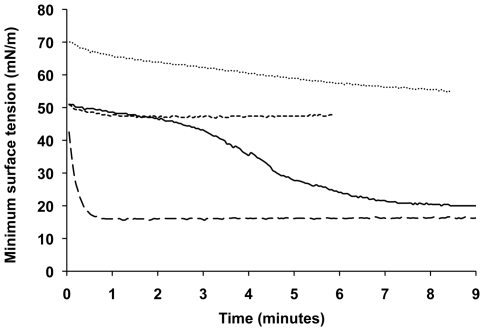
METHODOLOGY/PRINCIPAL FINDINGS: Based on its marked hydrophobicity, we hypothesized that PLUNC may be an airway surfactant. We found that purified recombinant human PLUNC greatly enhanced the ability of aqueous solutions to spread on a hydrophobic surface. Furthermore, we discovered that PLUNC significantly reduced surface tension at the air-liquid interface in aqueous solutions, indicating novel and biologically relevant surfactant properties. Of note, surface tensions achieved by adding PLUNC to solutions are very similar to measurements of the surface tension in tracheobronchial secretions from humans and animal models. Because surfactants of microbial origin can disperse matrix-encased bacterial clusters known as biofilms [1], we hypothesized that PLUNC may also have anti-biofilm activity. We found that, at a physiologically relevant concentration, PLUNC inhibited biofilm formation by the airway pathogen Pseudomonas aeruginosa in an in vitro model.
CONCLUSIONS/SIGNIFICANCE: Our data suggest that the PLUNC protein contributes to the surfactant properties of airway secretions, and that this activity may interfere with biofilm formation by an airway pathogen.
PLUNC(“腭、肺、鼻上皮克隆”)蛋白是人类和其他哺乳动物呼吸道上皮细胞的丰富分泌产物,它与脂质转移/脂多糖结合蛋白(LT/LBP)家族在进化上有关。该家族的两个成员——杀菌/通透性增加蛋白(BPI)和脂多糖结合蛋白(LBP)——是先天免疫分子,其在识别和应对革兰氏阴性菌方面具有公认的作用,这使得许多人提出 PLUNC 可能在人体气道中发挥宿主防御作用。
方法/主要发现:基于其显著的疏水性,我们假设 PLUNC 可能是一种气道表面活性剂。我们发现纯化的重组人 PLUNC 大大增强了水溶液在疏水表面上扩展的能力。此外,我们发现 PLUNC 显著降低了水溶液在气液界面处的表面张力,表明具有新颖且具有生物学相关性的表面活性剂特性。值得注意的是,通过向溶液中添加 PLUNC 达到的表面张力与从人类和动物模型的气管支气管分泌物中测量的表面张力非常相似。由于微生物来源的表面活性剂可以分散称为生物膜的基质包裹的细菌簇[1],我们假设 PLUNC 也可能具有抗生物膜活性。我们发现,在生理相关浓度下,PLUNC 抑制了气道病原体铜绿假单胞菌在体外模型中的生物膜形成。
结论/意义:我们的数据表明,PLUNC 蛋白有助于气道分泌物的表面活性剂特性,并且这种活性可能干扰气道病原体的生物膜形成。