Department of Medicine, Union Memorial Hospital, Baltimore, MD 21218, USA.
Med Educ Online. 2009 Jul 14;14:8. doi: 10.3885/meo.2009.Res00307.
Since 2002, market studies have predicted a physician shortage with an increasing need for future subspecialists. A Residency Review Committee (RRC) rule that restricted sponsorship of fellowships was eliminated in 2005, but the influence of this change on the number of fellowships is not known. We believed that the rules change might make it possible for community hospitals to offer fellowships. Our objectives were to determine the extent of change in the number of fellowships in university and community hospitals from 2000 through 2008, both before and after the RRC regulation change in 2005, and to determine whether community hospitals contributed substantially to the number of new fellowships available to internal medicine graduates.
We used archived Accreditation Council for Graduate Medical Education (ACGME) data from July 2000 through June 2008. The community hospital category included multispecialty clinics, community programs, and municipal hospitals.
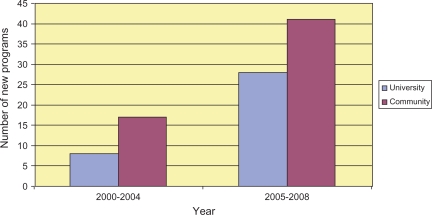
Of the 94 newly approved internal medicine subspecialty fellowships in this time period, 59 (63%) were community sponsored. As of 6/02/08, all were in good standing. Thirteen programs were started as a department of medicine solo fellowship since 2005. The number of new programs approved between 2005 and 2008 was roughly three times the number approved between 2000 and 2004.
The number of subspecialty fellowship programs and approved positions has increased dramatically in the last 8 years. Many of the new programs were at community hospitals. The change in RRC rules has been associated with increased availability of fellowship programs in the university and community hospital setting for subspecialty training.
自 2002 年以来,市场研究预测未来将出现医生短缺,对专科医生的需求也将增加。2005 年,取消了限制专科住院医师培训赞助的住院医师评审委员会(RRC)规定,但该规定的改变对专科住院医师培训数量的影响尚不清楚。我们认为,规则的改变可能使社区医院提供专科住院医师培训成为可能。我们的目的是确定 2000 年至 2008 年期间,大学和社区医院的专科住院医师培训数量在 2005 年 RRC 规定改变前后的变化程度,并确定社区医院是否对内科毕业生可获得的新专科住院医师培训数量做出了重大贡献。
我们使用了 2000 年 7 月至 2008 年 6 月期间存档的研究生医学教育认证委员会(ACGME)数据。社区医院类别包括多专科诊所、社区项目和市立医院。
在此期间,新批准的 94 个内科亚专科住院医师培训中,有 59 个(63%)是社区赞助的。截至 2008 年 6 月 2 日,所有项目均状况良好。自 2005 年以来,有 13 个项目作为医学系单一专科住院医师培训开始。2005 年至 2008 年期间批准的新项目数量约为 2000 年至 2004 年期间批准项目数量的三倍。
过去 8 年来,专科住院医师培训项目和批准的职位数量显著增加。许多新项目都在社区医院。RRC 规则的改变与大学和社区医院专科培训的住院医师培训项目可用性增加有关。