Department of Radiology, University of Alabama at Birmingham, JTN322, 619 S 19th St., Birmingham, AL 35233, USA.
AJR Am J Roentgenol. 2010 Mar;194(3):615-22. doi: 10.2214/AJR.08.1022.
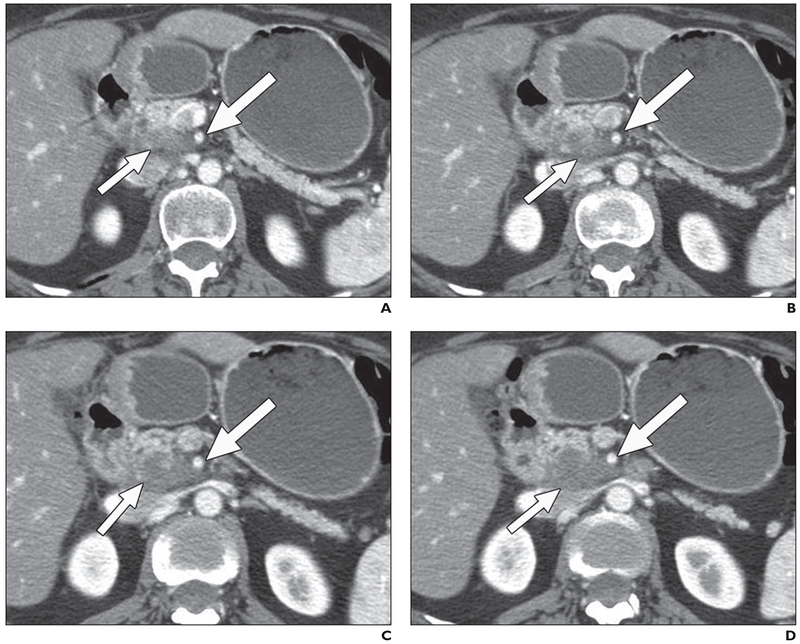
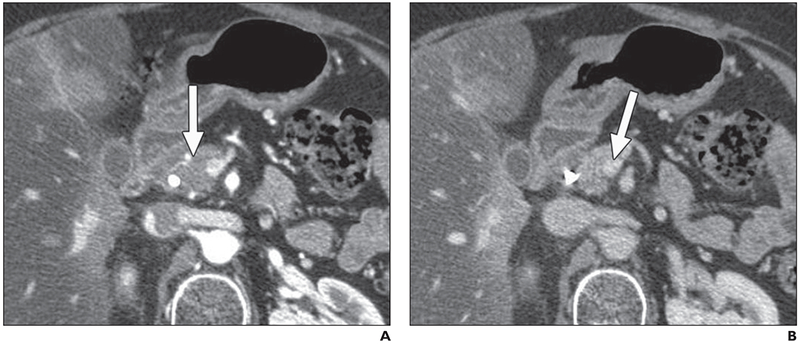
The purpose of this study was to determine whether preoperative neoadjuvant therapy in patients with locally advanced pancreatic cancer affects the ability of multiphasic MDCT to predict successful surgical resection.
From 2000 to 2006, there were 12 patients with prior neoadjuvant therapy successfully downstaged by CT and 31 age-matched pancreatic cancer patients without preoperative therapy who underwent pancreatic MDCT followed by attempted pancreaticoduodenectomy. Three readers blinded to surgical findings independently analyzed immediate preoperative MDCT scans of 43 patients comprising the retrospective data set in random order for vascular involvement (degree of contact and narrowing) and distant metastases. Individual reader sensitivity and specificity for resectability prediction were compared for study and control groups using the Fisher's exact test. Interobserver agreement was assessed using the kappa statistic.
Seven (58%) of 12 neoadjuvant-treated adenocarcinomas and 10 (32%) of 31 control pancreatic carcinomas were resectable (p > 0.05). For resectable disease, sensitivities were 86%, 71%, and 14% for the neoadjuvant group and 90%, 90%, and 60% for the control group (p > 0.05). Specificities were 80%, 100%, and 100% for the neoadjuvant group and 57%, 43%, and 76% for the control group (reader 2 specificity difference, p = 0.04). The multi rater kappa value of resectability prediction for neoadjuvant patients was 0.28, and that for control subjects was 0.63 (p < 0.001). In the neoadjuvant group, the majority of individual reader errors were false-negative resectability interpretations resulting from overestimation of vascular involvement. Consideration of degrees of venous abutment did not improve estimation of resectability in patients with neoadjuvant therapy.
Sensitivity for prediction of resectability tends to be lower for patients with locally advanced pancreatic cancer that has been downstaged by neoadjuvant therapy, but this trend is not statistically significant. Interobserver variability for determination of resectability is statistically higher than for controls who did not receive preoperative therapy.
本研究旨在确定局部晚期胰腺癌患者术前新辅助治疗是否会影响多期 MDCT 预测手术切除成功的能力。
2000 年至 2006 年,12 例接受 CT 成功降期的新辅助治疗患者和 31 例年龄匹配的无术前治疗的胰腺癌患者接受胰腺 MDCT 检查后尝试行胰十二指肠切除术。3 位观察者对包含回顾性数据的 43 例患者的即刻术前 MDCT 扫描进行盲法分析,评估血管受累(接触程度和狭窄程度)和远处转移情况。采用 Fisher 精确检验比较研究组和对照组中每位观察者对可切除性预测的敏感性和特异性。采用 Kappa 统计评估观察者间一致性。
12 例新辅助治疗的腺癌中 7 例(58%)和 31 例对照组胰腺癌中 10 例(32%)可切除(p>0.05)。对于可切除疾病,新辅助组的敏感性分别为 86%、71%和 14%,对照组为 90%、90%和 60%(p>0.05)。新辅助组特异性分别为 80%、100%和 100%,对照组为 57%、43%和 76%(观察者 2 特异性差异,p=0.04)。新辅助组患者可切除性预测的多观察者 Kappa 值为 0.28,对照组为 0.63(p<0.001)。在新辅助组中,大多数观察者的错误是对血管受累的高估导致的可切除性假阴性解释。考虑静脉毗邻程度并不能改善新辅助治疗患者对可切除性的估计。
对于经新辅助治疗降期的局部晚期胰腺癌患者,预测可切除性的敏感性往往较低,但这种趋势无统计学意义。确定可切除性的观察者间变异性明显高于未接受术前治疗的对照组。