Department of Obstetrics and Gynecology, Johannes Gutenberg University, Mainz, Germany.
Arch Gynecol Obstet. 2011 Mar;283(3):469-74. doi: 10.1007/s00404-010-1390-8. Epub 2010 Feb 20.
The purpose of this retrospective study was to find a method of improving the accuracy of fetal birth weight estimation on the basis of traditional ultrasonographic measurements of the head, thorax, and femur at term. In this context, we analyzed a novel regression method comparing to existing algorithms.
The delivery records of two hospitals were searched for women who delivered macrosomic infants, and the patients' medical records were retrospectively reviewed in order to derive clinical and ultrasonographic data at term. A total of 223 patients with macrosomic infants (birth weight > 4,000 g) were identified. These patients were complemented by data for 212 women who had ultrasound fetal assessments of less than 4,000 g. We used the method of isotonic regression to construct a birth weight prediction function that increases monotonically with each of the input variables and which minimizes the empirical quadratic loss.
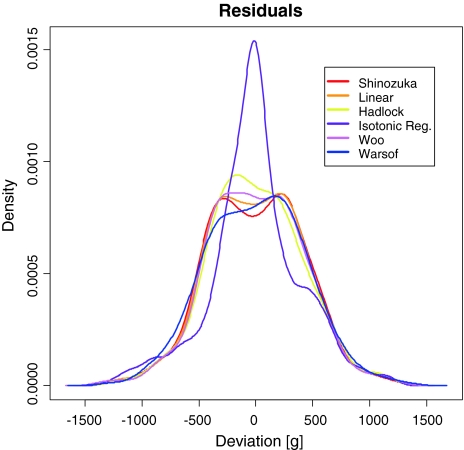
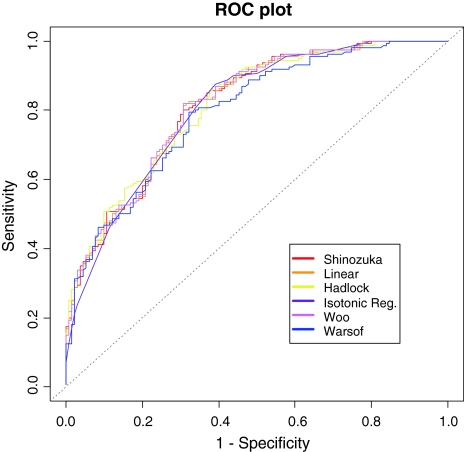
A suspicion of macrosomia was based on a history of macrosomia, fundal height, and sonographic weight estimation >4,000 g. The mean period between ultrasound weight estimation and delivery was 7.2 days. The ability of the biometric algorithms developed to predict fetal weight at term ranged between a mean absolute error of 312 and 344 g, given a confidence interval of 95%. We demonstrate that predictions of birth weight on the basis of ultrasound data can be improved significantly, if an isotonic regression model is used instead of a linear regression model.
This study demonstrates that ultrasound detection of macrosomia can be improved using the isotonic regression method.
本回顾性研究旨在寻找一种方法,在传统的头围、胸围和股骨超声测量的基础上提高胎儿出生体重估计的准确性。在这种情况下,我们分析了一种新的回归方法,与现有的算法进行了比较。
搜索了两家医院的分娩记录,以寻找分娩巨大儿的女性,并回顾性地审查了患者的病历,以得出足月时的临床和超声数据。共确定了 223 例巨大儿(出生体重>4000g)患者。这些患者的数据由 212 名超声胎儿评估体重<4000g 的女性数据补充。我们使用等渗回归方法构建了一个出生体重预测函数,该函数与每个输入变量单调增加,同时最小化经验二次损失。
巨大儿的可疑依据是既往巨大儿史、宫高和超声体重估计>4000g。超声体重估计与分娩之间的平均间隔时间为 7.2 天。用于预测足月胎儿体重的生物计量算法的能力在平均绝对误差为 312 至 344g 之间,置信区间为 95%。我们证明,如果使用等渗回归模型而不是线性回归模型,可以显著提高基于超声数据的出生体重预测。
本研究表明,使用等渗回归方法可以提高超声检测巨大儿的准确性。