Turku Centre for Biotechnology, University of Turku and Abo Akademi University, Turku, Finland.
J Cell Mol Med. 2010 Apr;14(4):758-70. doi: 10.1111/j.1582-4934.2010.01030.x. Epub 2010 Feb 22.
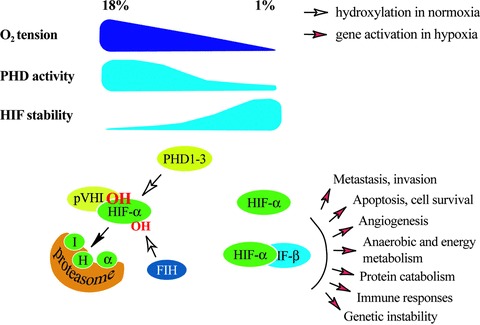
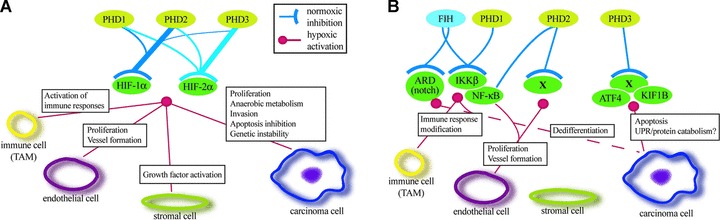
Tumour hypoxia is a well-known microenvironmental factor that causes cancer progression and resistance to cancer treatment. This involves multiple mechanisms of which the best-understood ones are mediated through transcriptional gene activation by the hypoxia-inducible factors (HIFs). HIFs in turn are regulated in response to oxygen availability by a family of iron- and 2-oxoglutarate-dependent dioxygenases, the HIF prolyl hydroxylases (PHDs). PHDs inactivate HIFs in normoxia by activating degradation of the HIF-alpha subunit but release HIF activation in poorly oxygenated conditions. The function of HIF in tumours is fairly well characterized but our understanding on the outcome of PHDs in tumours is much more limited. Here we review the function of PHDs on the HIF system, the expression of PHDs in human tumours as well as their putative function in cancer. The PHDs may have either tumour promoting or suppressing activity. Their outcome in cancer depends on the cell and cancer type-specific expression and on the availability of diverse natural PHD inhibitors in tumours. Moreover, besides the action of PHDs on HIF, recent data suggest PHD function in non-HIF signalling. Together the data illustrate a complex operation of the oxygen sensors in cancer.
肿瘤缺氧是一种众所周知的微环境因素,可导致癌症进展和对癌症治疗的耐药性。这涉及多种机制,其中最被理解的机制是通过缺氧诱导因子(HIFs)介导的转录基因激活。反过来,HIFs 通过一系列铁和 2-氧戊二酸依赖性双氧酶(HIF 脯氨酰羟化酶(PHD))来响应氧气可用性进行调节。在常氧条件下,PHD 通过激活 HIF-α亚基的降解来使 HIF 失活,但在缺氧条件下会释放 HIF 激活。HIF 在肿瘤中的功能已得到很好的描述,但我们对 PHD 在肿瘤中的作用的理解要有限得多。在这里,我们回顾了 PHD 在 HIF 系统中的功能、PHD 在人类肿瘤中的表达以及它们在癌症中的潜在功能。PHD 可能具有促进或抑制肿瘤的活性。它们在癌症中的作用取决于细胞和癌症类型特异性表达以及肿瘤中各种天然 PHD 抑制剂的可用性。此外,除了 PHD 对 HIF 的作用外,最近的数据表明 PHD 在非 HIF 信号转导中的功能。这些数据共同说明了癌症中氧气传感器的复杂运作。