National Heart, Lung, and Blood Institute (NHLBI) Proteomics Center, Department of Biochemistry and Molecular Biology, University of Texas Medical Branch, Galveston, Texas, United States of America.
PLoS One. 2010 Feb 22;5(2):e9337. doi: 10.1371/journal.pone.0009337.
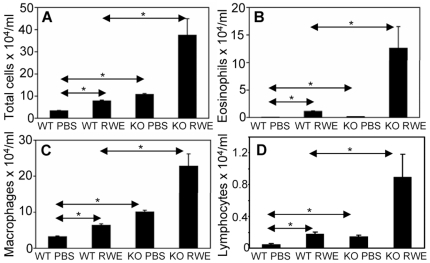
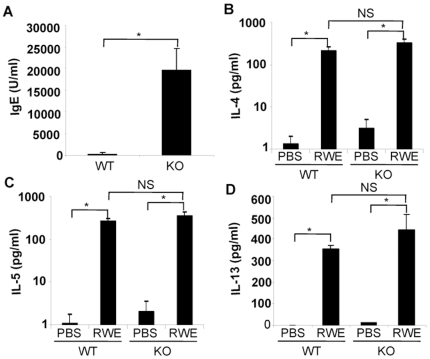
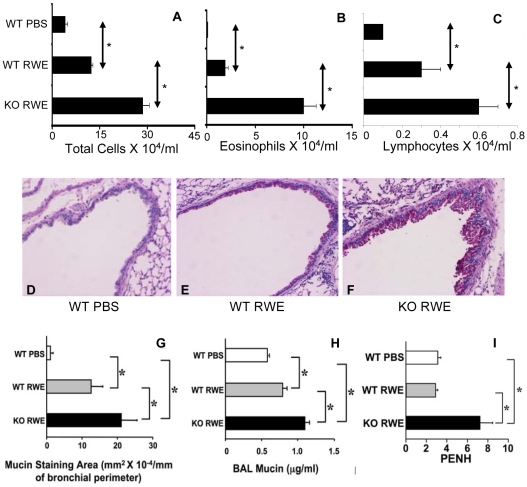
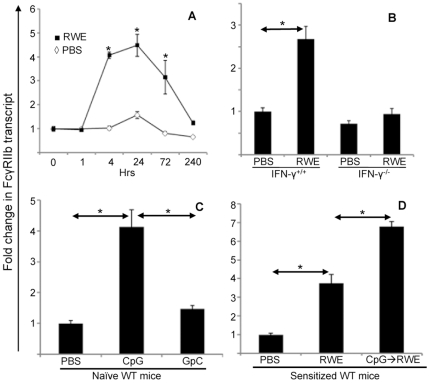
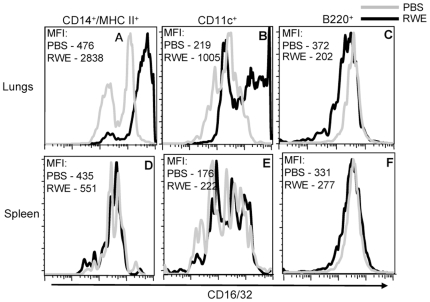
Allergic asthma is characterized by airway eosinophilia, increased mucin production and allergen-specific IgE. Fc gamma receptor IIb (FcgammaRIIb), an inhibitory IgG receptor, has recently emerged as a negative regulator of allergic diseases like anaphylaxis and allergic rhinitis. However, no studies to date have evaluated its role in allergic asthma. Our main objective was to study the role of FcgammaRIIb in allergic lung inflammation. We used a murine model of allergic airway inflammation. Inflammation was quantified by BAL inflammatory cells and airway mucin production. FcgammaRIIb expression was measured by qPCR and flow cytometry and the cytokines were quantified by ELISA. Compared to wild type animals, FcgammaRIIb deficient mice mount a vigorous allergic lung inflammation characterized by increased bronchoalveolar lavage fluid cellularity, eosinophilia and mucin content upon ragweed extract (RWE) challenge. RWE challenge in sensitized mice upregulated FcgammaRIIb in the lungs. Disruption of IFN-gamma gene abrogated this upregulation. Treatment of naïve mice with the Th1-inducing agent CpG DNA increased FcgammaRIIb expression in the lungs. Furthermore, treatment of sensitized mice with CpG DNA prior to RWE challenge induced greater upregulation of FcgammaRIIb than RWE challenge alone. These observations indicated that RWE challenge upregulated FcgammaRIIb in the lungs by IFN-gamma- and Th1-dependent mechanisms. RWE challenge upregulated FcgammaRIIb on pulmonary CD14+/MHC II+ mononuclear cells and CD11c+ cells. FcgammaRIIb deficient mice also exhibited an exaggerated RWE-specific IgE response upon sensitization when compared to wild type mice. We propose that FcgammaRIIb physiologically regulates allergic airway inflammation by two mechanisms: 1) allergen challenge mediates upregulation of FcgammaRIIb on pulmonary CD14+/MHC II+ mononuclear cells and CD11c+ cells by an IFN-gamma dependent mechanism; and 2) by attenuating the allergen specific IgE response during sensitization. Thus, stimulating FcgammaRIIb may be a therapeutic strategy in allergic airway disorders.
变应性哮喘的特征是气道嗜酸性粒细胞增多、粘蛋白生成增加和过敏原特异性 IgE。Fc 伽马受体 IIb(FcgammaRIIb),一种抑制性 IgG 受体,最近作为过敏反应和过敏性鼻炎等过敏疾病的负调节剂而出现。然而,迄今为止尚无研究评估其在变应性哮喘中的作用。我们的主要目标是研究 FcgammaRIIb 在变应性肺炎症中的作用。我们使用了变应性气道炎症的小鼠模型。通过 BAL 炎症细胞和气道粘蛋白生成来量化炎症。通过 qPCR 和流式细胞术测量 FcgammaRIIb 的表达,并通过 ELISA 定量细胞因子。与野生型动物相比,FcgammaRIIb 缺陷型小鼠在豚草提取物(RWE)挑战时会引发剧烈的变应性肺炎症,表现为支气管肺泡灌洗液细胞增多、嗜酸性粒细胞增多和粘蛋白含量增加。致敏小鼠的 RWE 挑战上调了肺部的 FcgammaRIIb。IFN-γ 基因的破坏消除了这种上调。用 Th1 诱导剂 CpG DNA 处理 naive 小鼠可增加肺部的 FcgammaRIIb 表达。此外,在 RWE 挑战之前用 CpG DNA 处理致敏小鼠可诱导比单独 RWE 挑战更大的 FcgammaRIIb 上调。这些观察结果表明,RWE 挑战通过 IFN-γ 和 Th1 依赖性机制上调肺部的 FcgammaRIIb。RWE 挑战上调了肺 CD14+/MHC II+单核细胞和 CD11c+细胞上的 FcgammaRIIb。与野生型小鼠相比,FcgammaRIIb 缺陷型小鼠在致敏时也表现出更强烈的 RWE 特异性 IgE 反应。我们提出,FcgammaRIIb 通过两种机制生理性调节变应性气道炎症:1)过敏原挑战通过 IFN-γ 依赖性机制介导肺 CD14+/MHC II+单核细胞和 CD11c+细胞上的 FcgammaRIIb 上调;2)通过在致敏期间减弱过敏原特异性 IgE 反应。因此,刺激 FcgammaRIIb 可能是变应性气道疾病的一种治疗策略。