Tenin Gennady, Wright David, Ferjentsik Zoltan, Bone Robert, McGrew Michael J, Maroto Miguel
Division of Cell and Developmental Biology, College of Life Sciences, University of Dundee, Dow Street, Dundee, UK.
BMC Dev Biol. 2010 Feb 25;10:24. doi: 10.1186/1471-213X-10-24.
Somitogenesis is the earliest sign of segmentation in the developing vertebrate embryo. This process starts very early, soon after gastrulation has initiated and proceeds in an anterior-to-posterior direction during body axis elongation. It is widely accepted that somitogenesis is controlled by a molecular oscillator with the same periodicity as somite formation. This periodic mechanism is repeated a specific number of times until the embryo acquires a defined specie-specific final number of somites at the end of the process of axis elongation. This final number of somites varies widely between vertebrate species. How termination of the process of somitogenesis is determined is still unknown.
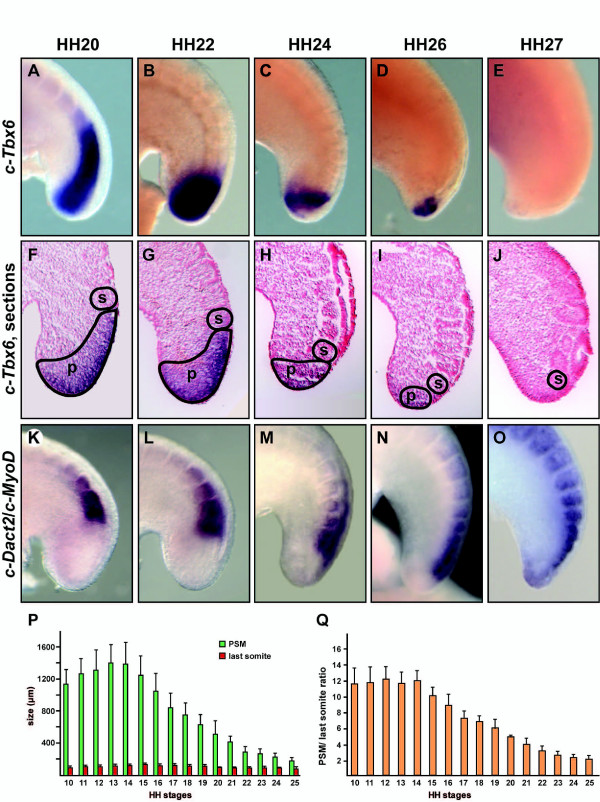
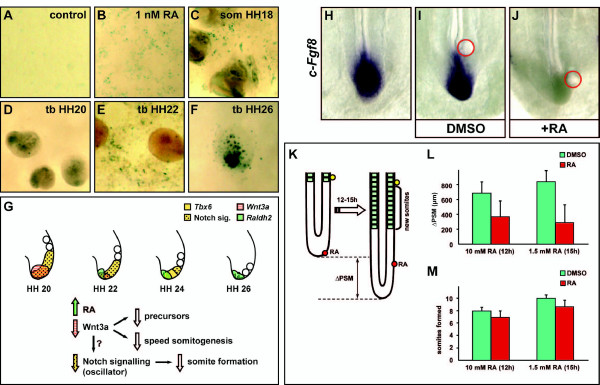
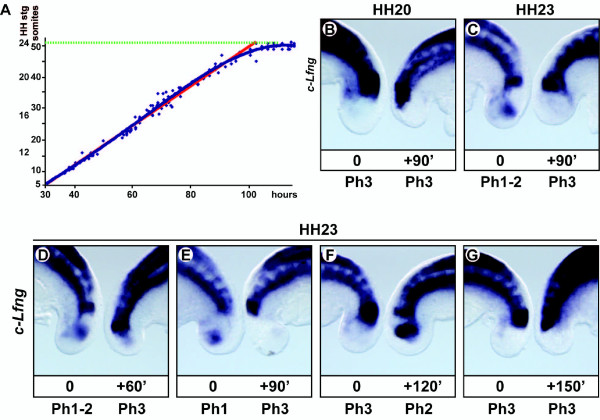
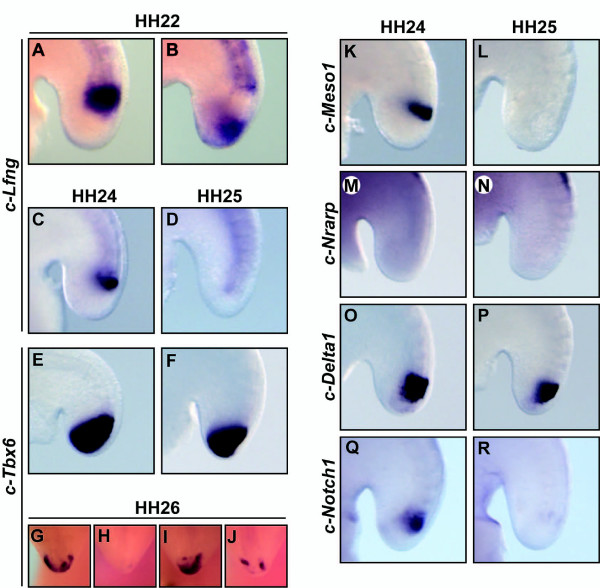
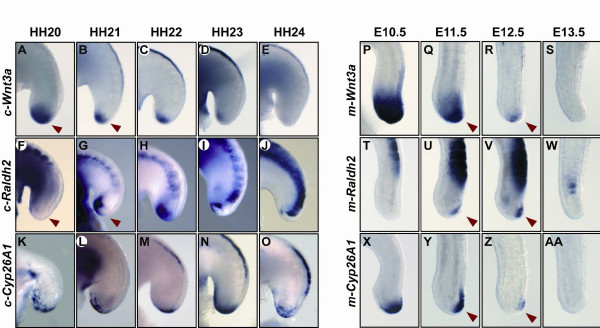
Here we show that during development there is an imbalance between the speed of somite formation and growth of the presomitic mesoderm (PSM)/tail bud. This decrease in the PSM size of the chick embryo is not due to an acceleration of the speed of somite formation because it remains constant until the last stages of somitogenesis, when it slows down. When the chick embryo reaches its final number of somites at stage HH 24-25 there is still some remaining unsegmented PSM in which expression of components of the somitogenesis oscillator is no longer dynamic. Finally, we identify a change in expression of retinoic acid regulating factors in the tail bud at late stages of somitogenesis, such that in the chick embryo there is a pronounced onset of Raldh2 expression while in the mouse embryo the expression of the RA inhibitor Cyp26A1 is downregulated.
Our results show that the chick somitogenesis oscillator is arrested before all paraxial mesoderm is segmented into somites. In addition, endogenous retinoic acid is probably also involved in the termination of the process of segmentation, and in tail growth in general.
体节发生是发育中的脊椎动物胚胎最早出现的分节迹象。这个过程很早就开始了,在原肠胚形成后不久就启动,并在体轴伸长过程中从前向后进行。人们普遍认为,体节发生受一个与体节形成具有相同周期的分子振荡器控制。这个周期性机制会重复特定次数,直到胚胎在体轴伸长过程结束时获得特定物种特有的最终体节数。脊椎动物物种之间的最终体节数差异很大。体节发生过程的终止是如何确定的仍然未知。
我们在此表明,在发育过程中,体节形成的速度与前体中胚层(PSM)/尾芽的生长之间存在不平衡。鸡胚PSM大小的减小并非由于体节形成速度的加快,因为在体节发生的最后阶段之前它一直保持恒定,直到最后阶段才减缓。当鸡胚在HH 24 - 25阶段达到其最终体节数时,仍有一些未分节的PSM残留,其中体节发生振荡器的成分表达不再动态变化。最后,我们确定了在体节发生后期尾芽中视黄酸调节因子表达的变化,即在鸡胚中Raldh2表达明显开始,而在小鼠胚胎中视黄酸抑制剂Cyp26A1的表达下调。
我们的结果表明,鸡的体节发生振荡器在所有轴旁中胚层都被分割成体节之前就停止了。此外,内源性视黄酸可能也参与了分割过程的终止以及一般的尾部生长。