Department of Medicine, University of Minnesota, 420 Delaware St SE, MMC508, Minneapolis, MN 55455, USA.
Arterioscler Thromb Vasc Biol. 2010 May;30(5):1000-6. doi: 10.1161/ATVBAHA.110.203141. Epub 2010 Feb 25.
Acadesine, an adenosine-regulating agent and activator of AMP-activated protein kinase, has been shown to possess antiinflammatory activity. This study investigated whether and how acadesine inhibits tissue factor (TF) expression and thrombus formation.
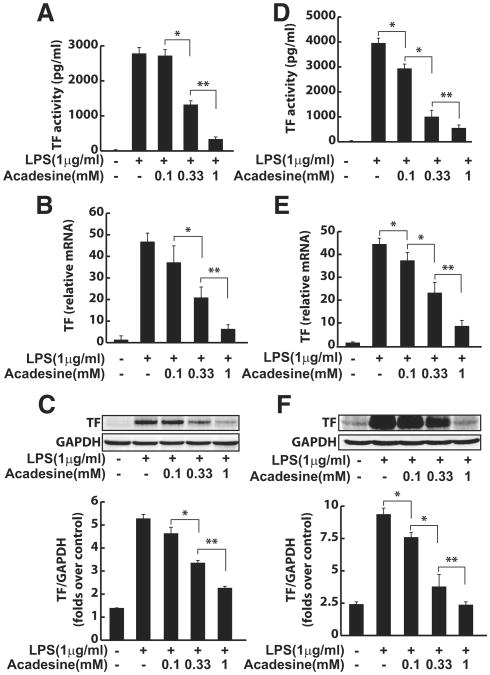
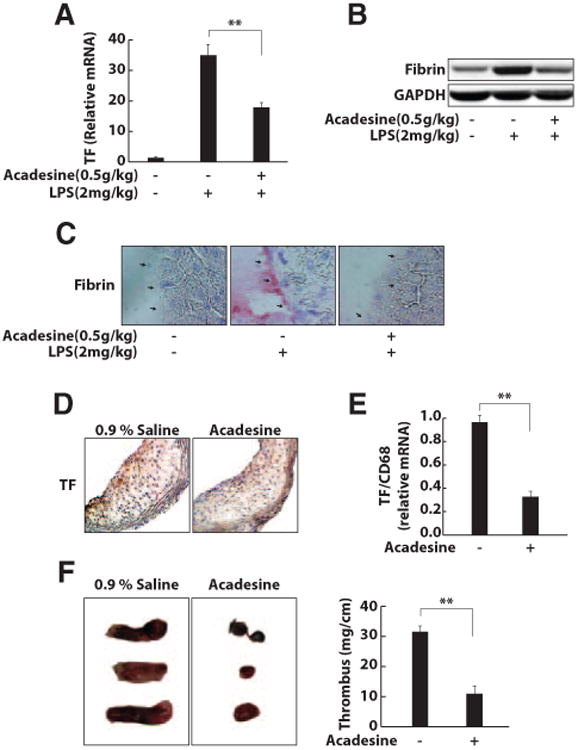
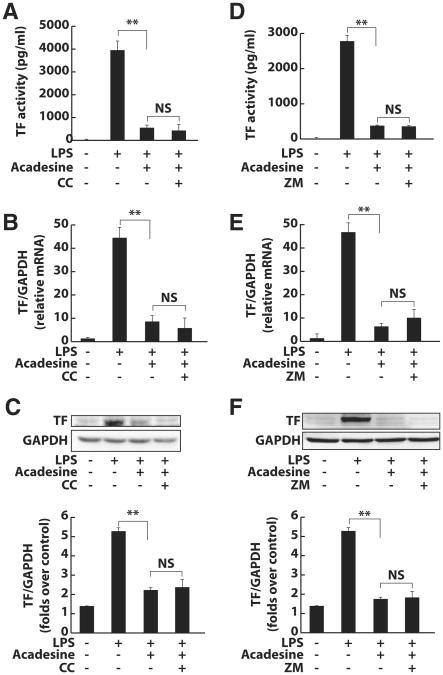
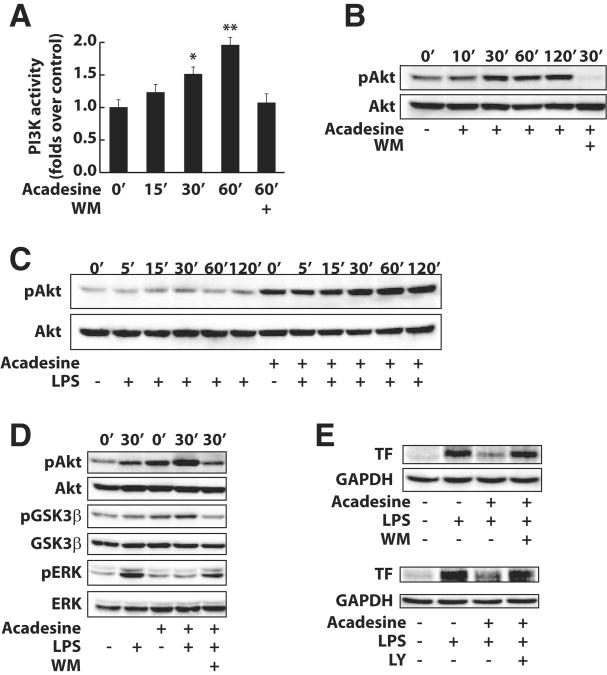
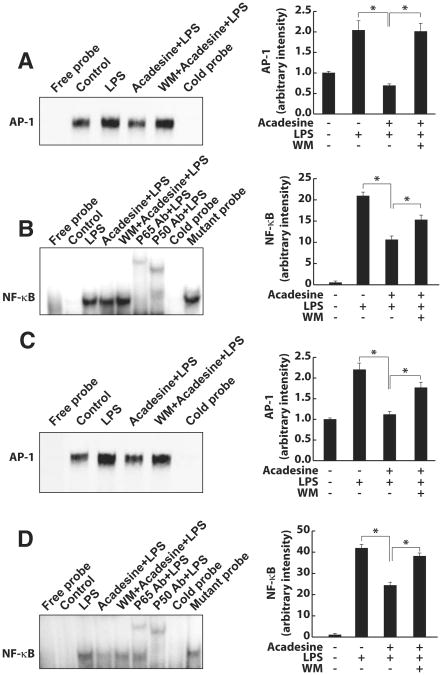
Human umbilical vein endothelial cells and human peripheral blood monocytes were stimulated with lipopolysaccharide to induce TF expression. Pretreatment with acadesine dramatically suppressed the clotting activity and expression of TF (protein and mRNA). These inhibitory effects of acadesine were unchanged for endothelial cells treated with ZM241385 (a specific adenosine A(2A) receptor antagonist) or AMP-activated protein kinase inhibitor compound C, and in macrophages lacking adenosine A(2A) receptor or alpha1-AMP-activated protein kinase. In endothelial cells and macrophages, acadesine activated the phosphoinositide 3-kinase/Akt signaling pathway, reduced the activity of mitogen-activated protein kinases, and consequently suppressed TF expression by inhibiting the activator protein-1 and NF-kappaB pathways. In mice, acadesine suppressed lipopolysaccharide-mediated increases in blood coagulation, decreased TF expression in atherosclerotic lesions, and reduced deep vein thrombus formation.
Acadesine inhibits TF expression and thrombus formation by activating the phosphoinositide 3-kinase/Akt pathway. This novel finding implicates acadesine as a potentially useful treatment for many disorders associated with thrombotic pathology, such as angina pain, deep vein thrombosis, and sepsis.
腺嘌呤核苷调节物和 AMP 激活的蛋白激酶激活剂阿昔来昔具有抗炎活性。本研究旨在探讨阿昔来昔是否以及如何抑制组织因子(TF)的表达和血栓形成。
用脂多糖刺激人脐静脉内皮细胞和人外周血单核细胞,诱导 TF 表达。阿昔来昔预处理可显著抑制凝血活性和 TF(蛋白和 mRNA)的表达。内皮细胞用 ZM241385(一种特定的腺苷 A2A 受体拮抗剂)或 AMP 激活的蛋白激酶抑制剂化合物 C 预处理后,以及在缺乏腺苷 A2A 受体或α1-AMP 激活的蛋白激酶的巨噬细胞中,阿昔来昔的这些抑制作用没有改变。在血管内皮细胞和巨噬细胞中,阿昔来昔激活了磷酸肌醇 3-激酶/Akt 信号通路,降低了丝裂原激活蛋白激酶的活性,从而通过抑制激活蛋白-1 和 NF-κB 途径抑制 TF 表达。在小鼠中,阿昔来昔抑制了脂多糖介导的血液凝固增加,减少了动脉粥样硬化病变中的 TF 表达,并减少了深静脉血栓形成。
阿昔来昔通过激活磷酸肌醇 3-激酶/Akt 通路抑制 TF 表达和血栓形成。这一新发现表明,阿昔来昔可能是一种治疗与血栓病理相关的多种疾病的有用药物,如心绞痛、深静脉血栓形成和败血症。