Caliper Life Sciences Inc., Alameda, California, United States of America.
PLoS One. 2010 Feb 23;5(2):e9364. doi: 10.1371/journal.pone.0009364.
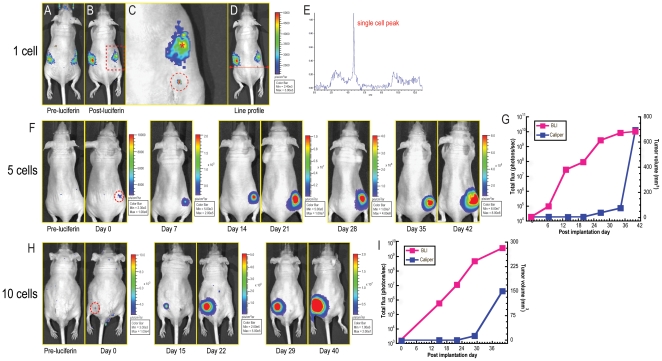
Early detection of tumors can significantly improve the outcome of tumor treatment. One of the most frequently asked questions in cancer imaging is how many cells can be detected non-invasively in a live animal. Although many factors limit such detection, increasing the light emission from cells is one of the most effective ways of overcoming these limitations. Here, we describe development and utilization of a lentiviral vector containing enhanced firefly luciferase (luc2) gene. The resulting single cell clones of the mouse mammary gland tumor (4T1-luc2) showed stable light emission in the range of 10,000 photons/sec/cell. In some cases individual 4T1-luc2 cells inserted under the skin of a nu/nu mouse could be detected non-invasively using a cooled CCD camera in some cases. In addition, we showed that only few cells are needed to develop tumors in these mice and tumor progression can be monitored right after the cells are implanted. Significantly higher luciferase activity in these cells allowed us to detect micrometastases in both, syngeneic Balb/c and nu/nu mice.
肿瘤的早期检测可以显著改善肿瘤治疗的效果。在癌症成像中最常被问到的问题之一是,在活体动物中可以非侵入性地检测到多少个细胞。尽管许多因素限制了这种检测,但增加细胞的发光是克服这些限制的最有效方法之一。在这里,我们描述了一种含有增强型萤火虫荧光素酶(luc2)基因的慢病毒载体的开发和利用。从鼠乳腺肿瘤(4T1-luc2)中获得的单个细胞克隆在 10,000 个光子/秒/细胞的范围内显示出稳定的发光。在某些情况下,在 nu/nu 小鼠的皮肤下插入的单个 4T1-luc2 细胞在某些情况下可以使用冷却的 CCD 相机进行非侵入性检测。此外,我们表明,在这些小鼠中只需要少量细胞就可以形成肿瘤,并且可以在细胞植入后立即监测肿瘤的进展。这些细胞中更高的荧光素酶活性使我们能够检测到同源 Balb/c 和 nu/nu 小鼠中的微转移。