• 文献检索
  • 文档翻译
  • 深度研究
  • 学术资讯
  • Suppr Zotero 插件Zotero 插件
  • 邀请有礼
  • 套餐&价格
  • 历史记录
应用&插件
Suppr Zotero 插件Zotero 插件浏览器插件Mac 客户端Windows 客户端微信小程序
定价
高级版会员购买积分包购买API积分包
服务
文献检索文档翻译深度研究API 文档MCP 服务
关于我们
关于 Suppr公司介绍联系我们用户协议隐私条款
关注我们

Suppr 超能文献

核心技术专利:CN118964589B侵权必究
粤ICP备2023148730 号-1Suppr @ 2026

文献检索

告别复杂PubMed语法,用中文像聊天一样搜索,搜遍4000万医学文献。AI智能推荐,让科研检索更轻松。

立即免费搜索

文件翻译

保留排版,准确专业,支持PDF/Word/PPT等文件格式,支持 12+语言互译。

免费翻译文档

深度研究

AI帮你快速写综述,25分钟生成高质量综述,智能提取关键信息,辅助科研写作。

立即免费体验

爱丁堡成瘾队列研究:基于初级保健的注射吸毒者和非注射吸毒对照者的招募和随访。

The Edinburgh Addiction Cohort: recruitment and follow-up of a primary care based sample of injection drug users and non drug-injecting controls.

机构信息

Muirhouse Medical Group, 1 Muirhouse Avenue, Edinburgh EH44PL, UK.

出版信息

BMC Public Health. 2010 Feb 26;10:101. doi: 10.1186/1471-2458-10-101.

DOI:10.1186/1471-2458-10-101
PMID:20187928
原文链接:https://pmc.ncbi.nlm.nih.gov/articles/PMC2841670/
Abstract

BACKGROUND

Injection drug use is an important public health problem. Epidemiological understanding of this problem is incomplete as longitudinal studies in the general population are difficult to undertake. In particular little is known about early life risk factors for later drug injection or about the life course of injection once established including the influence of medical and social interventions.

METHODS

Individuals thought to be drug injectors were identified through a single primary medical care facility in Edinburgh between 1980 and 2006 and flagged with the General Registry Office. From October 2005 - October 2007, these cases were traced and invited to undergo interview assessment covering early life experience, substance use, health and social histories. Age and sex matched controls for confirmed cases (alive and dead) were later recruited through the same health facility. Controls for living cases completed the same structured interview schedule. Data were also collected on cases and controls through linkage to routine primary care records, death registrations, hospital contact statistics and police and prison records. All interviews were conducted with the knowledge and permission of the current GP.

RESULTS

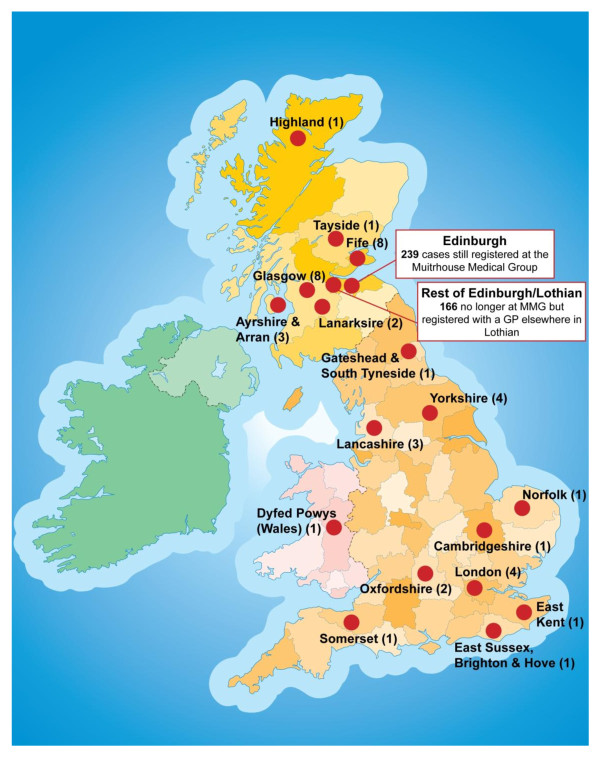
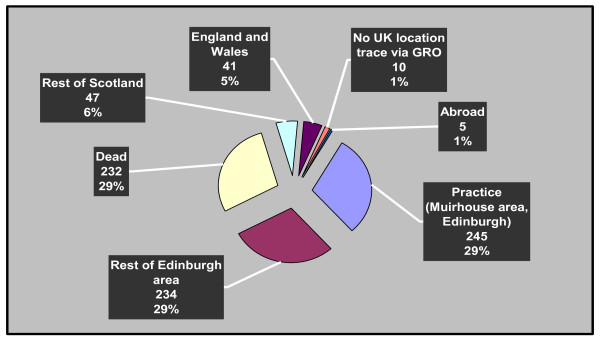
The initial cohort size was 814. At start of follow up 227 had died. Of the remaining 587: 20 had no contact details and 5 had embarked from the UK; 40 declined participation; 38 did not respond to invitations; 14 were excluded by their GP on health or social grounds and 22 had their contact details withheld by administrative authorities. 448 were interviewed of whom 16 denied injection and were excluded. Of 191 dead cases with medical records 4 were excluded as their records contained no evidence of injection. 5 interviewed cases died before follow up was concluded though these individuals were counted as "live" cases. 1 control per case (dead and alive) was recruited. Linkage to Scottish Morbidity Records data (available from 1981 onwards) on general acute inpatient and day cases, mental health inpatient and day cases and cancer was provided by Information Services, NHS Scotland, for all cases interviewed and all dead cases. The Scottish Prison Service provided records for 198 (46%) of cases interviewed, 48 cases not interviewed and 34 (18%) of dead cases. For a sub-sample of 100 interviewees a search of the Lothian and Borders police database was made for official criminal records and 94 had criminal records. Data linkage for controls is ongoing.

CONCLUSIONS

Injecting drug users recruited from a community setting can be successfully followed-up through interviews and record linkage. Information from injecting cases is being analysed in terms of injecting patterns and possible influences on these. Comparisons between cases and controls will allow identification of possibly modifiable early life risk factors for drug injection and will also clarify the burden of disease associated with injection and the influence on this of different health and social interventions.
https://cdn.ncbi.nlm.nih.gov/pmc/blobs/20d3/2841670/4f59c8769a2b/1471-2458-10-101-3.jpg
https://cdn.ncbi.nlm.nih.gov/pmc/blobs/20d3/2841670/9b09dc30537e/1471-2458-10-101-1.jpg
https://cdn.ncbi.nlm.nih.gov/pmc/blobs/20d3/2841670/17da71f3f8c9/1471-2458-10-101-2.jpg
https://cdn.ncbi.nlm.nih.gov/pmc/blobs/20d3/2841670/4f59c8769a2b/1471-2458-10-101-3.jpg
https://cdn.ncbi.nlm.nih.gov/pmc/blobs/20d3/2841670/9b09dc30537e/1471-2458-10-101-1.jpg
https://cdn.ncbi.nlm.nih.gov/pmc/blobs/20d3/2841670/17da71f3f8c9/1471-2458-10-101-2.jpg
https://cdn.ncbi.nlm.nih.gov/pmc/blobs/20d3/2841670/4f59c8769a2b/1471-2458-10-101-3.jpg
摘要

背景

注射吸毒是一个重要的公共卫生问题。由于难以在普通人群中开展纵向研究,对这一问题的流行病学了解并不完整。特别是,对于后来的药物注射的早期生活风险因素,或者一旦建立了药物注射,包括医疗和社会干预的影响,知之甚少。

方法

1980 年至 2006 年间,通过爱丁堡的一家单一初级医疗保健机构发现并标记被认为是药物注射者的个体。从 2005 年 10 月至 2007 年 10 月,对这些病例进行了追踪,并邀请他们进行访谈评估,涵盖早期生活经历、物质使用、健康和社会史。随后通过同一健康设施招募了经过确认的病例(存活和死亡)的年龄和性别匹配对照。对于存活病例,通过相同的结构化访谈时间表完成了对对照的评估。还通过与常规初级保健记录、死亡登记、医院接触统计数据和警察与监狱记录进行数据链接,收集了病例和对照的数据。所有访谈均在当前全科医生的了解和许可下进行。

结果

最初的队列规模为 814 人。在开始随访时,已有 227 人死亡。在剩余的 587 人中:20 人没有联系方式,5 人已离开英国;40 人拒绝参与;38 人未回复邀请;14 人因健康或社会原因被他们的全科医生排除在外;22 人的联系方式被行政当局扣留。共对 448 人进行了访谈,其中 16 人否认注射并被排除在外。在有医疗记录的 191 名死亡病例中,有 4 人被排除在外,因为他们的记录中没有注射的证据。尽管这些人被算作“存活”病例,但在随访结束前,有 5 名接受采访的病例死亡。为每个病例(存活和死亡)招募了 1 个对照。苏格兰信息服务部(NHS Scotland)根据所有接受访谈的病例和所有死亡病例提供了苏格兰发病率记录数据(自 1981 年起可用)的链接,包括一般急性住院和日间病例、心理健康住院和日间病例以及癌症。苏格兰监狱管理局提供了接受访谈的 198 名(46%)病例、48 名未接受访谈的病例和 34 名(18%)死亡病例的记录。对于 100 名接受访谈的参与者的一个子样本,对洛锡安和边境警察局数据库进行了官方犯罪记录搜索,其中 94 人有犯罪记录。对对照的资料链接仍在进行中。

结论

从社区环境中招募的注射吸毒者可以通过访谈和记录链接成功追踪。正在根据注射模式和可能对这些模式产生影响的因素对来自注射病例的信息进行分析。病例与对照之间的比较将有助于确定可能可改变的药物注射早期生活风险因素,并阐明与注射相关的疾病负担以及不同健康和社会干预对这种负担的影响。

相似文献

1
The Edinburgh Addiction Cohort: recruitment and follow-up of a primary care based sample of injection drug users and non drug-injecting controls.爱丁堡成瘾队列研究:基于初级保健的注射吸毒者和非注射吸毒对照者的招募和随访。
BMC Public Health. 2010 Feb 26;10:101. doi: 10.1186/1471-2458-10-101.
2
Folic acid supplementation and malaria susceptibility and severity among people taking antifolate antimalarial drugs in endemic areas.在流行地区,服用抗叶酸抗疟药物的人群中,叶酸补充剂与疟疾易感性和严重程度的关系。
Cochrane Database Syst Rev. 2022 Feb 1;2(2022):CD014217. doi: 10.1002/14651858.CD014217.
3
Early life influences on the risk of injecting drug use: case control study based on the Edinburgh Addiction Cohort.早期生活对注射吸毒风险的影响:基于爱丁堡成瘾队列的病例对照研究。
Addiction. 2013 Apr;108(4):743-50. doi: 10.1111/add.12056. Epub 2012 Dec 21.
4
Premature mortality in Scottish injecting drug users: a life-history approach.苏格兰注射吸毒者的过早死亡:一种生命史方法。
Scott Med J. 2012 Feb;57(1):38-42. doi: 10.1258/smj.2011.011289.
5
Prescription of Controlled Substances: Benefits and Risks管制药品的处方:益处与风险
6
Projecting severe sequelae of injection-related hepatitis C virus epidemic in the UK. Part 1: Critical hepatitis C and injector data.预测英国注射相关丙型肝炎病毒流行的严重后遗症。第1部分:重症丙型肝炎和注射者数据。
J Epidemiol Biostat. 2001;6(3):243-65; discussion 279-85.
7
Adolescents, sex and injecting drug use: risks for HIV infection.青少年、性行为与注射吸毒:感染艾滋病毒的风险
AIDS Care. 1990;2(2):103-16. doi: 10.1080/09540129008257721.
8
Deaths, HIV infection, abstinence, and other outcomes in a cohort of injecting drug users followed up for 10 years.一组注射吸毒者随访10年的死亡、艾滋病毒感染、禁欲及其他结局
BMJ. 1994 Aug 6;309(6951):369-72. doi: 10.1136/bmj.309.6951.369.
9
The transition from injection to non-injection drug use: long-term outcomes among heroin and cocaine users in New York City.从注射吸毒到非注射吸毒的转变:纽约市海洛因和可卡因使用者的长期结果。
Addiction. 2007 May;102(5):778-85. doi: 10.1111/j.1360-0443.2007.01764.x.
10
After the epidemic: follow up study of HIV seroprevalence and changing patterns of drug use.疫情之后:HIV血清流行率及吸毒模式变化的随访研究
BMJ. 1990 Jan 27;300(6719):219-23. doi: 10.1136/bmj.300.6719.219.

引用本文的文献

1
Factors affecting repeated cessations of injecting drug use and relapses during the entire injecting career among the Edinburgh Addiction Cohort.影响爱丁堡成瘾队列中整个注射吸毒生涯期间反复停止注射吸毒及复吸的因素。
Drug Alcohol Depend. 2015 Jun 1;151:76-83. doi: 10.1016/j.drugalcdep.2015.03.005. Epub 2015 Mar 18.
2
The natural history of injecting drug use: a 25-year longitudinal study of a cohort of injecting drug users in inner city Dublin.注射吸毒的自然史:都柏林市中心一个注射吸毒者队列的 25 年纵向研究。
Ir J Med Sci. 2012 Dec;181(4):541-8. doi: 10.1007/s11845-012-0814-9. Epub 2012 Mar 20.
3
Survival and cessation in injecting drug users: prospective observational study of outcomes and effect of opiate substitution treatment.

本文引用的文献

1
Incidence of hepatitis C in drug injectors: the role of homelessness, opiate substitution treatment, equipment sharing, and community size.吸毒注射者中丙型肝炎的发病率:无家可归、阿片类药物替代治疗、共用设备及社区规模的影响
Epidemiol Infect. 2009 Sep;137(9):1255-65. doi: 10.1017/S095026880900212X. Epub 2009 Feb 19.
2
Estimating the prevalence of ex-injecting drug use in the population.估算人群中曾经注射吸毒的流行率。
Stat Methods Med Res. 2009 Aug;18(4):381-95. doi: 10.1177/0962280208094704. Epub 2008 Nov 26.
3
A randomized clinical trial of methadone maintenance for prisoners: findings at 6 months post-release.
注射吸毒者的生存和停止:结局的前瞻性观察研究及阿片类物质替代治疗的效果。
BMJ. 2010 Jul 1;341:c3172. doi: 10.1136/bmj.c3172.
一项针对囚犯的美沙酮维持治疗随机临床试验:释放后6个月的结果
Addiction. 2008 Aug;103(8):1333-42. doi: 10.1111/j.1360-0443.2008.002238.x.
4
Estimating hepatitis C prevalence in England and Wales by synthesizing evidence from multiple data sources. Assessing data conflict and model fit.通过整合多个数据源的证据来估计英格兰和威尔士丙型肝炎的患病率。评估数据冲突和模型拟合情况。
Biostatistics. 2008 Oct;9(4):715-34. doi: 10.1093/biostatistics/kxn004. Epub 2008 Mar 18.
5
Trajectories of heroin addiction: growth mixture modeling results based on a 33-year follow-up study.海洛因成瘾轨迹:基于33年随访研究的生长混合模型结果
Eval Rev. 2007 Dec;31(6):548-63. doi: 10.1177/0193841X07307315.
6
Incidence and risk factors for hepatitis C seroconversion in injecting drug users in Australia.澳大利亚注射吸毒者丙型肝炎血清学转换的发病率及危险因素
Addiction. 2006 Oct;101(10):1499-508. doi: 10.1111/j.1360-0443.2006.01543.x.
7
Interventions for drug-using offenders in the courts, secure establishments and the community.针对法庭、安全机构及社区中吸毒罪犯的干预措施。
Cochrane Database Syst Rev. 2006 Jul 19(3):CD005193. doi: 10.1002/14651858.CD005193.pub2.
8
Incidence of heroin use in Zurich, Switzerland: a treatment case register analysis.瑞士苏黎世海洛因使用的发病率:一项治疗病例登记分析。
Lancet. 2006 Jun 3;367(9525):1830-4. doi: 10.1016/S0140-6736(06)68804-1.
9
Using cohort studies to estimate mortality among injecting drug users that is not attributable to AIDS.利用队列研究来估计注射吸毒者中并非由艾滋病导致的死亡率。
Sex Transm Infect. 2006 Jun;82 Suppl 3(Suppl 3):iii56-63. doi: 10.1136/sti.2005.019273.
10
Longitudinal predictors of injection cessation and subsequent relapse among a cohort of injection drug users in Baltimore, MD, 1988-2000.1988 - 2000年马里兰州巴尔的摩市一组注射吸毒者中注射行为停止及后续复吸的纵向预测因素
Drug Alcohol Depend. 2006 Jun 28;83(2):147-56. doi: 10.1016/j.drugalcdep.2005.11.007. Epub 2005 Dec 20.