
利用低摄取区域边界处的氟脱氧葡萄糖分布诊断心肌存活能力。
Diagnosis of myocardial viability by fluorodeoxyglucose distribution at the border zone of a low uptake region.
机构信息
Department of Cardiology, Kawasaki Medical School, Kurashiki, Okayama, Japan.
出版信息
Yonsei Med J. 2010 Mar;51(2):178-86. doi: 10.3349/ymj.2010.51.2.178. Epub 2010 Feb 12.
PURPOSE
In cardiac 2-[F-18]fluoro-2-deoxy-D-glucose (FDG)-positron emission tomography (PET) examination, interpretation of myocardial viability in the low uptake region (LUR) has been difficult without additional perfusion imaging. We evaluated distribution patterns of FDG at the border zone of the LUR in the cardiac FDG-PET and established a novel parameter for diagnosing myocardial viability and for discriminating the LUR of normal variants.
MATERIALS AND METHODS
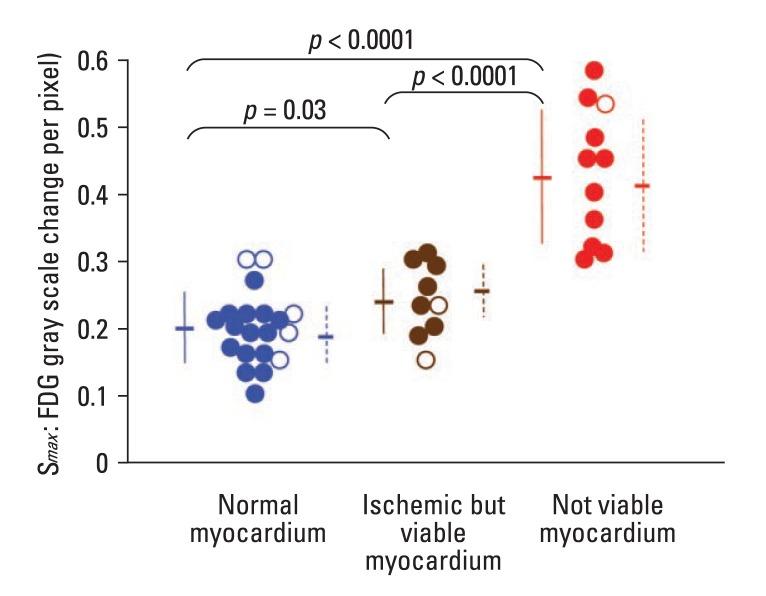
Cardiac FDG-PET was performed in patients with a myocardial ischemic event (n = 22) and in healthy volunteers (n = 22). Whether the myocardium was not a viable myocardium (not-VM) or an ischemic but viable myocardium (isch-VM) was defined by an echocardiogram under a low dose of dobutamine infusion as the gold standard. FDG images were displayed as gray scaled-bull's eye mappings. FDG-plot profiles for LUR (= true ischemic region in the patients or normal variant region in healthy subjects) were calculated. Maximal values of FDG change at the LUR border zone (a steepness index; S(max) scale/pixel) were compared among not-VM, isch-VM, and normal myocardium.
RESULTS
S(max) was significantly higher for n-VM compared to those with isch-VM or normal myocardium (ANOVA). A cut-off value of 0.30 in Smax demonstrated 100% sensitivity and 83% specificity for diagnosing n-VM and isch-VM. S(max) less than 0.23 discriminated LUR in normal myocardium from the LUR in patients with both n-VM and isch-VM with a 94% sensitivity and a 93% specificity.
CONCLUSION
S(max) of the LUR in cardiac FDG-PET is a simple and useful parameter to diagnose n-VM and isch-VM, as well as to discriminate thr LUR of normal variants.
目的
在心脏 2-[F-18]氟-2-脱氧-D-葡萄糖(FDG)正电子发射断层扫描(PET)检查中,如果没有额外的灌注成像,低摄取区(LUR)的心肌存活能力的解释一直很困难。我们评估了心脏 FDG-PET 中 LUR 边界区的 FDG 分布模式,并建立了一种新的参数来诊断心肌存活能力,并区分正常变异的 LUR。
材料和方法
对心肌缺血事件患者(n=22)和健康志愿者(n=22)进行心脏 FDG-PET。通过低剂量多巴酚丁胺输注下的超声心动图将心肌定义为非存活心肌(非-VM)或缺血但存活的心肌(缺血-VM)。以 FDG 图像显示为灰度牛眼映射。计算 LUR(=患者中的真实缺血区或健康受试者中的正常变异区)的 FDG-图轮廓。比较 LUR 边界区 FDG 变化的最大值(陡峭指数;S(max))在非-VM、缺血-VM 和正常心肌之间的差异。
结果
非-VM 的 S(max)明显高于缺血-VM 或正常心肌(ANOVA)。S(max)的截断值为 0.30,对诊断非-VM 和缺血-VM 的敏感性为 100%,特异性为 83%。S(max)小于 0.23 可以区分正常心肌的 LUR 与非-VM 和缺血-VM 患者的 LUR,其敏感性为 94%,特异性为 93%。
结论
心脏 FDG-PET 中 LUR 的 S(max)是一种简单而有用的参数,可用于诊断非-VM 和缺血-VM,以及区分正常变异的 LUR。




 Zotero 插件