Davis Allan Peter, Murphy Cynthia G, Saraceni-Richards Cynthia A, Rosenstein Michael C, Wiegers Thomas C, Hampton Thomas H, Mattingly Carolyn J
Department of Bioinformatics, The Mount Desert Island Biological Laboratory, Salisbury Cove, ME 04672, USA.
Bioinformation. 2009 Oct 15;4(4):173-4. doi: 10.6026/97320630004173.
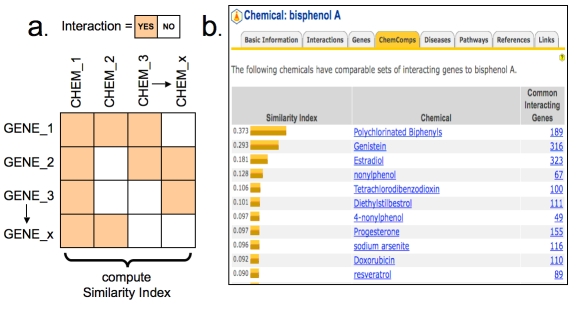
The Comparative Toxicogenomics Database is a public resource that promotes understanding about the effects of environmental chemicals on human health. Currently, CTD describes over 184,000 molecular interactions for more than 5,100 chemicals and 16,300 genes/proteins. We have leveraged this dataset of chemical-gene relationships to compute similarity indices following the statistical method of the Jaccard index. These scores are used to produce lists of comparable genes ("GeneComps") or chemicals ("ChemComps") based on shared toxicogenomic profiles. GeneComps and ChemComps are now provided for every curated gene and chemical in CTD. ChemComps are particularly significant because they provide a way to group chemicals based upon their biological effects, instead of their physical or structural properties. These metrics provide a novel way to view and classify genes and chemicals and will help advance testable hypotheses about environmental chemical-genedisease networks.
CTD is freely available at http://ctd.mdibl.org/
比较毒理基因组学数据库是一个促进对环境化学物质对人类健康影响理解的公共资源。目前,CTD描述了超过5100种化学物质与16300个基因/蛋白质之间的184000多种分子相互作用。我们利用这个化学-基因关系数据集,按照杰卡德指数的统计方法计算相似性指数。这些分数用于根据共享的毒理基因组学概况生成可比基因列表(“基因比较”)或化学物质列表(“化学物质比较”)。现在为CTD中每个经过整理的基因和化学物质都提供了基因比较和化学物质比较。化学物质比较尤为重要,因为它们提供了一种基于化学物质的生物学效应而非其物理或结构特性对化学物质进行分组的方法。这些指标提供了一种看待和分类基因与化学物质的新方法,并将有助于推进关于环境化学物质-基因-疾病网络的可检验假设。