Department of Regenerative Medicine and Cell Biology and Division of Rheumatology and Immunology, Medical University of South Carolina, 171 Ashley Ave., Charleston, SC 29425, USA.
J Biol Chem. 2010 Jun 25;285(26):19821-32. doi: 10.1074/jbc.M110.104273. Epub 2010 Mar 3.
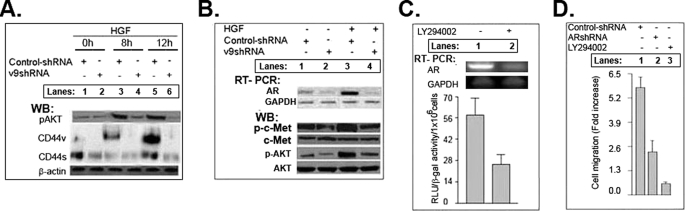
The main aim of our study is to determine the significance of the stromal microenvironment in the malignant behavior of prostate cancer. The stroma-derived growth factors/cytokines and hyaluronan act in autocrine/paracrine ways with their receptors, including receptor-tyrosine kinases and CD44 variants (CD44v), to potentiate and support tumor epithelial cell survival. Overexpression of hyaluronan, CD44v9 variants, and stroma-derived growth factors/cytokines are specific features in many cancers, including prostate cancer. Androgen/androgen receptor interaction has a critical role in regulating prostate cancer growth. Our previous study showed that 1) that increased synthesis of hyaluronan in normal epithelial cells promotes expression of CD44 variants; 2) hyaluronan interaction with CD44v6-v9 promotes activation of receptor-tyrosine kinase, which stimulates phosphatidylinositol 3-kinase-induced cell survival pathways; and 3) CD44v6/short hairpin RNA reduces colon tumor growth in vivo (Misra, S., Hascall, V. C., De Giovanni, C., Markwald, R. R., and Ghatak, S. (2009) J. Biol. Chem. 284, 12432-12446). Our results now show that hepatocyte growth factor synthesized by myofibroblasts associated with prostate cancer cells induces activation of HGF-receptor/cMet and stimulates hyaluronan/CD44v9 signaling. This, in turn, stabilizes the androgen receptor functions in prostate cancer cells. The stroma-derived HGF induces a lipid raft-associated signaling complex that contains CD44v9, cMet/phosphatidylinositol 3-kinase, HSP90 and androgen receptor. CD44v9/short hairpin RNA reverses the assembly of these components in the complex and inhibits androgen receptor function. Our results provide new insight into the hyaluronan/CD44v9-regulated androgen receptor function and the consequent malignant activities in prostate cancer cells. The present study describes a physiologically relevant in vitro model for studying the molecular mechanisms by which stroma-derived HGF and hyaluronan influence androgen receptor and CD44 functions in the secretory epithelia during prostate carcinogenesis.
我们研究的主要目的是确定基质微环境在前列腺癌恶性行为中的意义。基质衍生的生长因子/细胞因子和透明质酸通过与其受体(包括受体酪氨酸激酶和 CD44 变体(CD44v))自分泌/旁分泌方式发挥作用,增强和支持肿瘤上皮细胞存活。透明质酸、CD44v9 变体和基质衍生的生长因子/细胞因子的过度表达是许多癌症(包括前列腺癌)的特有特征。雄激素/雄激素受体相互作用在调节前列腺癌生长中起着关键作用。我们之前的研究表明:1)正常上皮细胞中透明质酸合成的增加促进了 CD44 变体的表达;2)透明质酸与 CD44v6-v9 的相互作用促进了受体酪氨酸激酶的激活,从而刺激了磷脂酰肌醇 3-激酶诱导的细胞存活途径;3)CD44v6/短发夹 RNA 减少了体内结肠癌的生长(Misra,S.,Hascall,V.C.,De Giovanni,C.,Markwald,R.R.,和 Ghatak,S.(2009)J. Biol. Chem. 284,12432-12446)。我们的研究结果现在表明,与前列腺癌细胞相关的肌成纤维细胞合成的肝细胞生长因子诱导 HGF 受体/cMet 的激活,并刺激透明质酸/CD44v9 信号。这反过来又稳定了前列腺癌细胞中的雄激素受体功能。基质衍生的 HGF 诱导含有 CD44v9、cMet/磷脂酰肌醇 3-激酶、HSP90 和雄激素受体的脂筏相关信号复合物。CD44v9/短发夹 RNA 逆转了复合物中这些成分的组装,并抑制了雄激素受体功能。我们的研究结果为透明质酸/CD44v9 调节的雄激素受体功能以及随后在前列腺癌细胞中的恶性活动提供了新的见解。本研究描述了一种生理相关的体外模型,用于研究基质衍生的 HGF 和透明质酸在前列腺癌发生过程中如何影响分泌上皮细胞中的雄激素受体和 CD44 功能的分子机制。