Laboratory of Vascular Biology and Genetics, Department of Medicine, A. Gemelli University Hospital, Catholic University School of Medicine, Rome, Italy.
Diabetes. 2010 Jun;59(6):1496-505. doi: 10.2337/db09-1507. Epub 2010 Mar 3.
High-mobility group box-1 (HMGB1) protein is a nuclear DNA-binding protein released from necrotic cells, inducing inflammatory responses and promoting tissue repair and angiogenesis. Diabetic human and mouse tissues contain lower levels of HMGB1 than their normoglycemic counterparts. Deficient angiogenesis after ischemia contributes to worse outcomes of peripheral arterial disease in patients with diabetes. To test the hypothesis that HMGB1 enhances ischemia-induced angiogenesis in diabetes, we administered HMGB1 protein in a mouse hind limb ischemia model using diabetic mice.
After the induction of diabetes by streptozotocin, we studied ischemia-induced neovascularization in the ischemic hind limb of normoglycemic, diabetic, and HMGB1-treated diabetic mice.
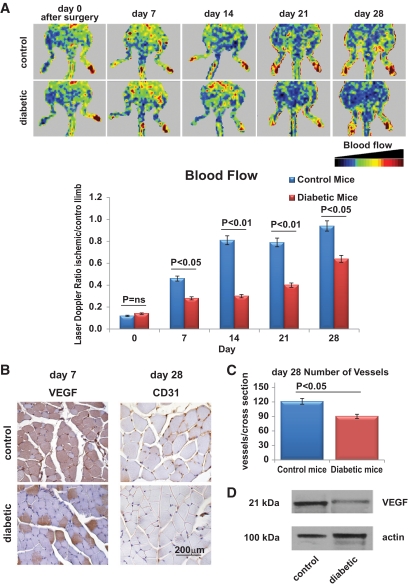
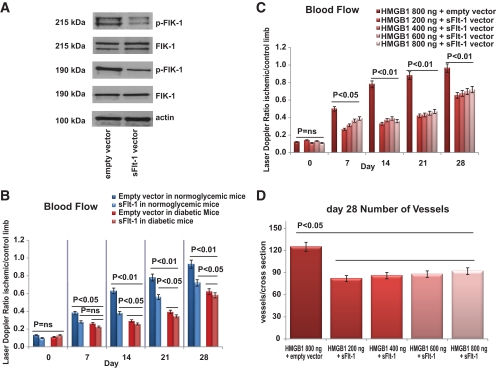
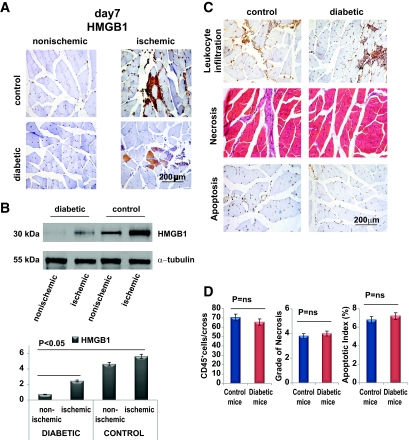
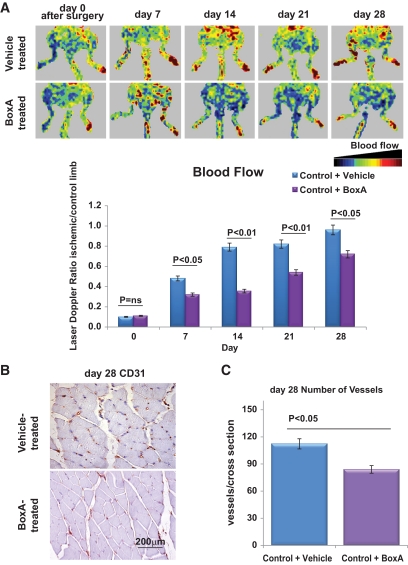
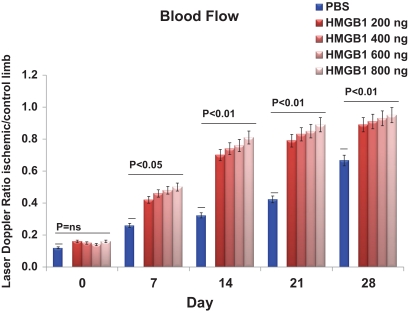
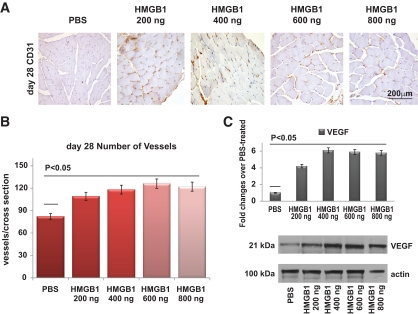
We found that the perfusion recovery was significantly attenuated in diabetic mice compared with normoglycemic control mice. Interestingly, HMGB1 protein expression was lower in the ischemic tissue of diabetic mice than in normoglycemic mice. Furthermore, we observed that HMGB1 administration restored the blood flow recovery and capillary density in the ischemic muscle of diabetic mice, that this process was associated with the increased expression of vascular endothelial growth factor (VEGF), and that HMGB1-induced angiogenesis was significantly reduced by inhibiting VEGF activity.
The results of this study show that endogenous HMGB1 is crucial for ischemia-induced angiogenesis in diabetic mice and that HMGB1 protein administration enhances collateral blood flow in the ischemic hind limbs of diabetic mice through a VEGF-dependent mechanism.
高迁移率族蛋白 B1(HMGB1)是一种从坏死细胞中释放出来的核 DNA 结合蛋白,可诱导炎症反应,并促进组织修复和血管生成。糖尿病患者和小鼠的组织中 HMGB1 水平低于血糖正常的对照组。缺血后血管生成不足导致糖尿病患者外周动脉疾病的预后更差。为了验证 HMGB1 可增强糖尿病患者缺血诱导的血管生成这一假说,我们在糖尿病小鼠的小鼠后肢缺血模型中给予 HMGB1 蛋白。
通过链脲佐菌素诱导糖尿病后,我们研究了血糖正常、糖尿病和给予 HMGB1 的糖尿病小鼠缺血后肢中的缺血诱导新生血管形成。
与血糖正常对照组小鼠相比,我们发现糖尿病小鼠的灌注恢复明显减弱。有趣的是,糖尿病小鼠缺血组织中的 HMGB1 蛋白表达低于血糖正常小鼠。此外,我们观察到 HMGB1 给药恢复了糖尿病小鼠缺血肌肉中的血流恢复和毛细血管密度,这一过程与血管内皮生长因子(VEGF)的表达增加有关,并且通过抑制 VEGF 活性,HMGB1 诱导的血管生成显著减少。
这项研究的结果表明,内源性 HMGB1 对糖尿病小鼠缺血诱导的血管生成至关重要,并且 HMGB1 蛋白给药通过 VEGF 依赖机制增强糖尿病小鼠缺血后肢的侧支血流。