Petrella Robert J, Cogliano Anthony, Decaria Joseph, Mohamed Naem, Lee Robert
Dept Medicine, Canadian Centre for Activity and Aging, 801 Commissioners Road, London, N6C5J1, Canada.
Sports Med Arthrosc Rehabil Ther Technol. 2010 Feb 2;2:4. doi: 10.1186/1758-2555-2-4.
To determine the efficacy and safety of peri-articular hyaluronic acid injections in chronic lateral epicondylosis (tennis elbow).
Prospective randomized clinical trial in primary care sport medicine.
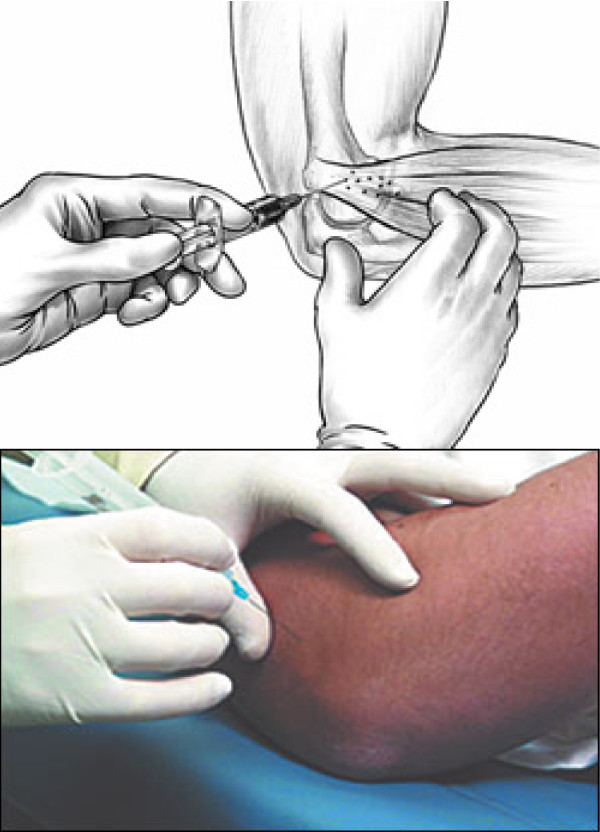
Three hundred and thirty one consecutive competitive racquette sport athletes with chronic (>3 months) lateral epicondylosis were administered 2 injections (first injection at baseline) into the subcutaneous tissue and muscle 1 cm. from the lateral epicondyle toward the primary point of pain using a two-dimensional fanning technique. A second injection was administered 1 week later.
Assessments were done at baseline, days 7, 14, 30, 90 and 356. Efficacy measures included patient's visual analogue scale (VAS) of pain at rest (0-100 mm) and following assessment of grip strength (0-100 mm). Grip strength was determined using a jamar hydraulic hand dynamometer. Other assessments included patients' global assessment of elbow injury (5 point categorical scale; 1 = no disability, 5 = maximal disability), patients' assessment of normal function/activity (5 point categorical scale), patients/physician satisfaction assessment (10 point categorical scale), time to return to pain-free and disability-free sport and adverse events as per WHO definition. Differences between groups were determined using an intent-to-treat ANOVA.
Average age of the study population was 49 years (+/- 12 years). One hundred and sixty-five patients were randomized to the HA and 166 were randomized to the control groups. The change in VAS pain was -6.7 (+/- 2.0) for HA vs -1.3 (+/- 1.5) for control (p < 0.001). The VAS post handgrip was -7.8 (+/- 1.3) vs +0.3 (+/- 2.0) (p < 0.001) which corresponded to a significant improvement in grip of 2.6 kg in the HA vs control groups (p < 0.01). Statistically significant improvement in patients' global assessment of elbow injury (p < 0.02), patients' assessment of normal function/activity (p < 0.05) and patients/physician satisfaction assessment (p < 0.05) were also observed favoring the HA group. Time to return to pain-free and disability-free sport was 18 (+/- 11) days in the HA group but was not achieved in the control group. VAS changes were maintained in the HA group at each followup while those in the control significantly declined from baseline. Assessment of patient and physician satisfaction continued to favor the HA group at subsequent followup.
Peri-articular HA treatment for tennis elbow was significantly better than control in improving pain at rest and after maximal grip testing. Further, HA treatment was highly satisfactory by patients and physicians and resulted in better return to pain free sport compared to control.
确定关节周围注射透明质酸治疗慢性外侧上髁炎(网球肘)的疗效和安全性。
基层运动医学中的前瞻性随机临床试验。
331名连续的患有慢性(>3个月)外侧上髁炎的竞技球拍类运动运动员,采用二维扇形技术在距外侧上髁1厘米处的皮下组织和肌肉中注射2次(首次注射在基线时),朝向主要疼痛点。1周后进行第二次注射。
在基线、第7天、14天、30天、90天和356天进行评估。疗效指标包括患者静息时疼痛的视觉模拟量表(VAS,0 - 100毫米)以及握力评估后(0 - 100毫米)。使用贾马尔液压式握力计测定握力。其他评估包括患者对肘部损伤的整体评估(5分分类量表;1 = 无残疾,5 = 最大残疾)、患者对正常功能/活动的评估(5分分类量表)、患者/医生满意度评估(10分分类量表)、恢复无痛且无残疾运动的时间以及根据世界卫生组织定义的不良事件。使用意向性分析方差分析确定组间差异。
研究人群的平均年龄为49岁(±12岁)。165名患者被随机分配到透明质酸组,166名被随机分配到对照组。透明质酸组VAS疼痛变化为-6.7(±2.0),而对照组为-1.3(±1.5)(p < 0.001)。握力测试后VAS为-7.8(±1.3)对+0.3(±2.0)(p < 0.001),这对应于透明质酸组相比对照组握力显著提高2.6千克(p < 0.01)。在患者对肘部损伤的整体评估(p < 0.02)、患者对正常功能/活动的评估(p < 0.05)以及患者/医生满意度评估(p < 0.05)方面也观察到有利于透明质酸组的统计学显著改善。透明质酸组恢复无痛且无残疾运动的时间为18(±11)天,而对照组未实现。透明质酸组在每次随访时VAS变化均得以维持,而对照组的变化从基线显著下降。在随后的随访中,患者和医生满意度评估继续有利于透明质酸组。
关节周围注射透明质酸治疗网球肘在改善静息时疼痛和最大握力测试后疼痛方面明显优于对照组。此外,与对照组相比,透明质酸治疗得到患者和医生的高度满意,并且能更好地恢复到无痛运动状态。
