Clinical Research Institute and Health Technology Assessment Unit, National University, Bogota, Colombia.
Health Res Policy Syst. 2010 Mar 6;8:7. doi: 10.1186/1478-4505-8-7.
Few methodological studies address the prioritization of clinical topics for the development of Clinical Practice Guidelines (CPGs). The aim of this study was to validate a methodology for Priority Determination of Topics (PDT) of CPGs.
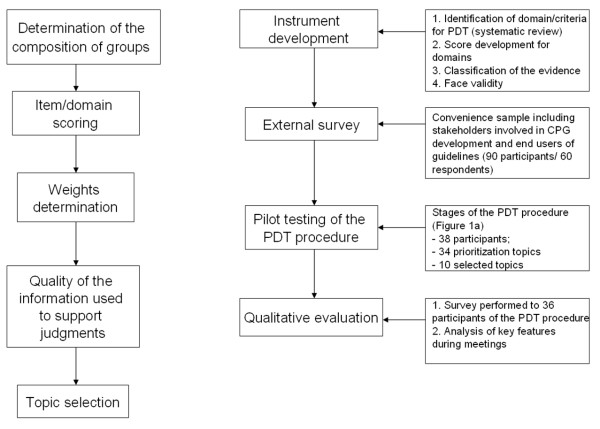
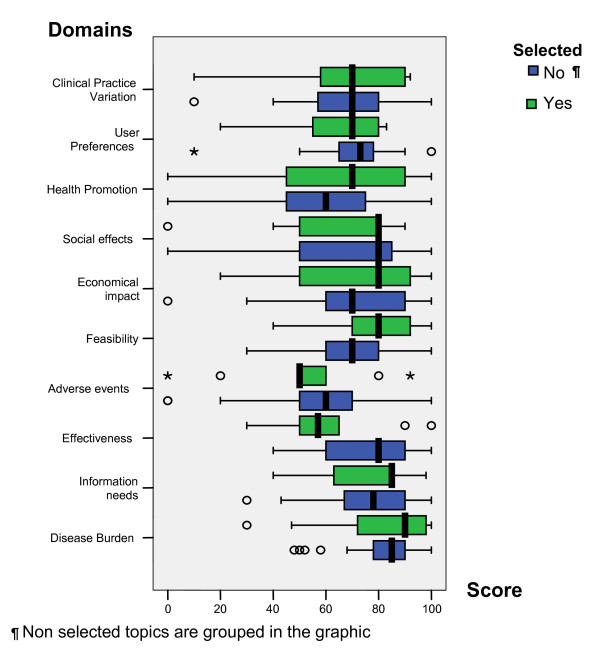
Firstly, we developed an instrument for PDT with 41 criteria that were grouped under 10 domains, based on a comprehensive systematic search. Secondly, we performed a survey of stakeholders involved in CPGs development, and end users of guidelines, using the instrument. Thirdly, a pilot testing of the PDT procedure was performed in order to choose 10 guideline topics among 34 proposed projects; using a multi-criteria analysis approach, we validated a mechanism that followed five stages: determination of the composition of groups, item/domain scoring, weights determination, quality of the information used to support judgments, and finally, topic selection. Participants first scored the importance of each domain, after which four different weighting procedures were calculated (including the survey results). The process of weighting was determined by correlating the data between them. We also reported the quality of evidence used for PDT. Finally, we provided a qualitative analysis of the process. The main domains used to support judgement, having higher quality scores and weightings, were feasibility, disease burden, implementation and information needs. Other important domains such as user preferences, adverse events, potential for health promotion, social effects, and economic impact had lower relevance for clinicians. Criteria for prioritization were mainly judged through professional experience, while good quality information was only used in 15% of cases.
The main advantages of the proposed methodology are supported by the use of a systematic approach to identify, score and weight guideline topics selection, limiting or exposing the influence of personal biases. However, the methodology was complex and included a number of quantitative and qualitative approaches reflecting the difficulties of the prioritization process.
很少有方法学研究关注临床主题在临床实践指南(CPG)制定中的优先级排序。本研究的目的是验证一种CPG 主题优先排序(PDT)的方法。
首先,我们基于全面的系统检索,制定了一个 41 项标准的 PDT 工具,这些标准分为 10 个领域。其次,我们使用该工具对参与 CPG 制定的利益相关者和指南的最终用户进行了调查。第三,我们对 PDT 程序进行了试点测试,以便在 34 个提出的项目中选择 10 个指南主题;使用多标准分析方法,我们验证了一个遵循五个阶段的机制:确定小组组成、项目/领域评分、权重确定、用于支持判断的信息质量,最后是主题选择。参与者首先对每个领域的重要性进行评分,然后计算了四种不同的权重程序(包括调查结果)。加权过程是通过它们之间的数据相关性来确定的。我们还报告了用于 PDT 的证据质量。最后,我们对该过程进行了定性分析。主要用于支持判断的领域,具有更高的质量评分和权重,是可行性、疾病负担、实施和信息需求。其他重要领域,如用户偏好、不良事件、促进健康的潜力、社会影响和经济影响,对临床医生的相关性较低。优先级排序的标准主要是通过专业经验判断的,而只有 15%的情况下使用了高质量的信息。
所提出的方法学的主要优点是使用系统方法来识别、评分和加权指南主题选择,限制或暴露个人偏见的影响。然而,该方法学很复杂,包括一些定量和定性方法,反映了优先级排序过程的困难。