National Institute for Medical Research, Tanga Medical Research Centre, Tanga, Tanzania.
BMC Infect Dis. 2010 Mar 8;10:55. doi: 10.1186/1471-2334-10-55.
A polymorphic malaria parasite antigen, merozoite surface protein 3 (MSP3), is among the blood stage malaria vaccine candidates. It is believed to induce immunity through cytophilic antibodies that disrupt the process of erythrocytes invasion by merozoites. This study aimed at assessing natural acquisition of antibodies to MSP3 in individuals living in an area with different malaria transmission intensity in preparation for malaria vaccine trials.
The study was conducted in individuals aged 0-19 years from villages located in lowland, intermediate and highland strata in Korogwe district, northeastern Tanzania. Blood samples from 492 study participants were collected between May and June 2006 for malaria diagnosis and immunological investigations. Reactivity of MSP3 to different types of antibodies (immunoglobulin M, G and IgG subclass 1 and 3) were analysed by Enzyme Linked ImmunoSorbent Assay (ELISA).
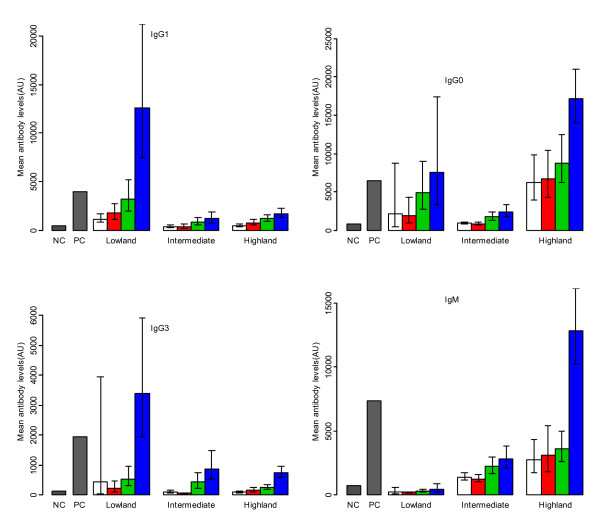
Malaria parasite prevalence was higher in the lowland (50%) compared to the intermediate (23.1%) and highland (9.8%) strata. Immunogloblin G subclasses 1 and 3 (IgG1 & IgG3), total IgG and IgM were found to increase with increasing age. IgG3 levels were significantly higher than IgG1 (p < 0.001). Furthermore, Plasmodium falciparum infection was associated with higher IgG3 levels (p = 0.008). Adjusting by strata and age in individuals who had positive blood smears, both IgG and IgM were associated with parasite density, whereby IgG levels decreased by 0.227 (95%CI: 0.064 - 0.391; p = 0.007) while IgM levels decreased by 0.165 (95%CI: 0.044 - 0.286; p = 0.008).
Individuals with higher levels of IgG3 might be partially protected from malaria infection. Higher levels of total IgG and IgM in highlands might be due to low exposure to malaria infection, recent infection or presence of cross-reactive antigens. Further studies of longitudinal nature are recommended. Data obtained from this study were used in selection of one village (Kwashemshi) for conducting MSP3 phase 1b malaria vaccine trial in Korogwe.
裂殖子表面蛋白 3(MSP3)是一种多态性疟原虫抗原,是血液阶段疟疾候选疫苗之一。它被认为通过亲细胞抗体诱导免疫,这些抗体破坏裂殖子侵入红细胞的过程。本研究旨在评估生活在疟疾传播强度不同地区的个体对 MSP3 的自然抗体获得情况,为疟疾疫苗试验做准备。
该研究在坦桑尼亚东北部科罗格韦区低地、中地和高地村落 0-19 岁的个体中进行。2006 年 5 月至 6 月期间采集了 492 名研究参与者的血样,用于疟疾诊断和免疫研究。酶联免疫吸附试验(ELISA)分析 MSP3 与不同类型抗体(免疫球蛋白 M、G 和 IgG 亚类 1 和 3)的反应性。
低地(50%)的疟原虫流行率高于中地(23.1%)和高地(9.8%)。发现 IgG 亚类 1 和 3(IgG1 和 IgG3)、总 IgG 和 IgM 随着年龄的增长而增加。IgG3 水平明显高于 IgG1(p<0.001)。此外,恶性疟原虫感染与 IgG3 水平升高相关(p=0.008)。在有阳性血涂片的个体中,按层和年龄调整后,IgG 和 IgM 均与寄生虫密度相关,IgG 水平下降 0.227(95%CI:0.064-0.391;p=0.007),而 IgM 水平下降 0.165(95%CI:0.044-0.286;p=0.008)。
IgG3 水平较高的个体可能部分免受疟疾感染的保护。高地上 IgG 和 IgM 总水平较高可能是由于对疟疾感染、近期感染或存在交叉反应性抗原的低暴露所致。建议进行进一步的纵向研究。本研究获得的数据用于在科罗格韦的一个村庄(Kwashemshi)选择进行 MSP3 1b 期疟疾疫苗试验。