HIV and AIDS Malignancy Branch, Center for Cancer Research, National Cancer Institute, National Institutes of Health, Bethesda, Maryland, United States of America.
PLoS One. 2010 Mar 10;5(3):e9641. doi: 10.1371/journal.pone.0009641.
Hypoxia inducible factors (HIFs) are the principal means by which cells upregulate genes in response to hypoxia and certain other stresses. There are two major HIFs, HIF-1 and HIF-2. We previously found that certain genes are preferentially activated by HIF-2. One was protein tyrosine phosphatase, receptor-type, Z polypeptide 1 (PTPRZ1). PTPRZ1 is overexpressed in a number of tumors and has been implicated in glioblastoma pathogenesis.
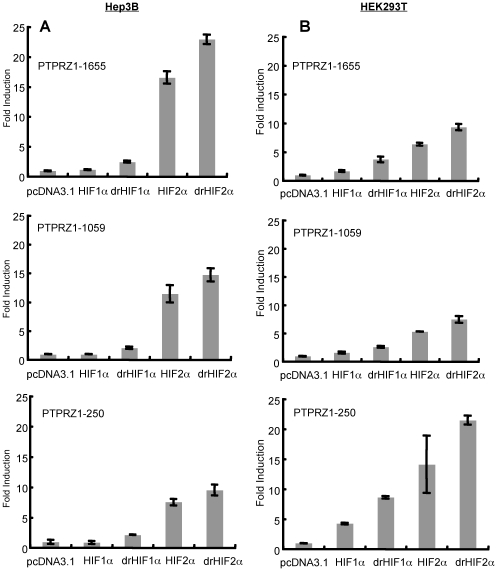
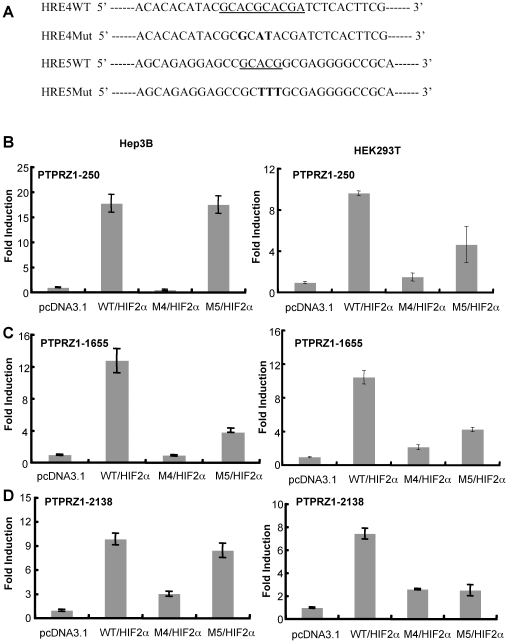
METHODOLOGY/PRINCIPAL FINDINGS: To understand the preferential activation of PTPRZ1 by HIF-2, we studied the PTPRZ1 promoter in HEK293T cells and Hep3B cells. Through deletion and mutational analysis, we identified the principal hypoxia response element. This element bound to both HIF-1 and HIF-2. We further identified a role for ELK1, an E26 transformation-specific (Ets) factor that can bind to HIF-2alpha but not HIF-1alpha, in the HIF-2 responsiveness. Knock-down experiments using siRNA to ELK1 decreased HIF-2 activation by over 50%. Also, a deletion mutation of one of the two Ets binding motifs located near the principal hypoxia response element similarly decreased activation of the PTPRZ1 promoter by HIF-2. Finally, chromatin immunoprecipitation assays showed binding of HIF and ELK1 to the PTPRZ1 promoter region.
CONCLUSIONS/SIGNIFICANCE: These results identify HIF-binding and Ets-binding motifs on the PTPRZ1 promoter and provide evidence that preferential activation of PTPRZ1 by HIF-2 results at least in part from cooperative binding of HIF-2 and ELK1 to nearby sites on the PTPRZ1 promoter region. These results may have implications in tumor pathogenesis and in understanding neurobiology, and may help inform the development of novel tumor therapy.
缺氧诱导因子(HIFs)是细胞响应缺氧和某些其他应激而上调基因的主要手段。存在两种主要的 HIFs,即 HIF-1 和 HIF-2。我们之前发现某些基因优先被 HIF-2 激活。其中一个是蛋白酪氨酸磷酸酶,受体型,Z 多肽 1(PTPRZ1)。PTPRZ1 在许多肿瘤中过度表达,并与神经胶质瘤的发病机制有关。
方法/主要发现:为了了解 HIF-2 对 PTPRZ1 的优先激活作用,我们在 HEK293T 细胞和 Hep3B 细胞中研究了 PTPRZ1 启动子。通过缺失和突变分析,我们确定了主要的缺氧反应元件。该元件与 HIF-1 和 HIF-2 都结合。我们进一步确定了 E26 转化特异性(Ets)因子 ELK1 的作用,ELK1 可以与 HIF-2alpha 结合,但不能与 HIF-1alpha 结合,在 HIF-2 反应中起作用。使用 siRNA 进行的 ELK1 敲低实验使 HIF-2 的激活减少了超过 50%。此外,位于主要缺氧反应元件附近的两个 Ets 结合基序之一的缺失突变同样减少了 HIF-2 对 PTPRZ1 启动子的激活。最后,染色质免疫沉淀分析显示 HIF 和 ELK1 结合到 PTPRZ1 启动子区域。
结论/意义:这些结果确定了 PTPRZ1 启动子上的 HIF 结合和 Ets 结合基序,并提供了证据表明 PTPRZ1 优先被 HIF-2 激活,至少部分原因是 HIF-2 和 ELK1 对 PTPRZ1 启动子区域附近的位点的协同结合。这些结果可能对肿瘤发病机制和神经生物学的理解具有重要意义,并可能有助于为新型肿瘤治疗提供信息。