Department of Physiology, Emory University, Atlanta, Georgia, United States of America.
PLoS One. 2010 Mar 22;5(3):e9802. doi: 10.1371/journal.pone.0009802.
Motor neuron degeneration in SOD1(G93A) transgenic mice begins at the nerve terminal. Here we examine whether this degeneration depends on expression of mutant SOD1 in muscle fibers.
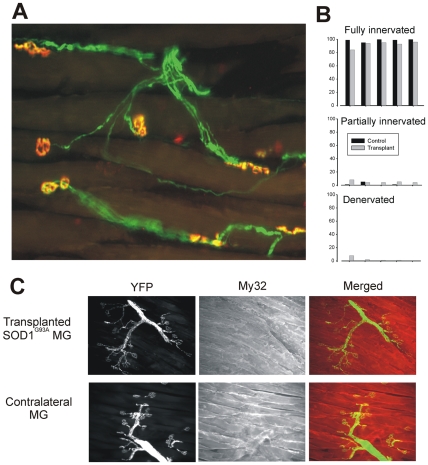
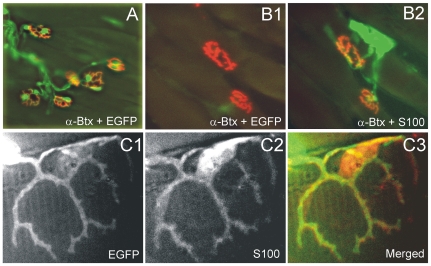
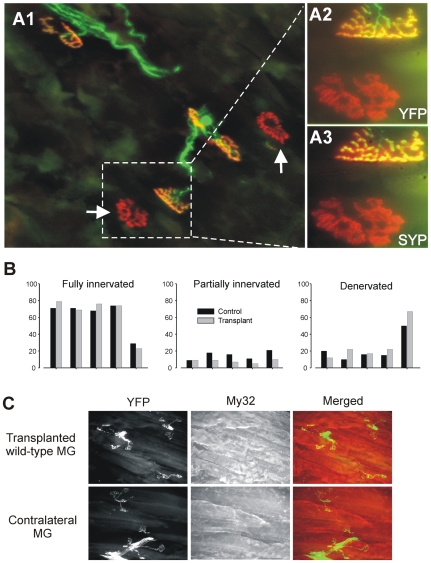
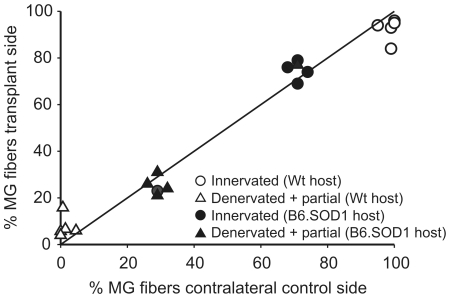
METHODOLOGY/PRINCIPAL FINDINGS: Hindlimb muscles were transplanted between wild-type and SOD1(G93A) transgenic mice and the innervation status of neuromuscular junctions (NMJs) was examined after 2 months. The results showed that muscles from SOD1(G93A) mice did not induce motor terminal degeneration in wildtype mice and that muscles from wildtype mice did not prevent degeneration in SOD1(G93A) transgenic mice. Control studies demonstrated that muscles transplanted from SOD1(G93A) mice continued to express mutant SOD1 protein. Experiments on wildtype mice established that the host supplied terminal Schwann cells (TSCs) at the NMJs of transplanted muscles.
CONCLUSIONS/SIGNIFICANCE: These results indicate that expression of the mutant protein in muscle is not needed to cause motor terminal degeneration in SOD1(G93A) transgenic mice and that a combination of motor terminals, motor axons and Schwann cells, all of which express mutant protein may be sufficient.
SOD1(G93A)转基因小鼠中的运动神经元退化始于神经末梢。在这里,我们研究了这种退化是否依赖于肌肉纤维中突变型 SOD1 的表达。
方法/主要发现:将野生型和 SOD1(G93A)转基因小鼠的后肢肌肉进行移植,并在 2 个月后检查运动终板神经肌肉接头(NMJ)的神经支配状态。结果表明,SOD1(G93A)小鼠的肌肉不会在野生型小鼠中诱导运动终板退化,而野生型小鼠的肌肉也不能防止 SOD1(G93A)转基因小鼠中的退化。对照研究表明,从 SOD1(G93A)小鼠移植的肌肉继续表达突变型 SOD1 蛋白。在野生型小鼠上的实验证实,宿主在移植肌肉的 NMJ 处提供了终末 Schwann 细胞(TSC)。
结论/意义:这些结果表明,在 SOD1(G93A)转基因小鼠中,肌肉中突变蛋白的表达不是引起运动终板退化所必需的,并且可能足以表达突变蛋白的运动终板、运动轴突和 Schwann 细胞的组合。