Department of Molecular, University of New Hampshire, Durham, New Hampshire, United States of America.
PLoS Comput Biol. 2010 Apr 1;6(4):e1000732. doi: 10.1371/journal.pcbi.1000732.
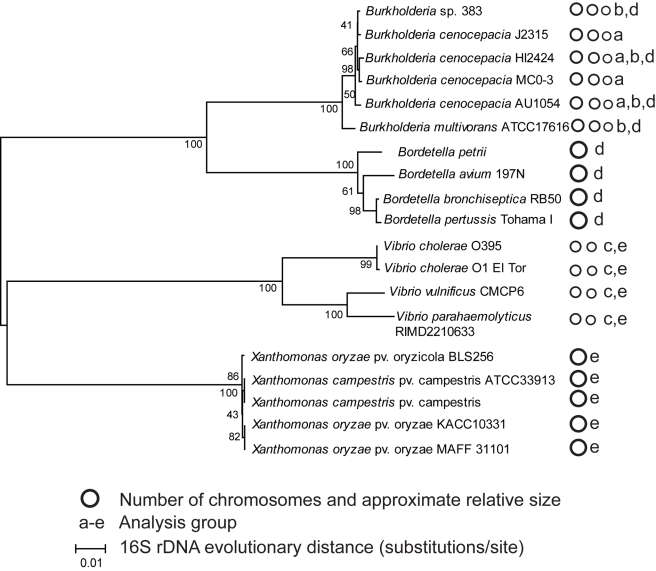
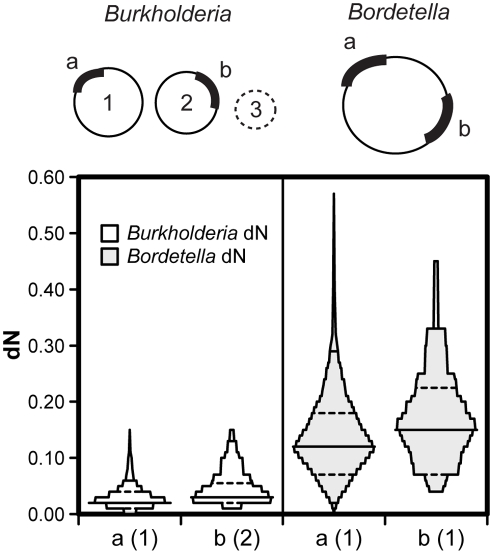
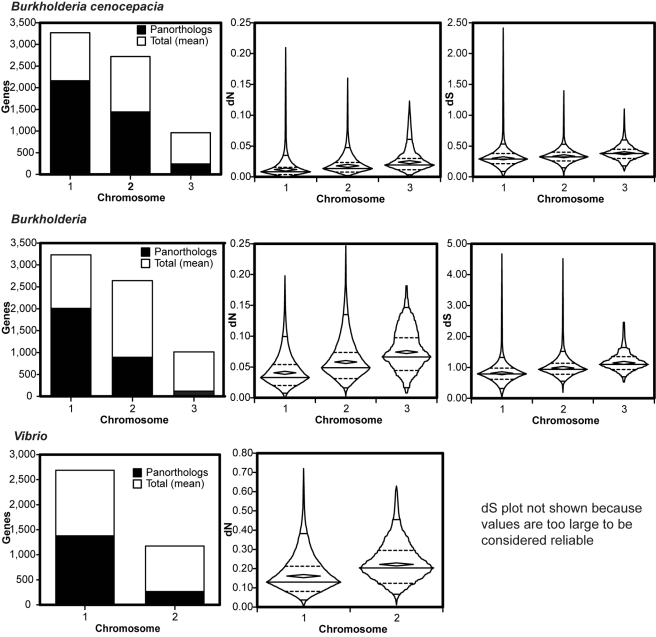
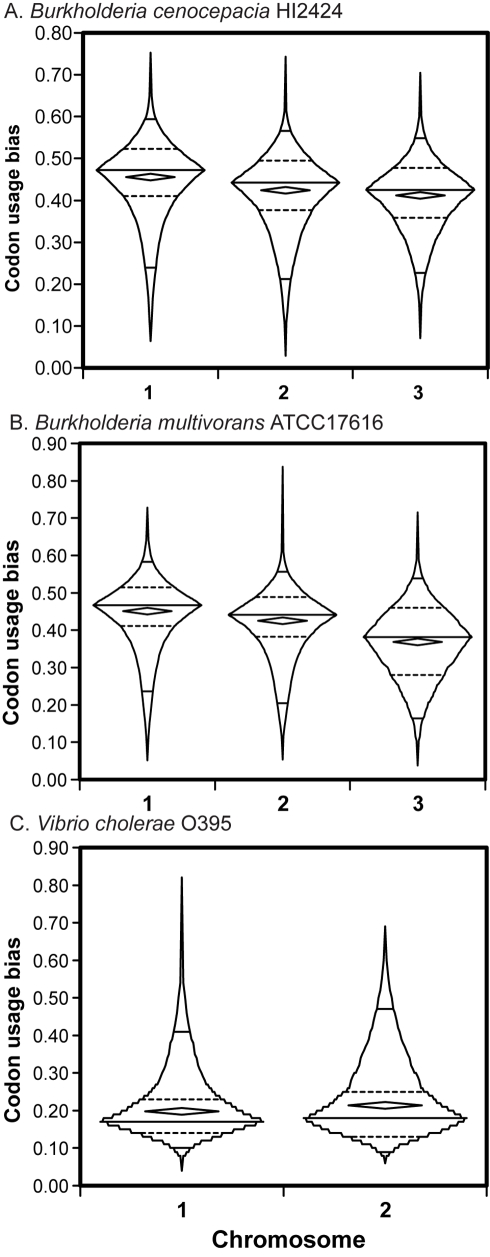
In bacterial genomes composed of more than one chromosome, one replicon is typically larger, harbors more essential genes than the others, and is considered primary. The greater variability of secondary chromosomes among related taxa has led to the theory that they serve as an accessory genome for specific niches or conditions. By this rationale, purifying selection should be weaker on genes on secondary chromosomes because of their reduced necessity or usage. To test this hypothesis we selected bacterial genomes composed of multiple chromosomes from two genera, Burkholderia and Vibrio, and quantified the evolutionary rates (dN and dS) of all orthologs within each genus. Both evolutionary rate parameters were faster among orthologs found on secondary chromosomes than those on the primary chromosome. Further, in every bacterial genome with multiple chromosomes that we studied, genes on secondary chromosomes exhibited significantly weaker codon usage bias than those on primary chromosomes. Faster evolution and reduced codon bias could in turn result from global effects of chromosome position, as genes on secondary chromosomes experience reduced dosage and expression due to their delayed replication, or selection on specific gene attributes. These alternatives were evaluated using orthologs common to genomes with multiple chromosomes and genomes with single chromosomes. Analysis of these ortholog sets suggested that inherently fast-evolving genes tend to be sorted to secondary chromosomes when they arise; however, prolonged evolution on a secondary chromosome further accelerated substitution rates. In summary, secondary chromosomes in bacteria are evolutionary test beds where genes are weakly preserved and evolve more rapidly, likely because they are used less frequently.
在由多个染色体组成的细菌基因组中,一个复制子通常更大,比其他复制子拥有更多的必需基因,因此被认为是主要的复制子。次级染色体在相关分类群中的更大变异性导致了这样一种理论,即它们作为特定小生境或条件的辅助基因组。根据这一原理,由于次级染色体的必要性或使用性降低,对其基因的纯化选择应该较弱。为了检验这一假设,我们从两个属,伯克霍尔德菌属和弧菌属中选择了具有多个染色体的细菌基因组,并量化了每个属内所有直系同源基因的进化率(dN 和 dS)。与主染色体上的直系同源基因相比,次级染色体上的直系同源基因的这两个进化率参数都更快。此外,在我们研究的每个具有多个染色体的细菌基因组中,次级染色体上的基因表现出明显较弱的密码子使用偏好,而主染色体上的基因则没有。更快的进化和减少的密码子偏好反过来可能是由于染色体位置的全局效应造成的,因为次级染色体上的基因由于其延迟复制而经历了减少的剂量和表达,或者对特定基因属性的选择。通过比较具有多个染色体的基因组和具有单个染色体的基因组中的直系同源基因来评估这些替代方案。对这些直系同源基因集的分析表明,当新基因出现时,固有快速进化的基因往往会被分配到次级染色体上;然而,在次级染色体上的长期进化进一步加速了替代率。总之,细菌中的次级染色体是进化试验台,其中基因保存较弱,进化速度更快,可能是因为它们的使用频率较低。