Suppr超能文献

曲坦类药物诱导的潜伏致敏:药物过度使用性头痛的可能基础。

Triptan-induced latent sensitization: a possible basis for medication overuse headache.

机构信息

Department of Pharmacology, University of Arizona College of Medicine, Tucson, AZ, USA.

出版信息

Ann Neurol. 2010 Mar;67(3):325-37. doi: 10.1002/ana.21897.

Abstract

OBJECTIVE

Identification of the neural mechanisms underlying medication overuse headache resulting from triptans.

METHODS

Triptans were administered systemically to rats by repeated intermittent injections or by continuous infusion over 6 days. Periorbital and hind paw sensory thresholds were measured to detect cutaneous allodynia. Immunofluorescent histochemistry was employed to detect changes in peptidic neurotransmitter expression in identified dural afferents. Enzyme-linked immunoabsorbent assay was used to measure calcitonin gene-related peptide (CGRP) levels in blood.

RESULTS

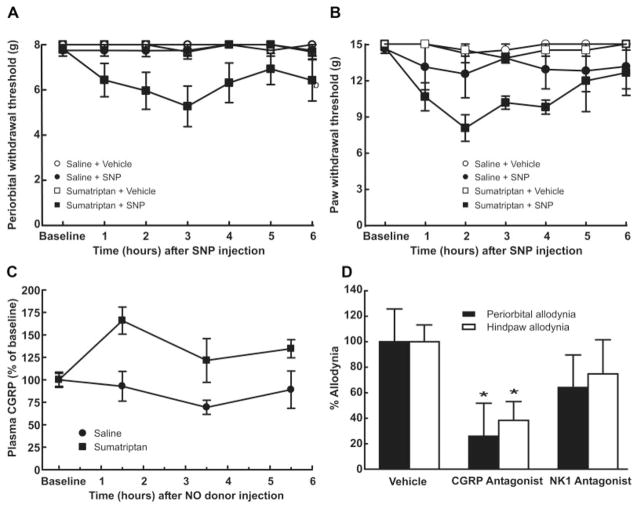
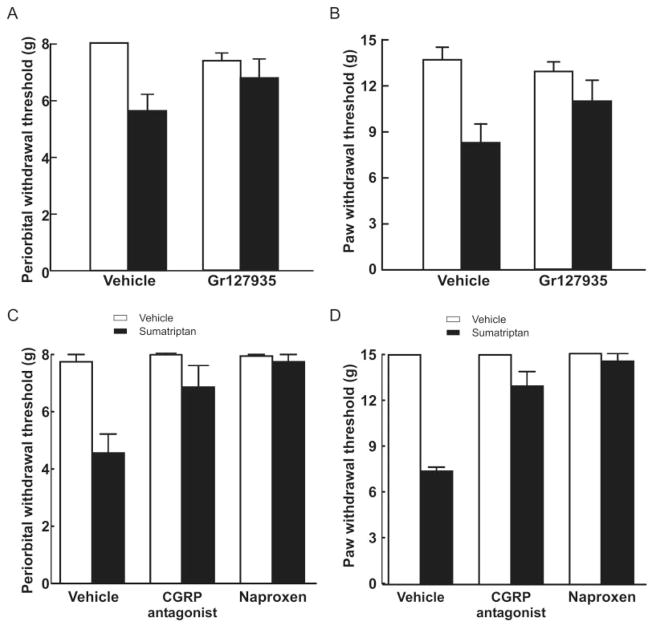
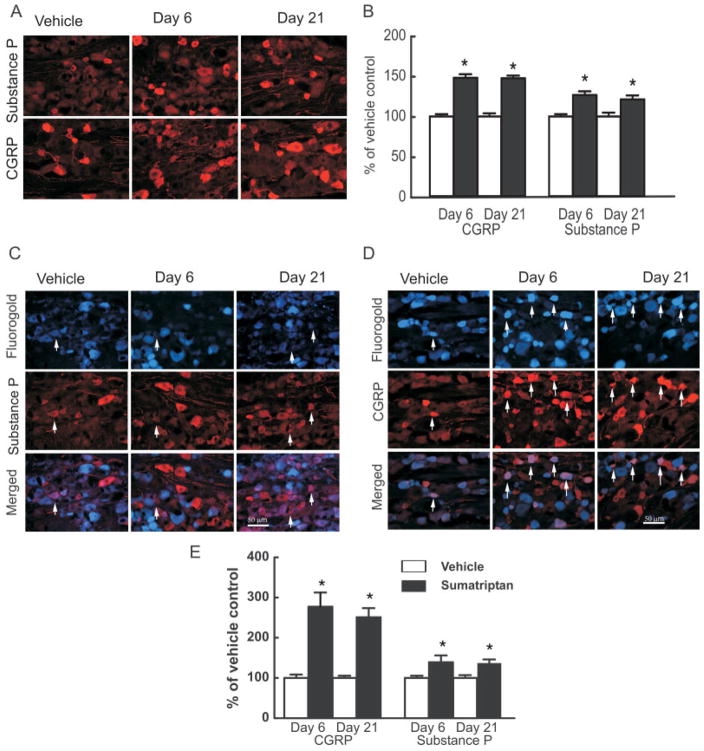
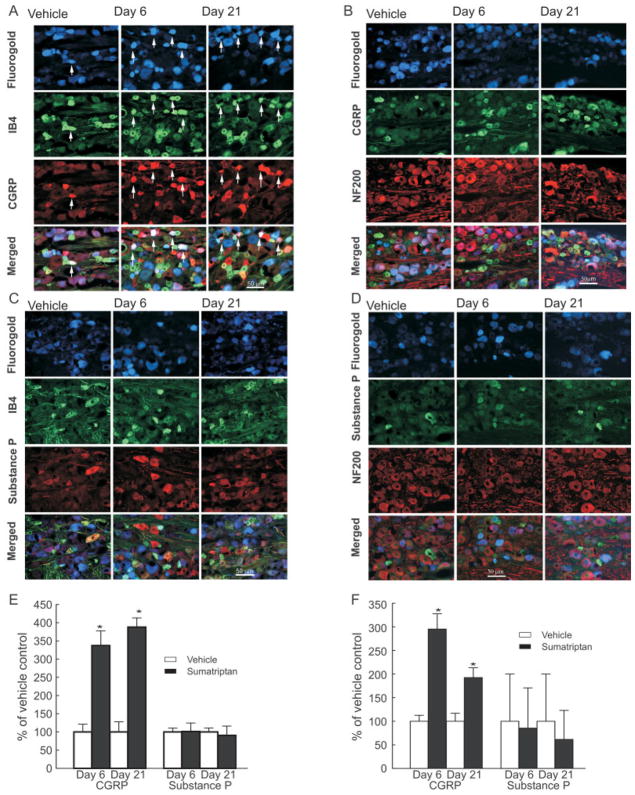
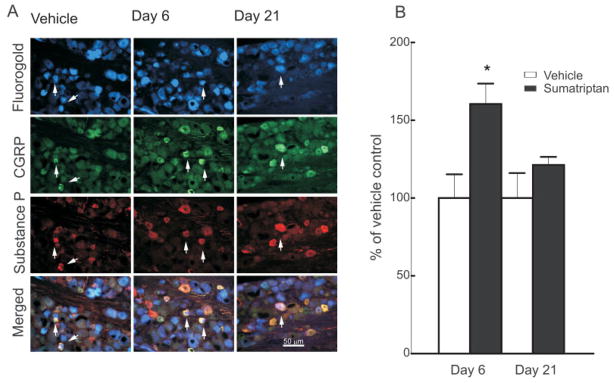
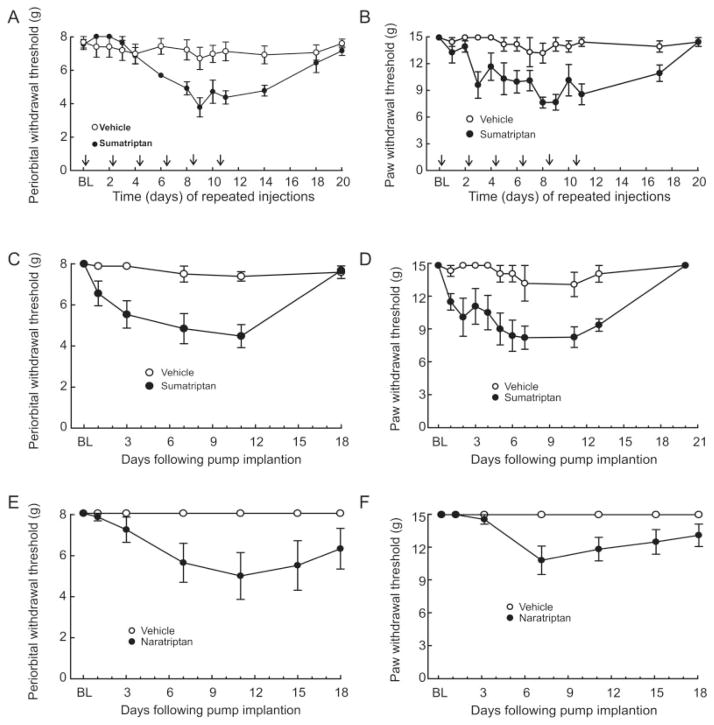
Sustained or repeated administration of triptans to rats elicited time-dependent and reversible cutaneous tactile allodynia that was maintained throughout and transiently after drug delivery. Triptan administration increased labeling for CGRP in identified trigeminal dural afferents that persisted long after discontinuation of triptan exposure. Two weeks after triptan exposure, when sensory thresholds returned to baseline levels, rats showed enhanced cutaneous allodynia and increased CGRP in the blood following challenge with a nitric oxide donor. Triptan treatment thus induces a state of latent sensitization characterized by persistent pronociceptive neural adaptations in dural afferents and enhanced responses to an established trigger of migraine headache in humans.

INTERPRETATION

Triptans represent the treatment of choice for moderate and severe migraine headaches. However, triptan overuse can lead to an increased frequency of migraine headache. Overuse of these medications could induce neural adaptations that result in a state of latent sensitization, which might increase sensitivity to migraine triggers. The latent sensitization could provide a mechanistic basis for the transformation of migraine to medication overuse headache.

摘要

目的

确定曲坦类药物过度使用性头痛的神经机制。

方法

通过重复间歇性注射或连续输注 6 天,向大鼠体内系统给予曲坦类药物。测量眶周和后爪感觉阈值,以检测皮肤感觉过敏。采用免疫荧光组织化学方法检测已知硬脑膜传入神经中肽类神经递质表达的变化。酶联免疫吸附试验用于测量血液中降钙素基因相关肽(CGRP)的水平。

结果

持续或重复给予曲坦类药物会引起大鼠产生时间依赖性和可逆性的皮肤触觉过敏,这种过敏在药物输送期间和之后短暂持续存在。曲坦类药物给药增加了已鉴定的三叉神经硬脑膜传入神经中 CGRP 的标记,这种标记在停止曲坦类药物暴露后仍持续很长时间。在曲坦类药物暴露 2 周后,当感觉阈值恢复到基线水平时,大鼠在接受一氧化氮供体挑战时表现出增强的皮肤感觉过敏和血液中 CGRP 增加。因此,曲坦类药物治疗会导致潜伏致敏状态,其特征是硬脑膜传入神经中持续存在促伤害性神经适应,以及对人类偏头痛头痛的既定触发因素的反应增强。

解释

曲坦类药物是治疗中度和重度偏头痛头痛的首选药物。然而,曲坦类药物的过度使用会导致偏头痛头痛的频率增加。这些药物的过度使用可能会引起神经适应,导致潜伏致敏状态,从而增加对偏头痛触发因素的敏感性。潜伏致敏状态可能为偏头痛向药物过度使用性头痛的转变提供机制基础。
相似文献

1
Triptan-induced latent sensitization: a possible basis for medication overuse headache.
Ann Neurol. 2010 Mar;67(3):325-37. doi: 10.1002/ana.21897.
3
Ubrogepant does not induce latent sensitization in a preclinical model of medication overuse headache.
Cephalalgia. 2020 Aug;40(9):892-902. doi: 10.1177/0333102420938652. Epub 2020 Jul 2.
4
Opiate-induced persistent pronociceptive trigeminal neural adaptations: potential relevance to opiate-induced medication overuse headache.
Cephalalgia. 2009 Dec;29(12):1277-84. doi: 10.1111/j.1468-2982.2009.01873.x. Epub 2009 May 11.
5
Update on medication-overuse headache.
Curr Pain Headache Rep. 2011 Feb;15(1):79-83. doi: 10.1007/s11916-010-0155-1.

引用本文的文献

4
Critical reflections on medication overuse headache in patients with migraine: An unsolved riddle in nociception.
Neurobiol Pain. 2025 Feb 9;17:100179. doi: 10.1016/j.ynpai.2025.100179. eCollection 2025 Jan-Jun.
5
Chronification of migraine sensitizes to CGRP in male and female mice.
Cephalalgia. 2025 Feb;45(2):3331024251317446. doi: 10.1177/03331024251317446.
9
Potential mechanisms for osteopathic manipulative treatment to alleviate migraine-like pain in female rats.
Front Pain Res (Lausanne). 2024 Feb 5;5:1280589. doi: 10.3389/fpain.2024.1280589. eCollection 2024.
10
Problems in management of medication overuse headache in transgender and gender non-conforming populations.
Front Neurol. 2024 Jan 30;15:1320791. doi: 10.3389/fneur.2024.1320791. eCollection 2024.

本文引用的文献

1
Medullary pain facilitating neurons mediate allodynia in headache-related pain.
Ann Neurol. 2009 Feb;65(2):184-93. doi: 10.1002/ana.21537.
2
Migraine in the triptan era: lessons from epidemiology, pathophysiology, and clinical science.
Headache. 2009 Feb;49 Suppl 1:S21-33. doi: 10.1111/j.1526-4610.2008.01336.x.
4
Excessive acute migraine medication use and migraine progression.
Neurology. 2008 Nov 25;71(22):1821-8. doi: 10.1212/01.wnl.0000335946.53860.1d.
7
Comparison of CGRP and NO responses in the human peripheral microcirculation of migraine and control subjects.
Cephalalgia. 2008 May;28(5):563-6. doi: 10.1111/j.1468-2982.2008.01558.x. Epub 2008 Mar 31.
8
The neuropathic pain triad: neurons, immune cells and glia.
Nat Neurosci. 2007 Nov;10(11):1361-8. doi: 10.1038/nn1992.
9
CGRP antagonists: unravelling the role of CGRP in migraine.
Trends Pharmacol Sci. 2007 Nov;28(11):580-7. doi: 10.1016/j.tips.2007.10.005. Epub 2007 Oct 25.
10
Randomized controlled trial of an oral CGRP receptor antagonist, MK-0974, in acute treatment of migraine.
Neurology. 2008 Apr 15;70(16):1304-12. doi: 10.1212/01.WNL.0000286940.29755.61. Epub 2007 Oct 3.

文献AI研究员

20分钟写一篇综述,助力文献阅读效率提升50倍。

立即体验

用中文搜PubMed

大模型驱动的PubMed中文搜索引擎

马上搜索

文档翻译

学术文献翻译模型,支持多种主流文档格式。

立即体验