Institut Cochin, Université Paris Descartes, CNRS (UMR 8104), Paris, France.
Retrovirology. 2010 Apr 9;7:35. doi: 10.1186/1742-4690-7-35.
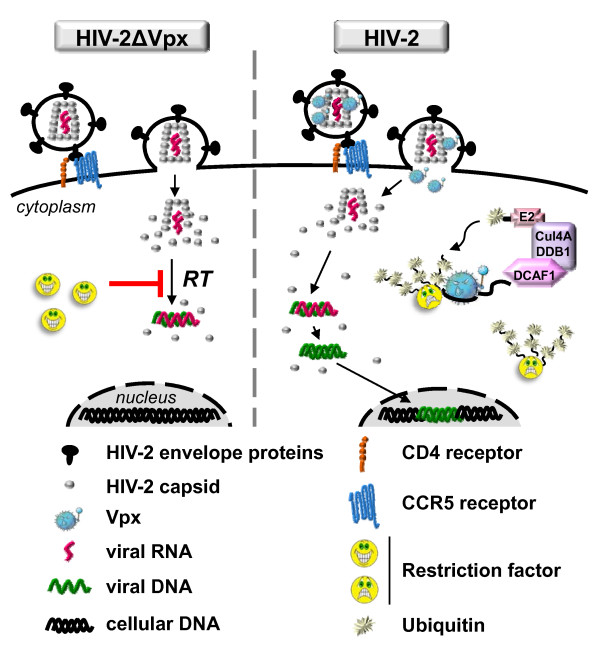
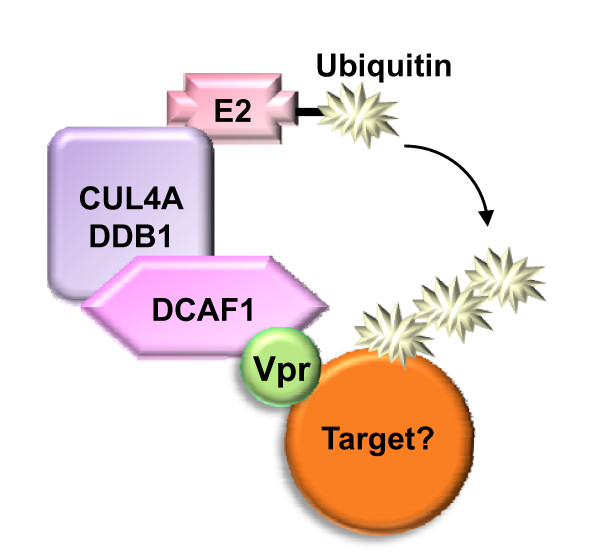
HIV viruses encode a set of accessory proteins, which are important determinants of virulence due to their ability to manipulate the host cell physiology for the benefit of the virus. Although these viral proteins are dispensable for viral growth in many in vitro cell culture systems, they influence the efficiency of viral replication in certain cell types. Macrophages are early targets of HIV infection which play a major role in viral dissemination and persistence in the organism. This review focuses on two HIV accessory proteins whose functions might be more specifically related to macrophage infection: Vpr, which is conserved across primate lentiviruses including HIV-1 and HIV-2, and Vpx, a protein genetically related to Vpr, which is unique to HIV-2 and a subset of simian lentiviruses. Recent studies suggest that both Vpr and Vpx exploit the host ubiquitination machinery in order to inactivate specific cellular proteins. We review here why it remains difficult to decipher the role of Vpr in macrophage infection by HIV-1 and how recent data underscore the ability of Vpx to antagonize a restriction factor which counteracts synthesis of viral DNA in monocytic cells.
HIV 病毒编码了一组辅助蛋白,这些蛋白由于能够操纵宿主细胞生理机能以有利于病毒的生存,因此成为了病毒毒力的重要决定因素。尽管这些病毒蛋白在许多体外细胞培养系统中对于病毒的生长是可有可无的,但它们会影响特定细胞类型中病毒复制的效率。巨噬细胞是 HIV 感染的早期靶细胞,在病毒在体内的传播和持续存在中发挥着重要作用。这篇综述主要关注两种 HIV 辅助蛋白,它们的功能可能与巨噬细胞感染更为相关:Vpr,它在包括 HIV-1 和 HIV-2 在内的灵长类慢病毒中保守存在,以及 Vpx,一种与 Vpr 具有遗传关系的蛋白,它是 HIV-2 和一部分灵长类慢病毒所特有的。最近的研究表明,Vpr 和 Vpx 都利用宿主泛素化机制来使特定的细胞蛋白失活。我们在这里回顾了为什么仍然难以确定 Vpr 在 HIV-1 感染巨噬细胞中的作用,以及最近的数据如何强调了 Vpx 拮抗一种限制因子的能力,该因子可在单核细胞中抑制病毒 DNA 的合成。