Li Ka Shing Insitute of Health Sciences and School of Biomedical Sciences, The Chinese University of Hong Kong, Shatin, Hong Kong, People's Republic of China.
Pflugers Arch. 2010 Jun;460(1):121-30. doi: 10.1007/s00424-010-0823-3.
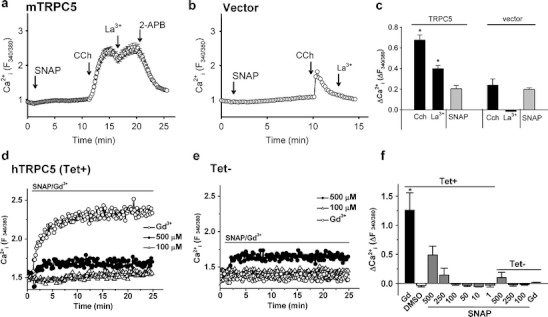
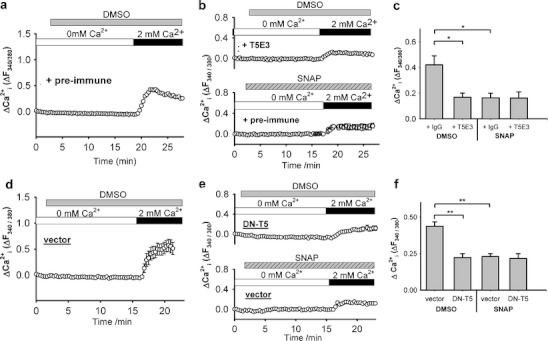
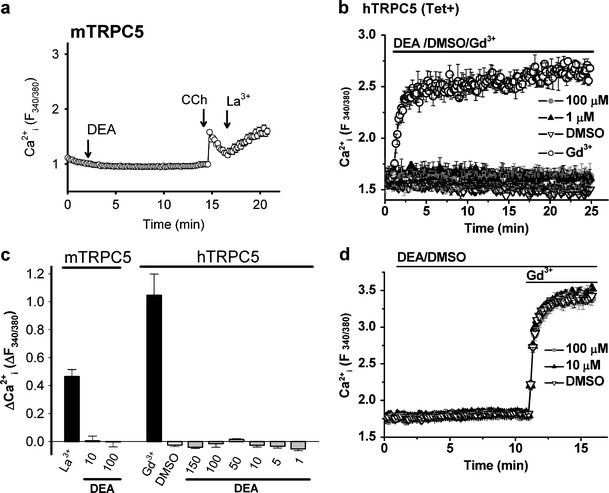
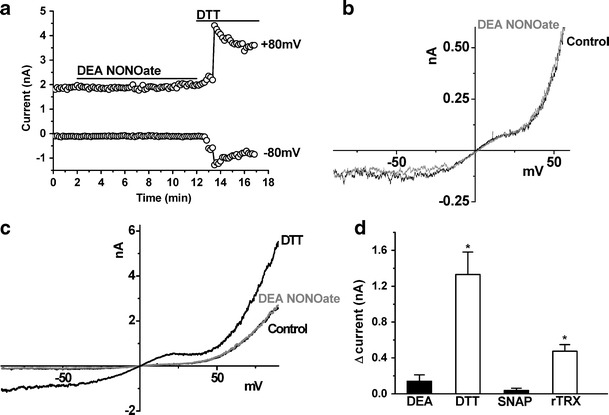
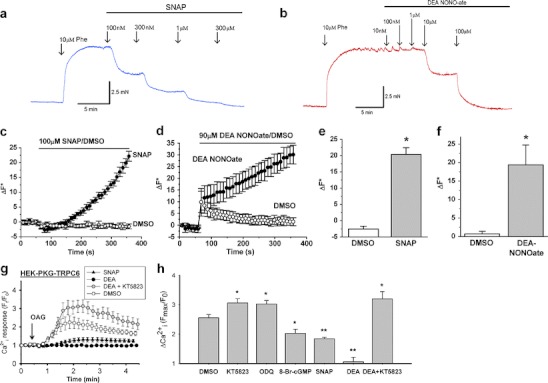
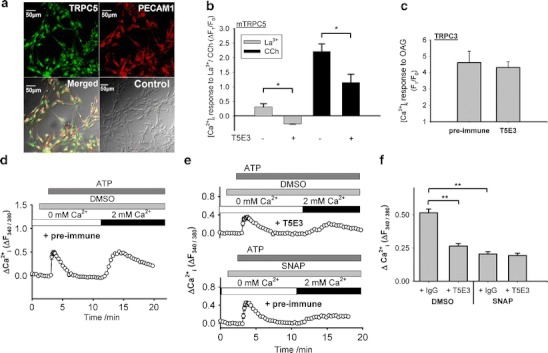
TRPC5 is a member of the canonical transient receptor potential (TRPC) family of proteins that forms cationic channels either through homomultimeric assembly or heteromultimeric coordination with other TRPC proteins. It is expressed in a variety of cells including central neurones and endothelial cells and has susceptibility to stimulation by multiple factors. Here we investigated if TRPC5 is sensitive to nitric oxide. Mouse TRPC5 or human TRPC5 was over-expressed in HEK293 cells, and TRPC5 activity was determined by measuring the cytosolic Ca(2+) concentration with an indicator dye or by recording membrane current under voltage clamp. TRPC5 activity could be evoked by carbachol acting at muscarinic receptors, lanthanum, or a reducing agent. However, S-nitroso-N-acetylpenicillamine (SNAP) and diethylamine NONOate (DEA-NONOate) failed to stimulate or inhibit TRPC5 at concentrations that generated nitric oxide, caused vasorelaxation, or suppressed activity of TRPC6 via protein kinase G. At high concentrations, SNAP (but not DEA-NONOate) occasionally stimulated TRPC5 but the effect was confounded by background TRPC5-independent Ca(2+) signals. Endogenous Ca(2+)-entry in bovine aortic endothelial cells (BAECs) was suppressed by SNAP; TRPC5 blocking antibody or dominant-negative mutant TRPC5 suppressed this Ca(2+) entry and occluded the effect of SNAP. The data suggest that nitric oxide is not a direct modulator of homomeric TRPC5 channels but may inhibit endogenous BAEC channels that contain TRPC5.
TRPC5 是经典的瞬时受体电位 (TRPC) 家族蛋白的成员,可通过同源三聚体组装或与其他 TRPC 蛋白的异源三聚体协调形成阳离子通道。它在多种细胞中表达,包括中枢神经元和内皮细胞,并易受多种因素的刺激。在这里,我们研究了 TRPC5 是否对一氧化氮敏感。在 HEK293 细胞中过表达小鼠 TRPC5 或人 TRPC5,并通过指示剂染料测量细胞内 Ca(2+)浓度或在电压钳下记录膜电流来测定 TRPC5 活性。TRPC5 活性可被乙酰胆碱作用于毒蕈碱受体、镧或还原剂激活。然而,S-亚硝基-N-乙酰青霉胺 (SNAP) 和二乙胺 NONOate (DEA-NONOate) 未能在产生一氧化氮、引起血管舒张或通过蛋白激酶 G 抑制 TRPC6 活性的浓度下刺激或抑制 TRPC5。在高浓度下,SNAP(但不是 DEA-NONOate)偶尔会刺激 TRPC5,但由于背景 TRPC5 独立的 Ca(2+)信号,这种作用很复杂。牛主动脉内皮细胞 (BAECs) 中的内源性 Ca(2+)内流被 SNAP 抑制;TRPC5 阻断抗体或显性负突变 TRPC5 抑制了这种 Ca(2+)内流,并阻断了 SNAP 的作用。数据表明,一氧化氮不是同型 TRPC5 通道的直接调节剂,但可能抑制含有 TRPC5 的内源性 BAEC 通道。