Department of Women's and Children's Health, Karolinska Institute, Solna S-171 76 Stockholm, Sweden.
Reprod Biol Endocrinol. 2010 Apr 16;8:35. doi: 10.1186/1477-7827-8-35.
In order to unravel the interactions between the epithelium and the extra cellular matrix (ECM) in breast tissue progressing to cancer, it is necessary to understand the relevant interactions in healthy tissue under normal physiologic settings. Proteoglycans in the ECM play an important role in the signaling between the different tissue compartments. The proteoglycan decorin is abundant in the breast stroma. Decreased expression in breast cancer tissue is a sign of a poor tumor prognosis. The heparane sulphate proteoglycans syndecan-1 and syndecan-4 promote the integration of cellular adhesion and proliferation. The aim of this study was to investigate the gene expression and location of decorin, syndecan-1 and syndecan-4 in the healthy breast during the menstrual cycle.
Tissue from healthy women undergoing breast reduction plastic surgery was examined using immunohistochemistry (n = 38) and Real-Time RT-PCR (n = 20). Both parous and nulliparous women were eligible and the mean age of the women was 34(+/- 10 years) with regular menstrual cycles (28 +/- 7 days). None of the women had used hormonal treatment the last three months. The women were randomized to needle biopsy two months before the operation in the follicular or luteal menstrual phase and for another biopsy at the operation in the opposite phase. Serum samples were obtained to characterize the menstrual phase. The Wilcoxon signed rank test and Mann Whitney test were used for statistical analyses.
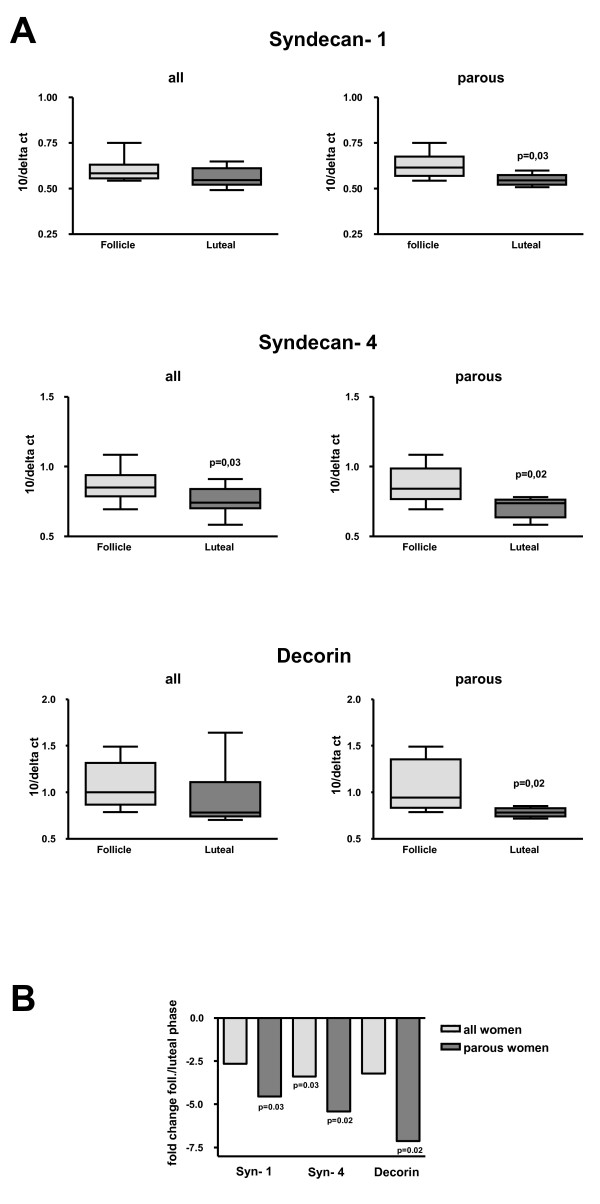
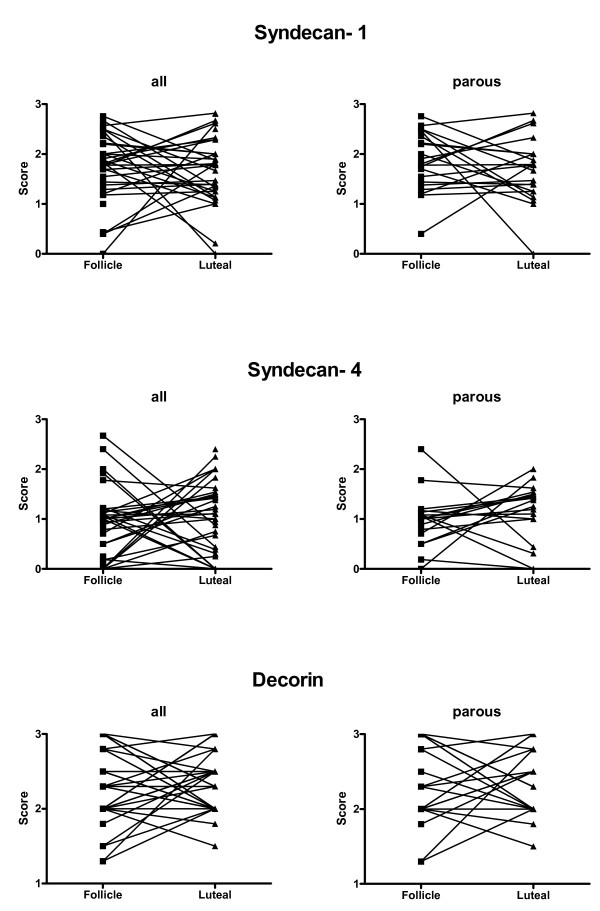
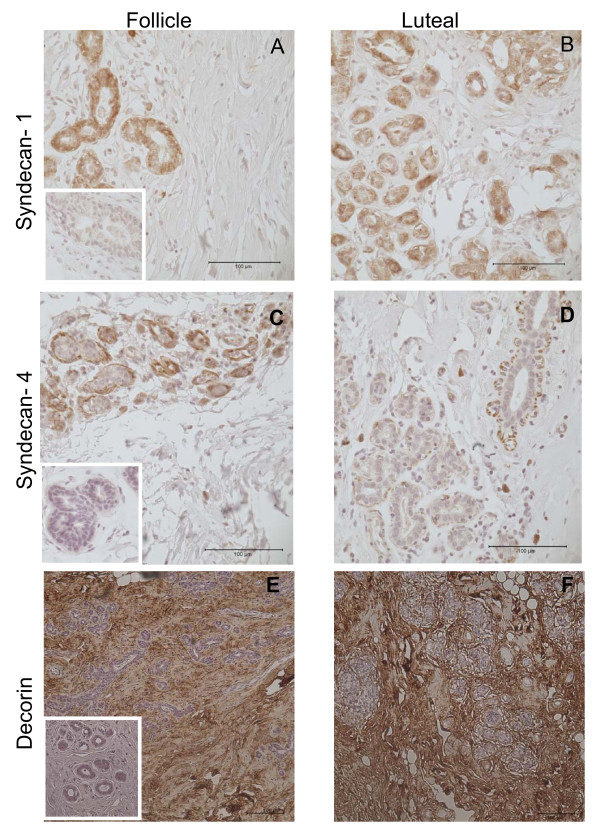
By real time-RT-PCR the gene signal for all three proteoglycans; decorin (p = 0.02) and syndecan-1 (p = 0.03) and syndecan-4 (p = 0.02) was significantly lower among parous women in the luteal phase than in the follicular phase. Immunohistochemistry confirmed the identification of the proteins but no significant difference between menstrual phases was observed. Serum samples verified the menstrual phase.
Our study shows, for the first time in the healthy breast, a significantly lower expression of the genes for the three proteoglycans, decorin, syndecan-1 and syndecan-4 in the luteal phase during the menstrual cycle. These changes were registered under normal physiologic conditions. Since ECM molecules appear to be involved in tumor progression, these findings in the normal breast could constitute a base for further studies in women receiving hormonal therapy or those with breast cancer.
为了揭示乳腺组织中上皮细胞与细胞外基质(ECM)之间的相互作用,了解正常生理状态下健康组织中的相关相互作用是必要的。ECM 中的蛋白聚糖在不同组织间隙的信号传递中起着重要作用。蛋白聚糖decorin 在乳腺基质中含量丰富。乳腺癌组织中表达减少是肿瘤预后不良的标志。硫酸乙酰肝素蛋白聚糖 syndecan-1 和 syndecan-4 促进细胞黏附和增殖的整合。本研究旨在研究在月经周期中健康乳房中 decorin、syndecan-1 和 syndecan-4 的基因表达和位置。
对接受乳房缩小整形手术的健康女性的组织进行免疫组织化学(n = 38)和实时 RT-PCR(n = 20)检查。多产妇和未产妇均符合条件,女性平均年龄为 34(+/-10 岁),月经周期规律(28 +/- 7 天)。最近三个月内,没有女性使用激素治疗。女性在手术前两个月随机进行卵泡期或黄体期的针吸活检,并在手术时进行相反阶段的活检。采集血清样本以确定月经周期。采用 Wilcoxon 符号秩检验和 Mann Whitney 检验进行统计学分析。
实时 RT-PCR 结果显示,在黄体期,所有三种蛋白聚糖的基因信号,即 decorin(p = 0.02)、syndecan-1(p = 0.03)和 syndecan-4(p = 0.02),在多产妇中均显著低于卵泡期。免疫组织化学证实了这些蛋白的鉴定,但在月经周期中未观察到明显的差异。血清样本验证了月经周期。
本研究首次在健康的乳房中显示,在月经周期的黄体期,三种蛋白聚糖 decorin、syndecan-1 和 syndecan-4 的基因表达显著降低。这些变化是在正常生理条件下记录的。由于细胞外基质分子似乎参与了肿瘤的进展,因此在正常乳房中的这些发现可以为接受激素治疗的女性或患有乳腺癌的女性进一步研究提供基础。