Department of Experimental Medicine, Sapienza University of Rome, Italy.
BMC Cancer. 2010 Apr 19;10:151. doi: 10.1186/1471-2407-10-151.
The urokinase plasminogen activating system (uPAS) is implicated in neoplastic progression and high tissue levels of uPAS components correlate with a poor prognosis in different human cancers. Despite that, relative few studies are available on the expression and function of the uPAS components in human seminomas. In the present study we characterized the expression of the urokinase plasminogen activator (uPA), its cognate receptor (uPAR) and the uPA inhibitors PAI-1 and PAI-2 in normal human testis and seminomas.
The expression of the above genes was evaluated by means of quantitative RT-PCR, western blot, zymographic analysis and immunohistochemistry.
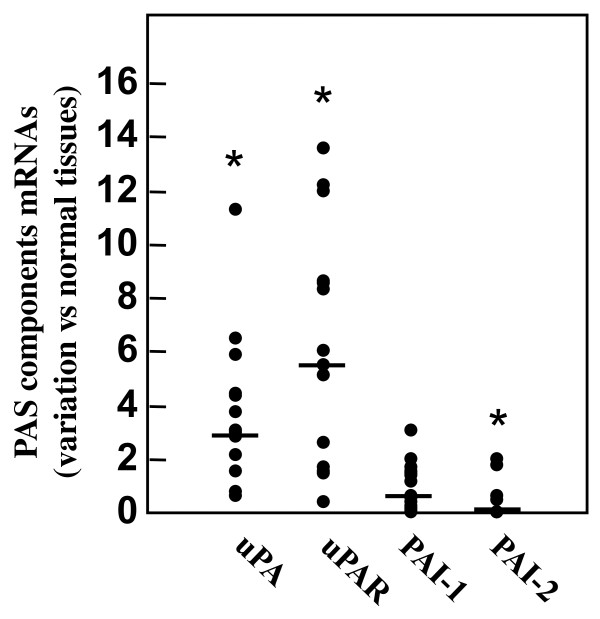
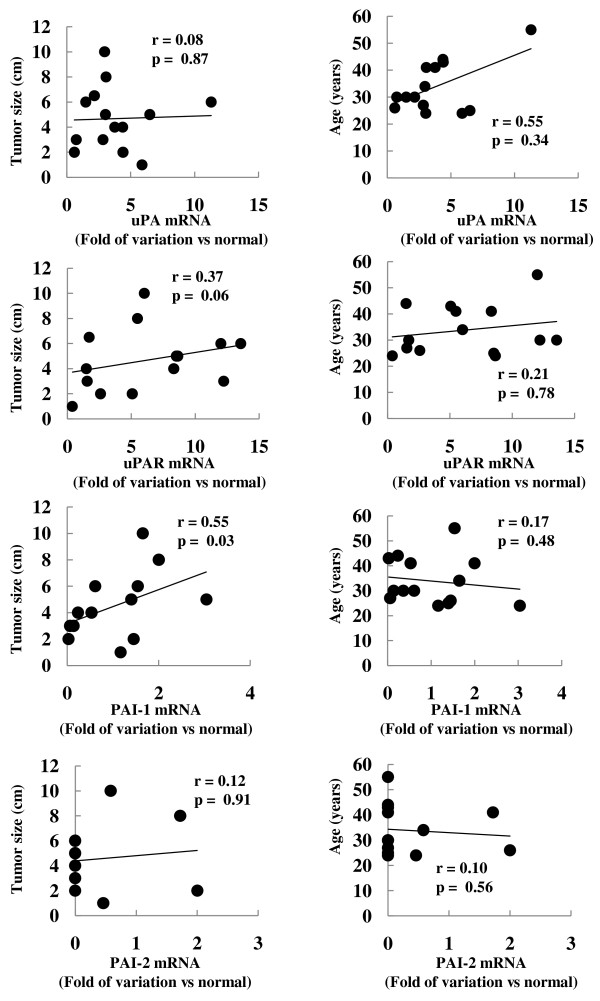
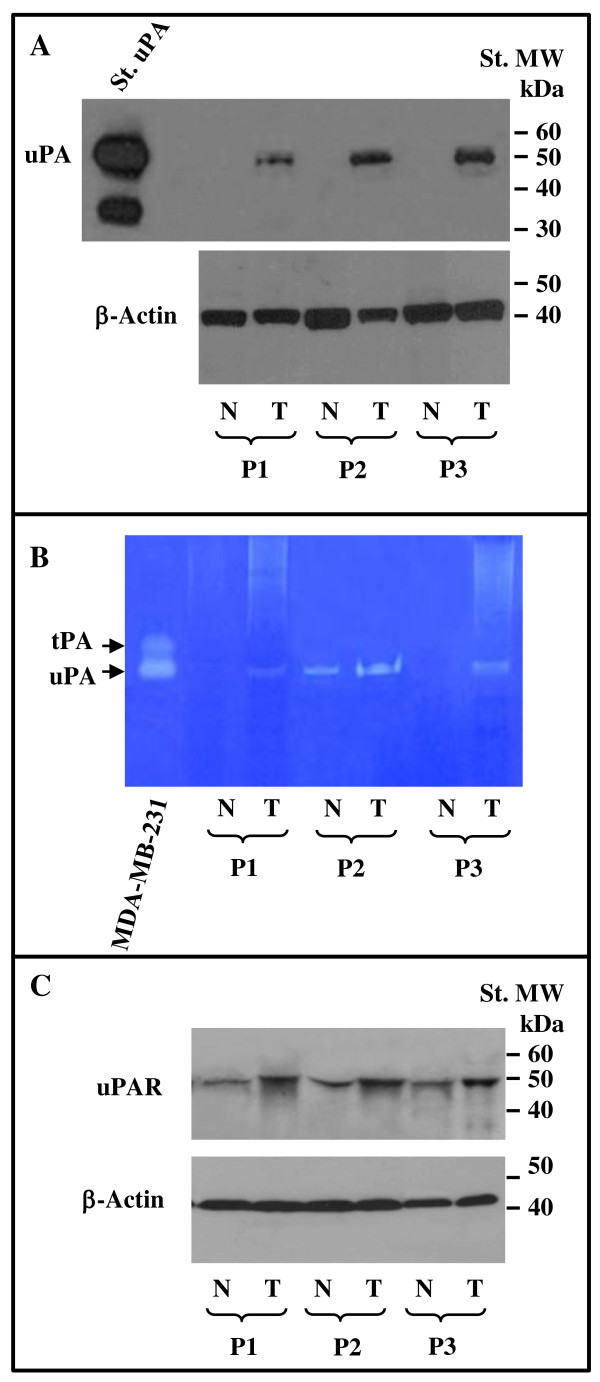
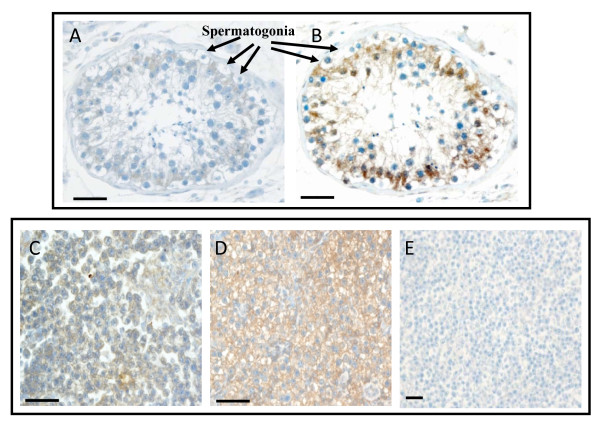
Quantitative RT-PCR analysis of 14 seminomas demonstrated that uPA and uPAR mRNAs were, with respect to control tissues, increased in tumor tissues by 3.80 +/- 0.74 (p < 0.01) and 6.25 +/- 1.18 (p < 0.01) fold, respectively. On the other hand, PAI-1 mRNA level was unchanged (1.02 +/- 0.24 fold), while that of PAI-2 was significantly reduced to 0.34 +/- 0.18 (p < 0.01) fold. Western blot experiments performed with protein extracts of three seminomas and normal tissues from the same patients showed that uPA protein levels were low or undetectable in normal tissues and induced in tumor tissues. On the same samples, zymographic analysis demonstrated increased uPA activity in tumor tissue extracts. Western blot experiments showed that also the uPAR protein was increased in tumor tissues by 1.83 +/- 0.15 fold (p < 0.01). The increased expression of uPA and uPAR was further confirmed by immunohistochemical staining performed in 10 seminomas and autologous uninvolved peritumoral tissues. Finally, variation in the mRNA level of PAI-1 significantly correlated with tumor size.
We demonstrated the increased expression of uPA and uPAR in human seminomas with respect to normal testis tissues, which may be relevant in testicular cancer progression.
尿激酶纤溶酶原激活系统 (uPAS) 参与肿瘤的进展,组织中 uPAS 成分的高表达与不同人类癌症的预后不良相关。尽管如此,关于人精原细胞瘤中 uPAS 成分的表达和功能的研究相对较少。在本研究中,我们研究了尿激酶纤溶酶原激活剂 (uPA)、其同源受体 (uPAR) 以及 uPA 抑制剂 PAI-1 和 PAI-2 在正常人类睾丸和精原细胞瘤中的表达。
通过定量 RT-PCR、western blot、酶谱分析和免疫组织化学方法评估上述基因的表达。
对 14 例精原细胞瘤的定量 RT-PCR 分析表明,与对照组织相比,uPA 和 uPAR mRNA 在肿瘤组织中分别增加了 3.80 +/- 0.74(p < 0.01)和 6.25 +/- 1.18(p < 0.01)倍。另一方面,PAI-1 mRNA 水平不变(1.02 +/- 0.24 倍),而 PAI-2 水平显著降低至 0.34 +/- 0.18(p < 0.01)倍。对来自同一位患者的三个精原细胞瘤和正常组织的蛋白提取物进行 western blot 实验表明,uPA 蛋白水平在正常组织中较低或无法检测到,而在肿瘤组织中诱导表达。在相同的样本中,酶谱分析表明肿瘤组织提取物中的 uPA 活性增加。Western blot 实验表明,uPAR 蛋白在肿瘤组织中也增加了 1.83 +/- 0.15 倍(p < 0.01)。在 10 例精原细胞瘤和同源非肿瘤旁组织中进行的免疫组织化学染色进一步证实了 uPA 和 uPAR 的表达增加。最后,PAI-1 mRNA 水平的变化与肿瘤大小显著相关。
我们证明了人精原细胞瘤中 uPA 和 uPAR 的表达相对于正常睾丸组织增加,这可能与睾丸癌的进展有关。