Division of Environmental Dermatology and Allergy, Helmholtz Zentrum/Technische Universität München, Helmholtz Zentrum München, German Research Center for Environmental Health (GmbH), Ingolstaedter Landstrasse 1, 85764 Neuherberg, Germany.
Part Fibre Toxicol. 2010 Apr 26;7:11. doi: 10.1186/1743-8977-7-11.
Clara cell protein (CC16), the main secretory product of bronchiolar Clara cells, plays an important protective role in the respiratory tract against oxidative stress and inflammation. The purpose of the study was to investigate the role of elemental carbon ultrafine particles (EC-UFP)-induced oxidative stress on Clara cells and CC16 in a mouse model of allergic lung inflammation.
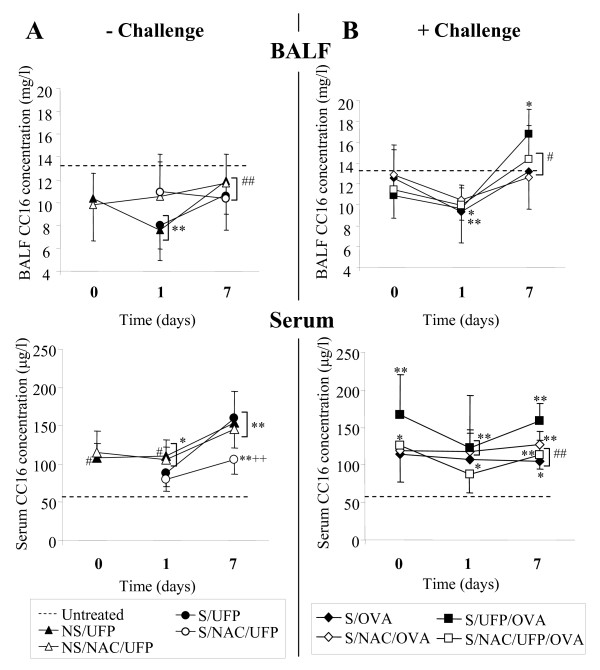
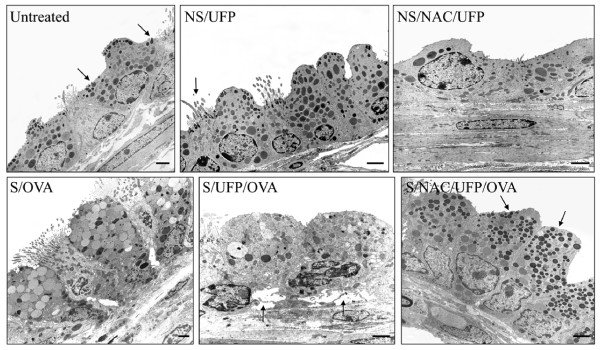
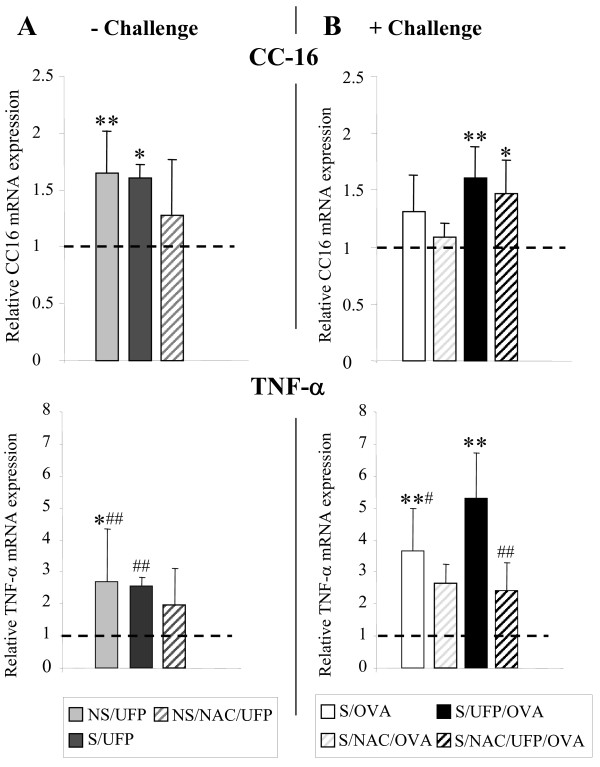
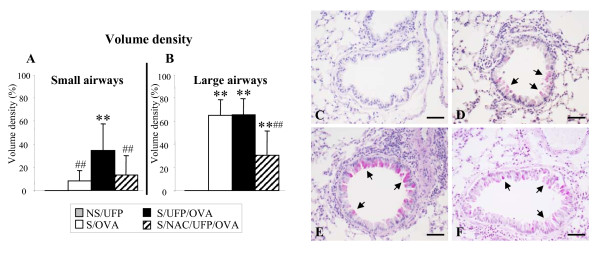
Ovalbumin (OVA)-sensitized mice were exposed to EC-UFP (507 microg/m(3) for 24 h) or filtered air immediately prior to allergen challenge and systemically treated with N-acetylcysteine (NAC) or vehicle prior and during EC-UFP inhalation. CC16 was measured up to one week after allergen challenge in bronchoalveolar lavage fluid (BALF) and in serum. The relative expression of CC16 and TNF-alpha mRNA were measured in lung homogenates. A morphometrical analysis of mucus hypersecretion and electron microscopy served to investigate goblet cell metaplasia and Clara cell morphological alterations.
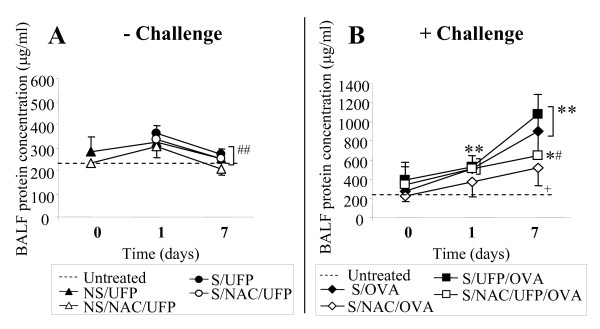
In non sensitized mice EC-UFP inhalation caused alterations in CC16 concentration, both at protein and mRNA level, and induced Clara cell hyperplasia. In sensitized mice, inhalation of EC-UFP prior to OVA challenge caused most significant alterations of BALF and serum CC16 concentration, BALF total protein and TNF-alpha relative expression compared to relevant controls; their Clara cells displayed the strongest morphological alterations and strongest goblet cell metaplasia occurred in the small airways. NAC strongly reduced both functional and morphological alterations of Clara cells.
Our findings demonstrate that oxidative stress plays an important role in EC-UFP-induced augmentation of functional and morphological alterations of Clara cells in allergic lung inflammation.
Clara 细胞蛋白(CC16)是细支气管 Clara 细胞的主要分泌产物,在呼吸道中对氧化应激和炎症发挥重要的保护作用。本研究的目的是探讨元素碳超细颗粒(EC-UFP)诱导的氧化应激对变应性肺炎症模型中 Clara 细胞和 CC16 的作用。
卵清蛋白(OVA)致敏的小鼠在过敏原攻击前立即暴露于 EC-UFP(507μg/m3,24 小时)或过滤空气中,并在 EC-UFP 吸入前和吸入期间用 N-乙酰半胱氨酸(NAC)或载体进行全身治疗。在过敏原攻击后一周内测量支气管肺泡灌洗液(BALF)和血清中的 CC16。测量肺匀浆中 CC16 和 TNF-αmRNA 的相对表达。粘液分泌过度的形态计量学分析和电子显微镜用于研究杯状细胞化生和 Clara 细胞形态改变。
在非致敏的小鼠中,EC-UFP 的吸入导致 CC16 浓度在蛋白和 mRNA 水平上发生改变,并诱导 Clara 细胞增生。在致敏的小鼠中,在 OVA 攻击前吸入 EC-UFP 引起 BALF 和血清 CC16 浓度、BALF 总蛋白和 TNF-α相对表达与相应对照相比发生最显著的改变;它们的 Clara 细胞显示出最强的形态改变,并且小气道中发生最强的杯状细胞化生。NAC 强烈减少 Clara 细胞的功能和形态改变。
我们的研究结果表明,氧化应激在 EC-UFP 诱导的变应性肺炎症中 Clara 细胞的功能和形态改变中发挥重要作用。