Miyakawa Hitoshi, Imai Maki, Sugimoto Naoki, Ishikawa Yuki, Ishikawa Asano, Ishigaki Hidehiko, Okada Yasukazu, Miyazaki Satoshi, Koshikawa Shigeyuki, Cornette Richard, Miura Toru
Graduate School of Environmental Science, Hokkaido University, Sapporo, Hokkaido 060-0810, Japan.
BMC Dev Biol. 2010 Apr 30;10:45. doi: 10.1186/1471-213X-10-45.
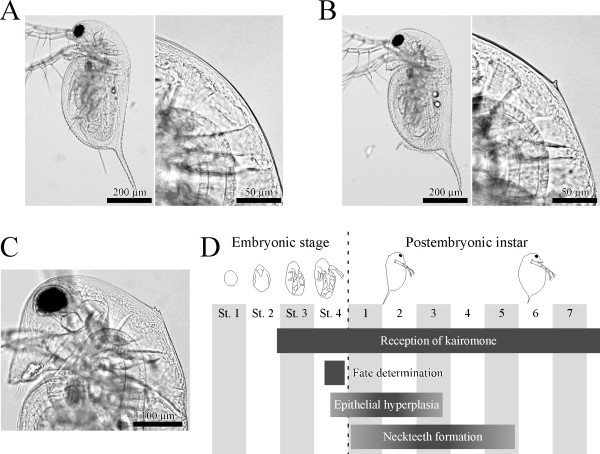
Numerous cases of predator-induced polyphenisms, in which alternate phenotypes are produced in response to extrinsic stimuli, have been reported in aquatic taxa to date. The genus Daphnia (Branchiopoda, Cladocera) provides a model experimental system for the study of the developmental mechanisms and evolutionary processes associated with predator-induced polyphenisms. In D. pulex, juveniles form neckteeth in response to predatory kairomones released by Chaoborus larvae (Insecta, Diptera).
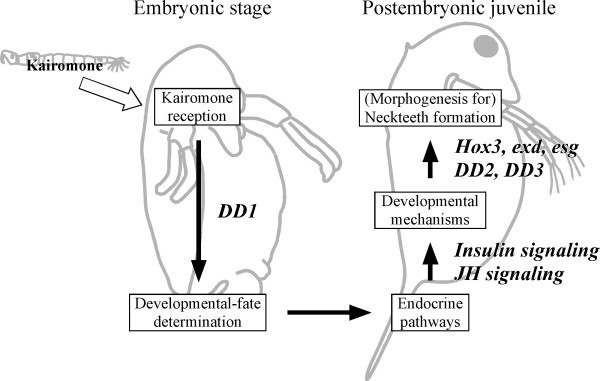
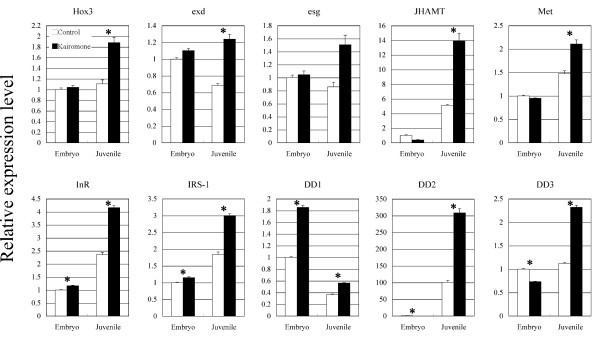
Previous studies suggest that the timing of the sensitivity to kairomones in D. pulex can generally be divided into the embryonic and postembryonic developmental periods. We therefore examined which of the genes in the embryonic and first-instar juvenile stages exhibit different expression levels in the presence or absence of predator kairomones. Employing a candidate gene approach and identifying differentially-expressed genes revealed that the morphogenetic factors, Hox3, extradenticle and escargot, were up-regulated by kairomones in the postembryonic stage and may potentially be responsible for defense morph formation. In addition, the juvenile hormone pathway genes, JHAMT and Met, and the insulin signaling pathway genes, InR and IRS-1, were up-regulated in the first-instar stage. It is well known that these hormonal pathways are involved in physiological regulation following morphogenesis in many insect species. During the embryonic stage when morphotypes were determined, one of the novel genes identified by differential display was up-regulated, suggesting that this gene may be related to morphotype determination. Biological functions of the up-regulated genes are discussed in the context of defense morph formation.
It is suggested that, following the reception of kairomone signals, the identified genes are involved in a series of defensive phenotypic alterations and the production of a defensive phenotype.
迄今为止,在水生类群中已报道了许多捕食者诱导的多型现象的案例,即对外界刺激产生交替表型。水蚤属(鳃足纲,枝角目)为研究与捕食者诱导的多型现象相关的发育机制和进化过程提供了一个模型实验系统。在蚤状溞中,幼体对摇蚊幼虫(昆虫纲,双翅目)释放的捕食性信息素产生颈齿。
先前的研究表明,蚤状溞对信息素的敏感时期通常可分为胚胎发育期和胚后发育期。因此,我们研究了在有或没有捕食者信息素的情况下,胚胎期和一龄幼体阶段的哪些基因表现出不同的表达水平。采用候选基因方法并鉴定差异表达基因,结果显示形态发生因子Hox3、extra denticle和escargot在胚后期被信息素上调,可能与防御形态的形成有关。此外,幼体激素途径基因JHAMT和Met以及胰岛素信号途径基因InR和IRS-1在一龄阶段上调。众所周知,这些激素途径在许多昆虫物种的形态发生后的生理调节中发挥作用。在确定形态类型的胚胎期,通过差异显示鉴定出的一个新基因被上调,这表明该基因可能与形态类型的确定有关。上调基因的生物学功能将在防御形态形成的背景下进行讨论。
研究表明,在接收到信息素信号后,所鉴定的基因参与了一系列防御性表型改变和防御性表型的产生。