Department of Biochemistry and Molecular Biophysics, University of Pennsylvania, Philadelphia, Pennsylvania 19104, USA.
Biochemistry. 2010 Jun 8;49(22):4672-8. doi: 10.1021/bi100426p.
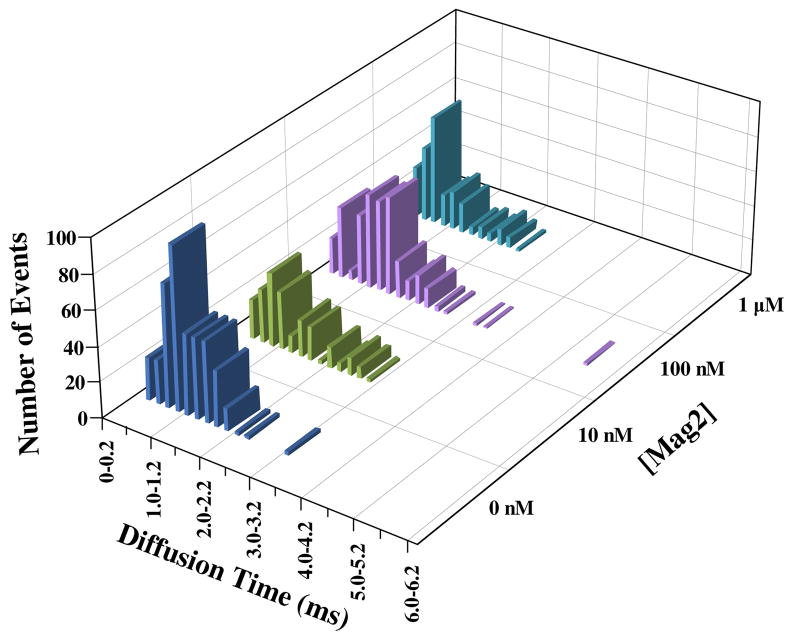
Many antimicrobial peptides (AMPs) function by forming various oligomeric structures and/or pores upon binding to bacterial membranes. Because such peptide aggregates are capable of inducing membrane thinning and membrane permeabilization, we expected that AMP binding would also affect the diffusivity or mobility of the lipid molecules in the membrane. Herein, we show that measurements of the diffusion times of individual lipids through a confocal volume via fluorescence correlation spectroscopy (FCS) provide a sensitive means of probing the underlying AMP-membrane interactions. In particular, results obtained with two well-studied AMPs, magainin 2 and mastoparan X, and two model membranes indicate that this method is capable of revealing structural information, especially the heterogeneity of the peptide-membrane system, that is otherwise difficult to obtain using common ensemble methods. Moreover, because of the high sensitivity of FCS, this method allows examination of the effect of AMPs on the membrane structure at very low peptide/lipid ratios.
许多抗菌肽 (AMPs) 通过与细菌膜结合形成各种寡聚结构和/或孔来发挥作用。由于这种肽聚集体能够诱导膜变薄和膜通透性增加,我们预计 AMP 结合也会影响膜中脂质分子的扩散性或迁移率。在此,我们表明,通过荧光相关光谱 (FCS) 测量单个脂质通过共聚焦体积的扩散时间,是一种灵敏的方法,可以探测潜在的 AMP-膜相互作用。特别是,使用两种研究充分的 AMP(magainin 2 和 mastoparan X)和两种模型膜获得的结果表明,该方法能够揭示结构信息,特别是肽-膜系统的异质性,这是使用常见的整体方法难以获得的。此外,由于 FCS 的高灵敏度,该方法允许在非常低的肽/脂质比下检查 AMP 对膜结构的影响。