Instituto de Física, Facultad de Ciencias, Iguá 4225, Universidad de República, Montevideo, Uruguay.
BMC Evol Biol. 2010 May 10;10:137. doi: 10.1186/1471-2148-10-137.
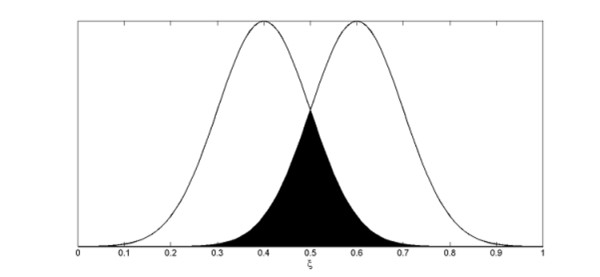
Viral quasispecies can be regarded as a swarm of genetically related mutants. A common approach employed to describe viral quasispecies is by means of the quasispecies equation (QE). However, a main criticism of QE is its lack of frequency-dependent selection. This can be overcome by an alternative formulation for the evolutionary dynamics: the replicator-mutator equation (RME). In turn, a problem with the RME is how to quantify the interaction coefficients between viral variants. Here, this is addressed by adopting an ecological perspective and resorting to the niche theory of competing communities, which assumes that the utilization of resources primarily determines ecological segregation between competing individuals (the different viral variants that constitute the quasispecies). This provides a theoretical framework to estimate quantitatively the fitness landscape.
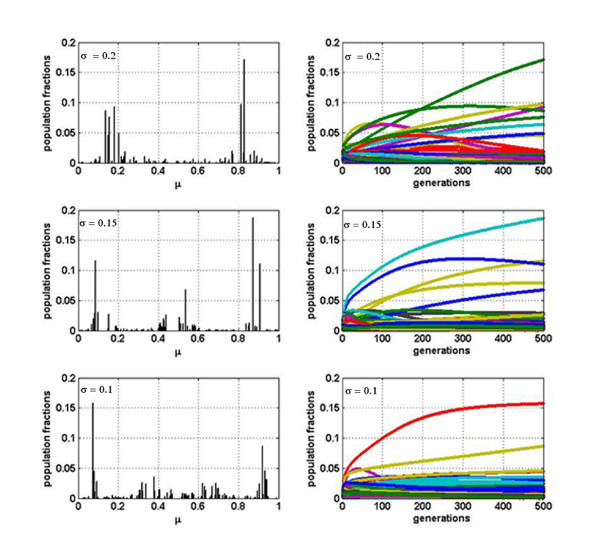
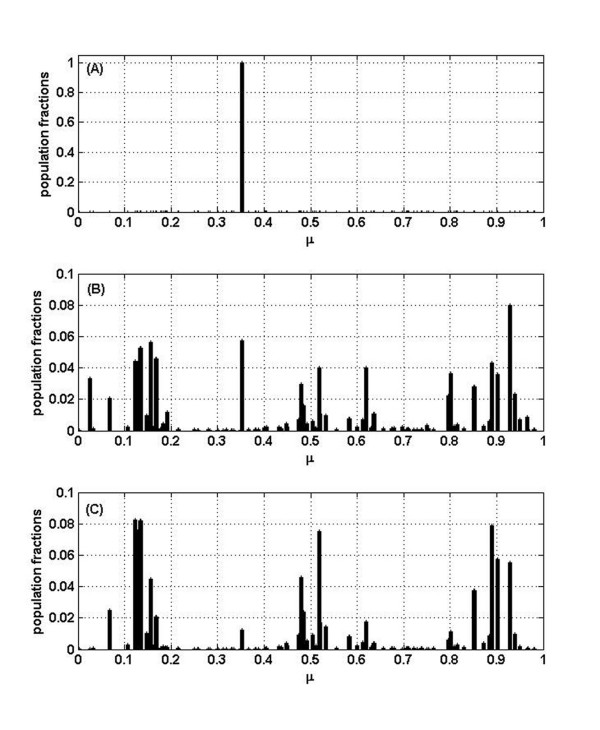
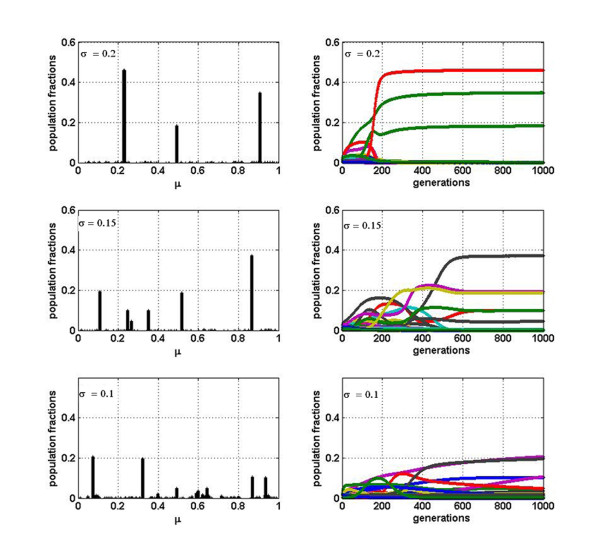
Using this novel combination of RME plus the ecological concept of niche overlapping for describing a quasispecies we explore the population distributions of viral variants that emerge, as well as the corresponding dynamics. We observe that the population distribution requires very long transients both to A) reach equilibrium and B) to show a clear dominating master sequence. Based on different independent and recent experimental evidence, we find that when some cooperation or facilitation between variants is included in appropriate doses we can solve both A) and B). We show that a useful quantity to calibrate the degree of cooperation is the Shannon entropy.
In order to get a typical quasispecies profile, at least within the considered mathematical approach, it seems that pure competition is not enough. Some dose of cooperation among viral variants is needed. This has several biological implications that might contribute to shed light on the mechanisms operating in quasispecies dynamics and to understand the quasispecies as a whole entity.
病毒准种可以被视为一群遗传相关的突变体。描述病毒准种的一种常见方法是通过准种方程(QE)。然而,QE 的一个主要批评是它缺乏频率依赖的选择。这可以通过进化动力学的替代公式:复制子-突变子方程(RME)来克服。反过来,RME 的一个问题是如何量化病毒变体之间的相互作用系数。在这里,通过采用生态视角并诉诸竞争群落的生态位理论来解决这个问题,该理论假设资源的利用主要决定了竞争个体(构成准种的不同病毒变体)之间的生态隔离。这为定量估计适应度景观提供了一个理论框架。
使用 RME 加上生态位重叠的生态概念的这种新组合来描述准种,我们探索了出现的病毒变体的种群分布以及相应的动力学。我们观察到,种群分布需要非常长的瞬态才能 A)达到平衡,B)显示出明显的主导主序列。基于不同的独立和最近的实验证据,我们发现当在适当剂量下包含变体之间的一些合作或促进时,我们可以解决 A)和 B)。我们表明,一个有用的校准合作程度的量是香农熵。
为了获得典型的准种分布,至少在考虑的数学方法内,似乎纯粹的竞争是不够的。需要病毒变体之间的一定剂量的合作。这有几个生物学意义,可能有助于阐明准种动力学中的机制,并将准种作为一个整体实体来理解。