Department of Nursing and Health Sciences, Institute of Health and Society, University of Oslo, PO Box 1153 Blindern, NO 0318 Oslo, Norway.
BMC Musculoskelet Disord. 2010 May 13;11:91. doi: 10.1186/1471-2474-11-91.
Recent studies have shown high prevalence rates for pelvic girdle pain (PGP) in pregnancy. Some risk factors for developing PGP have been suggested, but the evidence is weak. Furthermore there is almost no data on how findings from clinical examinations are related to subsequent PGP. The main purpose for this study was to study the associations between socio-demographical, psychological and clinical factors measured at inclusion in early pregnancy and disability or pain intensity in gestation week 30.
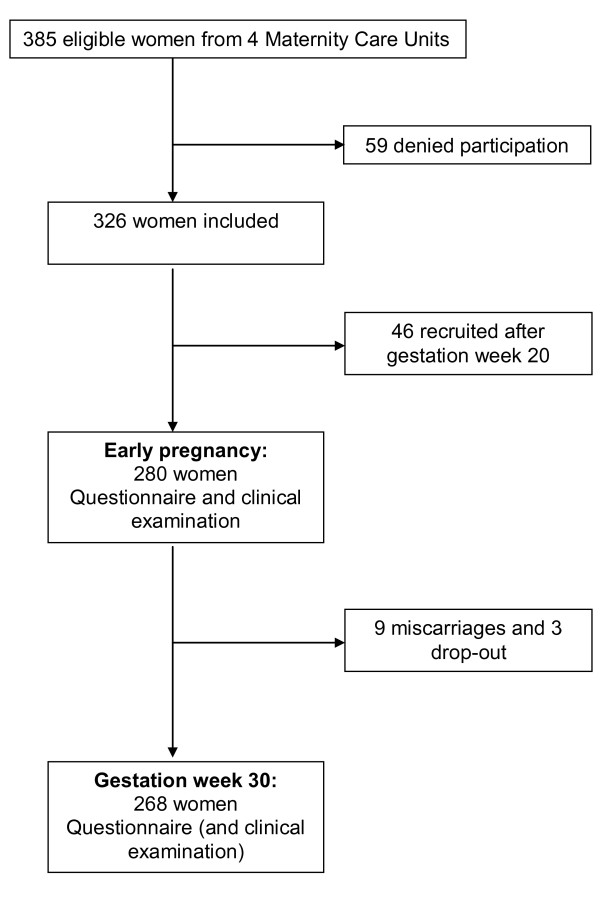
This is a prospective cohort study following women from early to late pregnancy. Eligible women were recruited at their first attendance at the maternity care unit. 268 pregnant women answered questionnaires and underwent clinical examinations in early pregnancy and in gestation week 30. We used scores on disability and pain intensity in gestation week 30 as outcome measures to capture the affliction level of PGP. Multiple linear regression analysis was used to study the associations between potential risk factors measured in early pregnancy and disability or pain intensity in gestation week 30.
Self-reported pain locations in the pelvis, positive posterior pelvic pain provocation (P4) test and a sum of pain provocation tests in early pregnancy were significantly associated with disability and pain intensity in gestation week 30 in a multivariable statistic model. In addition, distress was significantly associated with disability. The functional active straight leg raise (ASLR) test, fear avoidance beliefs and the number of pain sites were not significantly associated with either disability or pain intensity.
The results suggest that a clinical examination, including a few tests, performed in early pregnancy may identify women at risk of a more severe PGP late in pregnancy. The identification of clinical risk factors may provide a foundation for development of targeted prevention strategies.
最近的研究表明,妊娠期间骨盆带疼痛(PGP)的患病率很高。已经提出了一些发生 PGP 的危险因素,但证据薄弱。此外,关于临床检查结果与随后的 PGP 之间的关系的数据几乎没有。本研究的主要目的是研究在早孕时测量的社会人口统计学、心理和临床因素与妊娠 30 周时的残疾或疼痛强度之间的关联。
这是一项前瞻性队列研究,随访孕妇从早孕到晚期妊娠。符合条件的妇女在首次就诊于产科单位时被招募。268 名孕妇在早孕和妊娠 30 周时回答了问卷并接受了临床检查。我们使用妊娠 30 周时的残疾和疼痛强度评分作为结果测量指标,以捕捉 PGP 的发病程度。多元线性回归分析用于研究早孕时测量的潜在危险因素与妊娠 30 周时的残疾或疼痛强度之间的关联。
在多变量统计模型中,自我报告的骨盆疼痛部位、阳性后骨盆疼痛诱发试验(P4)和早孕时的疼痛诱发试验总和与妊娠 30 周时的残疾和疼痛强度显著相关。此外,痛苦与残疾显著相关。功能主动直腿抬高(ASLR)试验、恐惧回避信念和疼痛部位数量与残疾或疼痛强度均无显著相关性。
研究结果表明,在早孕时进行的包括少数几项检查在内的临床检查,可能可以识别出妊娠晚期更严重 PGP 的风险女性。确定临床危险因素可能为制定有针对性的预防策略提供基础。