Lancet Oncol. 2010 Jun;11(6):530-42. doi: 10.1016/S1470-2045(10)70095-4. Epub 2010 May 14.
Insulin-like growth factor 1 (IGF1) stimulates mitosis and inhibits apoptosis. Some published results have shown an association between circulating IGF1 and breast-cancer risk, but it has been unclear whether this relationship is consistent or whether it is modified by IGF binding protein 3 (IGFBP3), menopausal status, oestrogen receptor status or other factors. The relationship of IGF1 (and IGFBP3) with breast-cancer risk factors is also unclear. The Endogenous Hormones and Breast Cancer Collaborative Group was established to analyse pooled individual data from prospective studies to increase the precision of the estimated associations of endogenous hormones with breast-cancer risk.
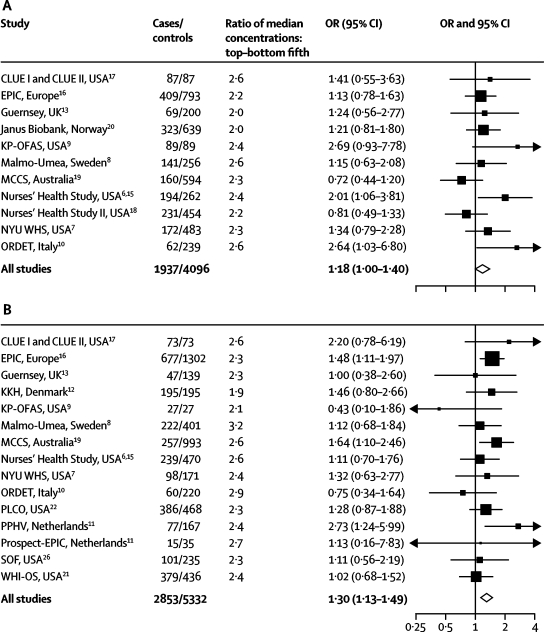
Individual data on prediagnostic IGF1 and IGFBP3 concentrations were obtained from 17 prospective studies in 12 countries. The associations of IGF1 with risk factors for breast cancer in controls were examined by calculating geometric mean concentrations in categories of these factors. The odds ratios (ORs) with 95% CIs of breast cancer associated with increasing IGF1 concentrations were estimated by conditional logistic regression in 4790 cases and 9428 matched controls, with stratification by study, age at baseline, and date of baseline. All statistical tests were two-sided, and a p value of less than 0.05 was considered significant.
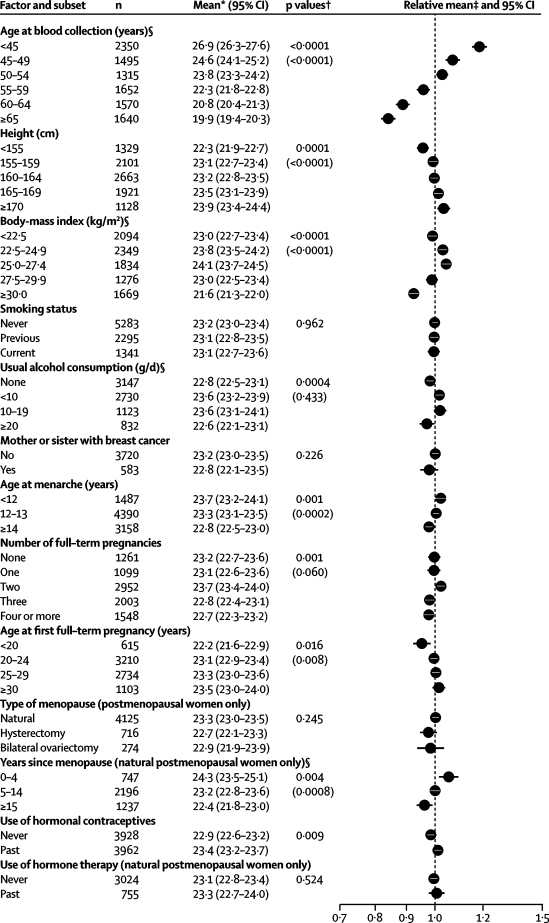
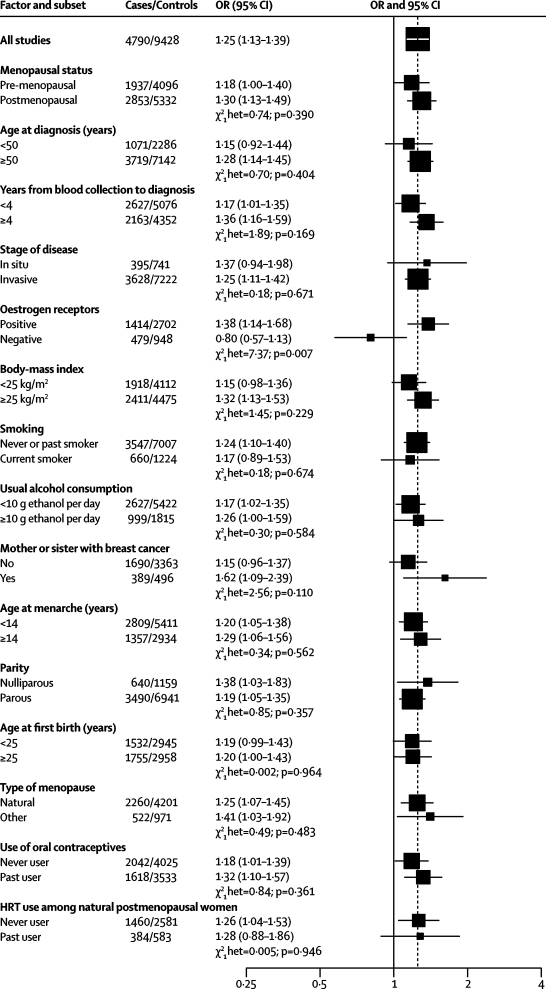
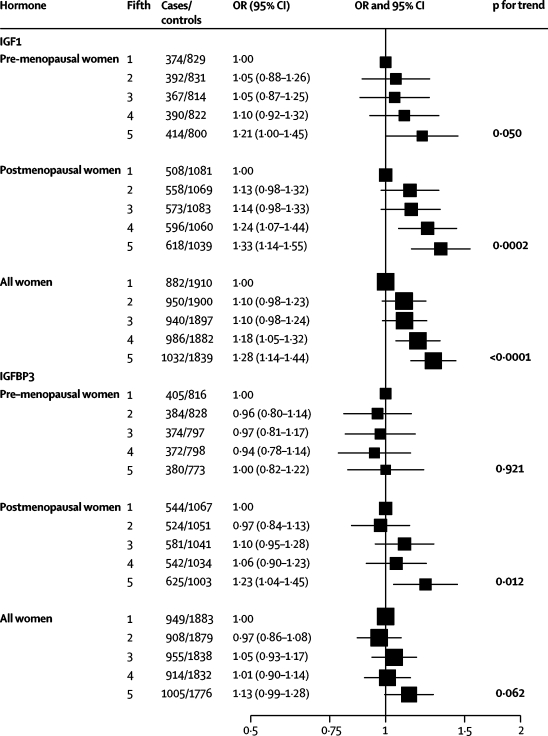
IGF1 concentrations, adjusted for age, were positively associated with height and age at first pregnancy, inversely associated with age at menarche and years since menopause, and were higher in moderately overweight women and moderate alcohol consumers than in other women. The OR for breast cancer for women in the highest versus the lowest fifth of IGF1 concentration was 1.28 (95% CI 1.14-1.44; p<0.0001). This association was not altered by adjusting for IGFBP3, and did not vary significantly by menopausal status at blood collection. The ORs for a difference in IGF1 concentration between the highest and lowest fifth were 1.38 (95% CI 1.14-1.68) for oestrogen-receptor-positive tumours and 0.80 (0.57-1.13) for oestrogen-receptor-negative tumours (p for heterogeneity=0.007).
Circulating IGF1 is positively associated with breast-cancer risk. The association is not substantially modified by IGFBP3, and does not differ markedly by menopausal status, but seems to be confined to oestrogen-receptor-positive tumours.
Cancer Research UK.
胰岛素样生长因子 1(IGF1)可刺激有丝分裂并抑制细胞凋亡。一些已发表的研究结果表明,循环 IGF1 与乳腺癌风险之间存在关联,但尚不清楚这种关系是否一致,或者是否受 IGF 结合蛋白 3(IGFBP3)、绝经状态、雌激素受体状态或其他因素的影响。IGF1(和 IGFBP3)与乳腺癌危险因素的关系也不清楚。为了分析内源性激素与乳腺癌风险的关联,建立了内源性激素与乳腺癌合作组,以分析来自 12 个国家 17 项前瞻性研究的个体数据,以提高估计内源性激素与乳腺癌风险关联的精度。
从 12 个国家的 17 项前瞻性研究中获得了 IGF1 和 IGFBP3 浓度的个体数据。通过计算这些因素分类中的几何平均浓度,检查 IGF1 与乳腺癌危险因素之间的关联。在 4790 例病例和 9428 例匹配对照中,通过条件逻辑回归估计与 IGF1 浓度增加相关的乳腺癌的比值比(OR)及其 95%置信区间(CI),并按研究、基线时的年龄和基线时的日期进行分层。所有统计检验均为双侧,p 值小于 0.05 被认为具有统计学意义。
调整年龄后,IGF1 浓度与身高和首次妊娠年龄呈正相关,与初潮年龄和绝经后年限呈负相关,在中度超重和中度饮酒的女性中高于其他女性。IGF1 浓度最高与最低五分之一的女性乳腺癌比值比为 1.28(95%CI 1.14-1.44;p<0.0001)。这种关联在调整 IGFBP3 后没有改变,并且在采血时的绝经状态上没有显著差异。IGF1 浓度最高与最低五分之一之间的差异的 OR 为 1.38(95%CI 1.14-1.68),对于雌激素受体阳性肿瘤,OR 为 0.80(0.57-1.13)(异质性 p 值=0.007)。
循环 IGF1 与乳腺癌风险呈正相关。该关联不受 IGFBP3 显著影响,绝经状态差异不明显,但似乎仅限于雌激素受体阳性肿瘤。
英国癌症研究中心。