Department of Internal Medicine and Rheumatology, Juntendo University School of Medicine, 2-1-1 Hongo, Bunkyo-ku, Tokyo, 113-8421, Japan.
Arthritis Res Ther. 2010;12(3):R92. doi: 10.1186/ar3019. Epub 2010 May 18.
Targeting joint destruction induced by osteoclasts (OCs) is critical for management of patients with rheumatoid arthritis (RA). Since phosphoinositide 3-kinase (PI3-K) plays a critical role in osteoclastogenesis and bone resorption, we examined the effects of ZSTK474, a novel phosphoinositide 3-kinase (PI3-K)-specific inhibitor, on murine OCs in vitro and in vivo.
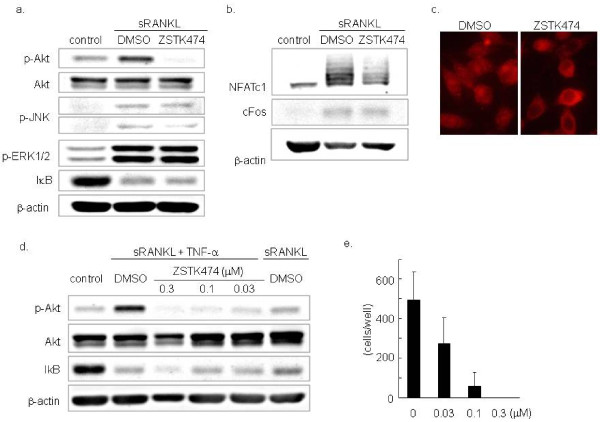
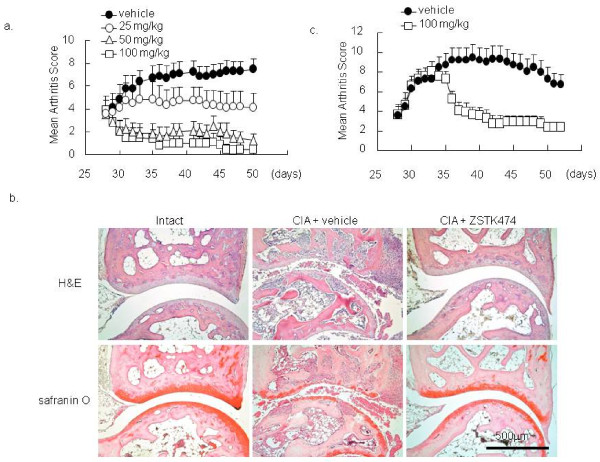
The inhibitory effect of ZSTK474 on OC formation was determined and compared with other PI3-K inhibitors by counting tartrate-resistant acid phosphatase (TRAP)-positive multinucleated cells after culturing murine bone marrow monocytic OC precursors, and RAW264.7 cells. Activation of Akt and expression of nuclear factor of activated T cells (NFAT) c1 in cultured RAW264.7 cells were examined. The suppressing effect of ZSTK474 on bone resorption was assessed by the pit formation assay. The in vivo effects of ZSTK474 were studied in collagen-induced arthritis (CIA) in the mouse. Oral daily administration of ZSTK474 was started either when more than half or when all mice developed arthritis. Effects of ZSTK474 were evaluated using the arthritis score and histological score of the hind paws.
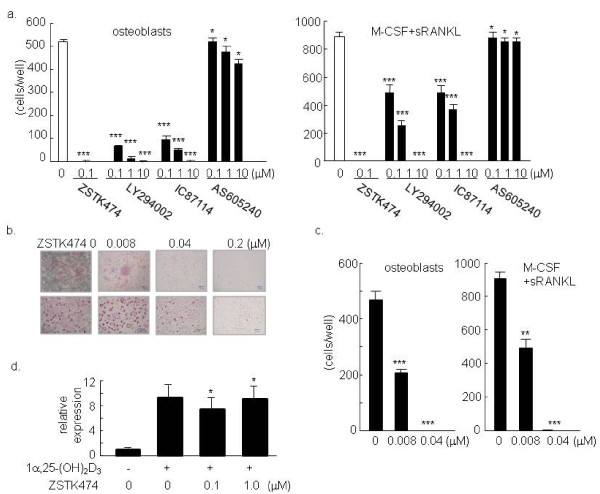
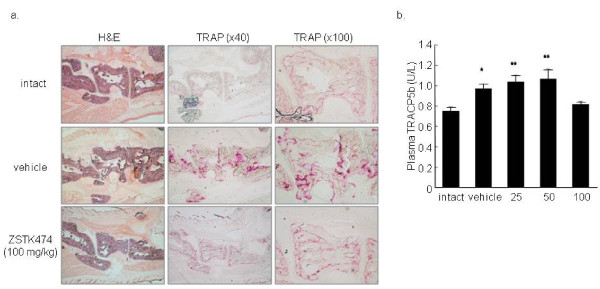
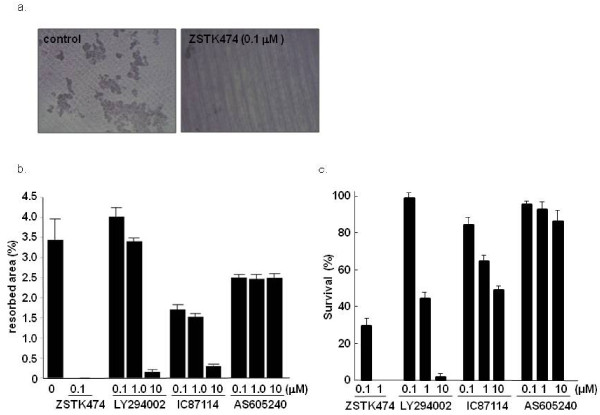
ZSTK474 inhibited the differentiation of bone marrow OC precursors and RAW264.7 cells in a dose-dependent manner. The inhibitory effect of ZSTK474 was much stronger than that of LY294002, the most commonly used PI3-K inhibitor. In addition, ZSTK474 suppressed the bone resorbing activity of mature OCs. Moreover, oral daily administration of ZSTK474, even when begun after the development of arthritis, ameliorated CIA in mice without apparent toxicity. Histological examination of the hind paw demonstrated noticeable reduction of inflammation and of cartilage destruction in ZSTK474-treated mice. ZSTK474 also significantly decreased OC formation adjacent to the tarsal bone of the hind paw.
These findings suggest that inhibition of PI3-K with ZSTK474 may potentially suppress synovial inflammation and bone destruction in patients with RA.
针对破骨细胞(OCs)诱导的关节破坏对于类风湿关节炎(RA)患者的治疗至关重要。由于磷酸肌醇 3-激酶(PI3-K)在破骨细胞生成和骨吸收中发挥关键作用,我们研究了新型磷酸肌醇 3-激酶(PI3-K)特异性抑制剂 ZSTK474 对体外和体内小鼠破骨细胞的影响。
通过在培养鼠骨髓单核细胞破骨细胞前体和 RAW264.7 细胞后计数抗酒石酸酸性磷酸酶(TRAP)阳性多核细胞,来确定 ZSTK474 对 OC 形成的抑制作用,并与其他 PI3-K 抑制剂进行比较。检测培养的 RAW264.7 细胞中 Akt 的激活和活化 T 细胞核因子(NFAT)c1 的表达。通过陷窝形成试验评估 ZSTK474 对骨吸收的抑制作用。在胶原诱导的关节炎(CIA)小鼠中研究 ZSTK474 的体内作用。当超过一半或所有小鼠出现关节炎时,开始每日口服 ZSTK474 给药。通过关节炎评分和后爪组织学评分评估 ZSTK474 的作用。
ZSTK474 以剂量依赖性方式抑制骨髓 OC 前体和 RAW264.7 细胞的分化。ZSTK474 的抑制作用比最常用的 PI3-K 抑制剂 LY294002 强得多。此外,ZSTK474 抑制成熟 OC 的骨吸收活性。此外,即使在关节炎发生后开始每日口服 ZSTK474 给药,也能改善 CIA 小鼠而无明显毒性。后爪组织学检查显示 ZSTK474 治疗的小鼠炎症和软骨破坏明显减少。ZSTK474 还显著减少了后爪跗骨附近的 OC 形成。
这些发现表明,用 ZSTK474 抑制 PI3-K 可能潜在地抑制 RA 患者的滑膜炎症和骨破坏。