School of Applied Sciences, RMIT University, Australia.
Ann Clin Microbiol Antimicrob. 2010 May 27;9:16. doi: 10.1186/1476-0711-9-16.
Coagulase-negative staphylococci are major causes of bloodstream infections in very low birth weight babies cared for in Neonatal Intensive Care Units. The virulence of these bacteria is mainly due to their ability to form biofilms on indwelling medical devices. Biofilm-related infections often fail to respond to antibiotic chemotherapy guided by conventional antibiotic susceptibility tests.
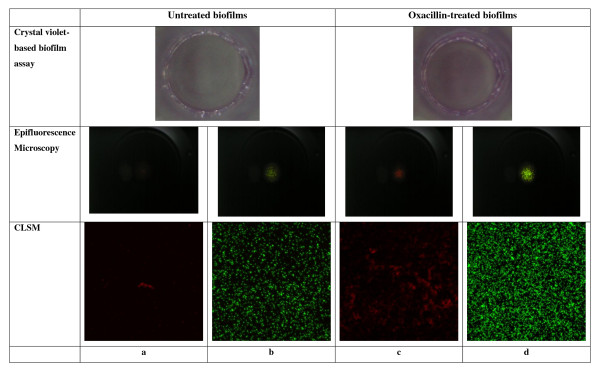
Coagulase-negative staphylococcal blood culture isolates were grown in different phases relevant to biofilm formation: planktonic cells at mid-log phase, planktonic cells at stationary phase, adherent monolayers and mature biofilms and their susceptibilities to conventional antibiotics were assessed. The effects of oxacillin, gentamicin, and vancomycin on preformed biofilms, at the highest achievable serum concentrations were examined. Epifluorescence microscopy and confocal laser scanning microscopy in combination with bacterial viability staining and polysaccharide staining were used to confirm the stimulatory effects of antibiotics on biofilms.
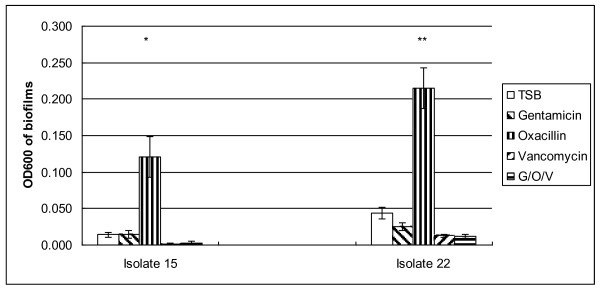
Most coagulase-negative staphylococcal clinical isolates were resistant to penicillin G (100%), gentamicin (83.3%) and oxacillin (91.7%) and susceptible to vancomycin (100%), ciprofloxacin (100%), and rifampicin (79.2%). Bacteria grown as adherent monolayers showed similar susceptibilities to their planktonic counterparts at mid-log phase. Isolates in a biofilm growth mode were more resistant to antibiotics than both planktonic cultures at mid-log phase and adherent monolayers; however they were equally resistant or less resistant than planktonic cells at stationary phase. Moreover, for some cell-wall active antibiotics, concentrations higher than conventional MICs were required to prevent the establishment of planktonic cultures from biofilms. Finally, the biofilm-growth of two S. capitis isolates could be enhanced by oxacillin at the highest achievable serum concentration.
We conclude that the resistance of coagulase-negative staphylococci to multiple antibiotics initially remain similar when the bacteria shift from a planktonic growth mode into an early attached mode, then increase significantly as the adherent mode further develops. Furthermore, preformed biofilms of some CoNS are enhanced by oxacillin in a dose-dependent manner.
凝固酶阴性葡萄球菌是新生儿重症监护病房极低出生体重儿血流感染的主要原因。这些细菌的毒力主要归因于它们在留置医疗器械上形成生物膜的能力。生物膜相关感染通常无法对抗常规抗生素药敏试验指导的抗生素化疗。
将凝固酶阴性葡萄球菌血培养分离株在与生物膜形成相关的不同阶段进行培养:对数中期的浮游细胞、静止期的浮游细胞、贴壁单层和成熟生物膜,并评估它们对常规抗生素的敏感性。检测了最高可达血清浓度的苯唑西林、庆大霉素和万古霉素对已形成的生物膜的影响。使用荧光显微镜和共聚焦激光扫描显微镜结合细菌活力染色和多糖染色来确认抗生素对生物膜的刺激作用。
大多数凝固酶阴性葡萄球菌临床分离株对青霉素 G(100%)、庆大霉素(83.3%)和苯唑西林(91.7%)耐药,对万古霉素(100%)、环丙沙星(100%)和利福平(79.2%)敏感。以附着单层生长的细菌对其对数中期浮游细胞的药敏性相似。生物膜生长模式的分离株对抗生素的耐药性高于对数中期的浮游培养物和附着单层;然而,它们与静止期的浮游细胞的耐药性相同或更低。此外,对于一些细胞壁活性抗生素,需要高于常规 MIC 的浓度来防止浮游培养物从生物膜中建立。最后,在最高可达血清浓度下,两种 S. capitis 分离株的生物膜生长可以被苯唑西林增强。
我们得出结论,凝固酶阴性葡萄球菌从浮游生长模式转变为早期附着模式时,对多种抗生素的耐药性最初保持相似,然后随着附着模式的进一步发展,耐药性显著增加。此外,一些 CoNS 的预形成生物膜以剂量依赖的方式被苯唑西林增强。