Department of Medicine, University of Washington School of Medicine, 1959 NE Pacific St, Seattle, WA, USA.
BMC Cancer. 2010 May 28;10:244. doi: 10.1186/1471-2407-10-244.
Estrogens suppress tumor growth in prostate cancer which progresses despite anorchid serum androgen levels, termed castration resistant prostate cancers (CRPC), although the mechanisms are unclear. We hypothesize that estrogen inhibits CRPC in anorchid animals by suppressing tumoral androgens, an effect independent of the estrogen receptor.
The human CRPC xenograft LuCaP 35V was implanted into orchiectomized male SCID mice and established tumors were treated with placebo, 17beta-estradiol or 17beta-estradiol and estrogen receptor antagonist ICI 182,780. Effects of 17beta-estradiol on tumor growth were evaluated and tissue testosterone (T) and dihydrotestosterone (DHT) evaluated by mass spectrometry.
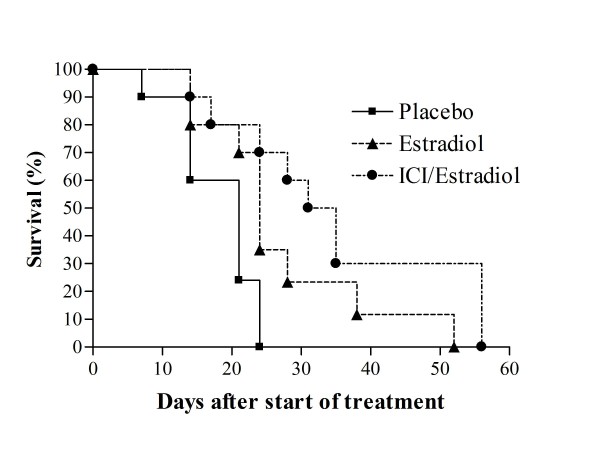
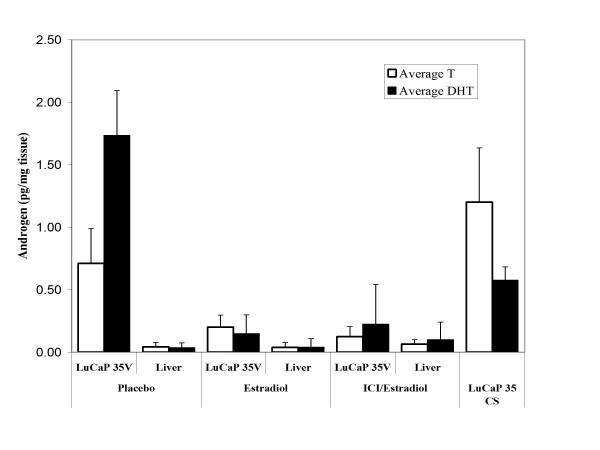
Treatment of LuCaP 35V with 17beta-estradiol slowed tumor growth compared to controls (tumor volume at day 21: 785 +/- 81 mm3 vs. 1195 +/- 84 mm3, p = 0.002). Survival was also significantly improved in animals treated with 17beta-estradiol (p = 0.03). The addition of the estrogen receptor antagonist ICI 182,780 did not significantly change survival or growth. 17beta-estradiol in the presence and absence of ICI 182,780 suppressed tumor testosterone (T) and dihydrotestosterone (DHT) as assayed by mass spectrometry. Tissue androgens in placebo treated LuCaP 35V xenografts were; T = 0.71 +/- 0.28 pg/mg and DHT = 1.73 +/- 0.36 pg/mg. In 17beta-estradiol treated LuCaP35V xenografts the tissue androgens were, T = 0.20 +/- 0.10 pg/mg and DHT = 0.15 +/- 0.15 pg/mg, (p < 0.001 vs. controls). Levels of T and DHT in control liver tissue were < 0.2 pg/mg.
CRPC in anorchid animals maintains tumoral androgen levels despite castration. 17beta-estradiol significantly suppressed tumor T and DHT and inhibits growth of CRPC in an estrogen receptor independent manner. The ability to manipulate tumoral androgens will be critical in the development and testing of agents targeting CRPC through tissue steroidogenesis.
尽管去势血清雄激素水平(称为去势抵抗性前列腺癌 [CRPC])仍会导致前列腺癌肿瘤生长,但雌激素可抑制其生长,但其机制尚不清楚。我们假设雌激素通过抑制肿瘤雄激素来抑制去势动物中的 CRPC,这种作用与雌激素受体无关。
将人 CRPC 异种移植物 LuCaP 35V 植入去势雄性 SCID 小鼠中,并建立肿瘤,然后用安慰剂、17β-雌二醇或 17β-雌二醇和雌激素受体拮抗剂 ICI 182,780 进行治疗。通过质谱法评估 17β-雌二醇对肿瘤生长的影响,并评估组织睾酮(T)和二氢睾酮(DHT)。
与对照组相比,用 17β-雌二醇治疗 LuCaP 35V 可减缓肿瘤生长(第 21 天的肿瘤体积:785±81mm3 与 1195±84mm3,p=0.002)。用 17β-雌二醇治疗的动物的生存时间也显著改善(p=0.03)。添加雌激素受体拮抗剂 ICI 182,780 并没有显著改变生存时间或生长情况。17β-雌二醇在存在和不存在 ICI 182,780 的情况下均可抑制肿瘤睾酮(T)和二氢睾酮(DHT),这可通过质谱法检测到。安慰剂治疗的 LuCaP 35V 异种移植物中的组织雄激素为:T=0.71±0.28pg/mg,DHT=1.73±0.36pg/mg。在 17β-雌二醇治疗的 LuCaP35V 异种移植物中,组织雄激素为:T=0.20±0.10pg/mg,DHT=0.15±0.15pg/mg(p<0.001 与对照组相比)。对照肝组织中的 T 和 DHT 水平均<0.2pg/mg。
去势雄性动物中的 CRPC 尽管去势,但仍维持肿瘤雄激素水平。17β-雌二醇可显著抑制肿瘤 T 和 DHT,并以雌激素受体非依赖性方式抑制 CRPC 的生长。通过组织甾体生成来操纵肿瘤雄激素的能力对于开发和测试针对 CRPC 的药物至关重要。