Koshikawa Shigeyuki, Cornette Richard, Matsumoto Tadao, Miura Toru
Graduate School of Environmental Science, Hokkaido University, Sapporo 060-0810, Japan.
BMC Dev Biol. 2010 Jun 8;10:63. doi: 10.1186/1471-213X-10-63.
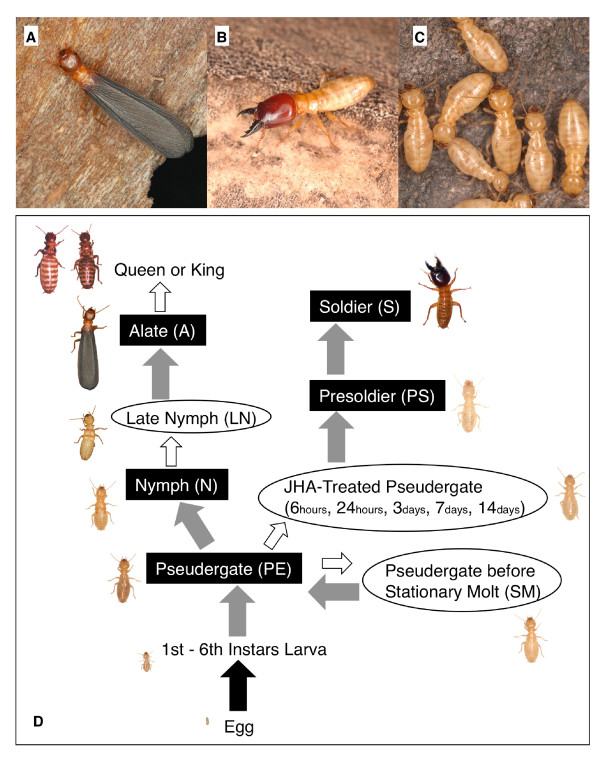
Caste differentiation in social insects is a type of polyphenism that enables division of labor among members of a colony. This elaborate social integration has attracted broad interest, although little is known about its regulatory mechanisms, especially in Isoptera (termites). In this study, we analyzed soldier differentiation in the damp-wood termite Hodotermopsis sjostedti, focusing on a possible effector gene for caste development. The gene for an actin-binding protein, HsjCib, which shows a high level of expression in developing mandibles during soldier differentiation, is characterized in detail.
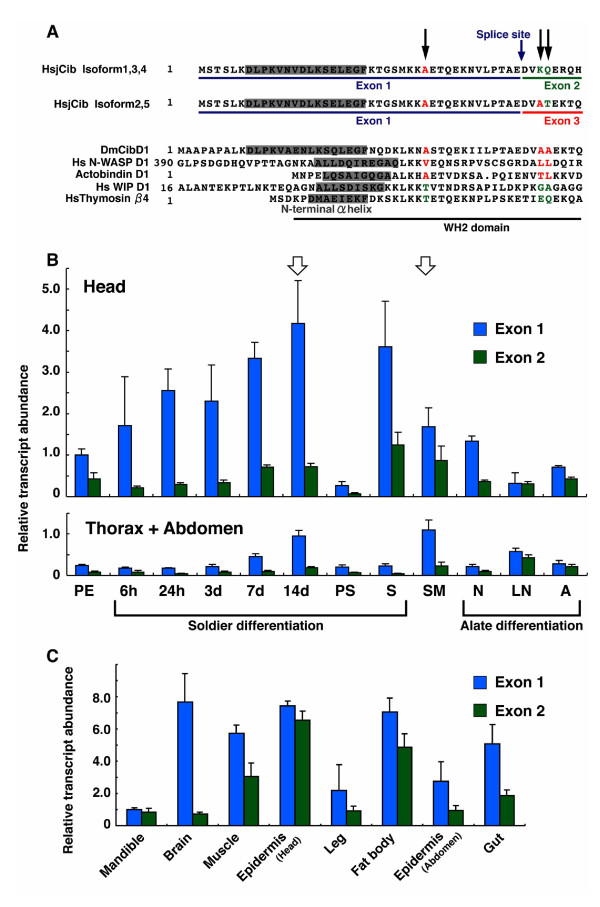
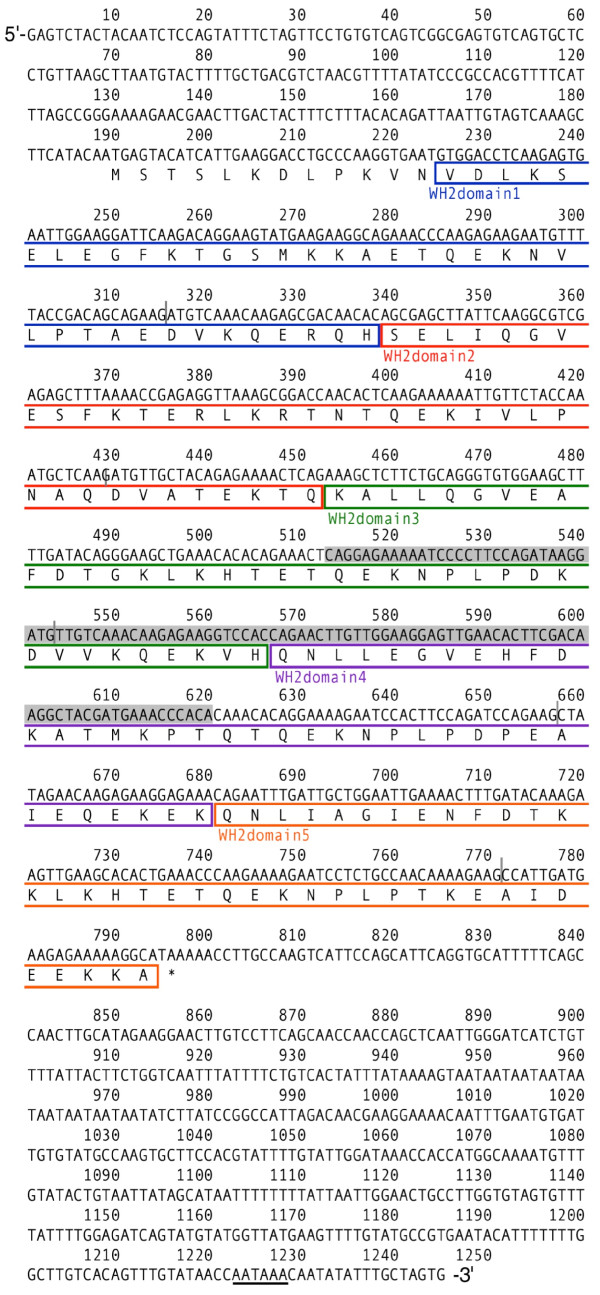
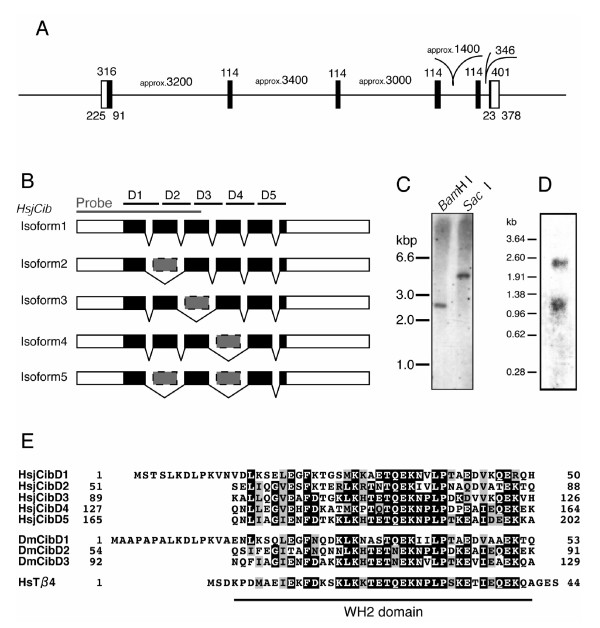
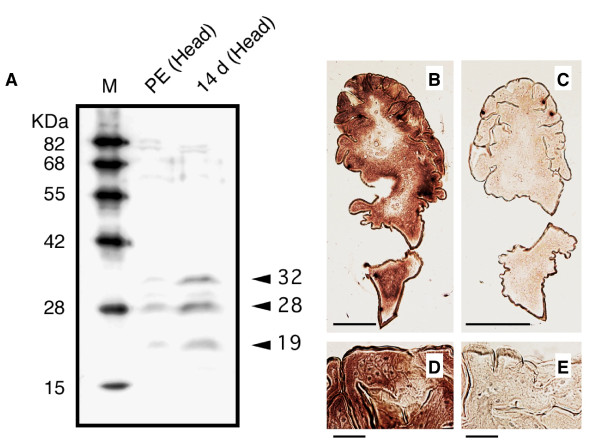
To examine the HsjCib gene, full-length cDNAs were obtained by rapid amplification of cDNA ends-polymerase chain reaction (RACE-PCR) and sequencing. Multiple isoforms were identified, and on the basis of the results of northern and Southern hybridization analyses, these isoforms were considered to be transcriptional variants from a single gene. On the basis of their sequence similarity to homologous genes of other organisms, functions in actin assembly were assumed to be different among isoforms. Expression analysis revealed high expression in the head during soldier differentiation, which was consistent with their allometric growth. Although isoform expression was observed in various tissues, different expression levels were observed among tissues, suggesting the possibility of tissue-specific morphogenetic regulation by HsjCib isoforms.
This study revealed the characteristics and dynamics of the HsjCib gene during soldier differentiation as a potential representative of downstream effector genes in caste-specific morphogenesis. From the expression patterns observed, this gene is considered to be involved in cephalic morphogenesis and neural reorganization, resulting in the establishment of caste-specific morphology and behavior.
社会昆虫中的 caste 分化是一种多型现象,它使得蚁群成员之间能够进行劳动分工。这种精细的社会整合引起了广泛关注,尽管对其调控机制知之甚少,尤其是在等翅目(白蚁)中。在本研究中,我们分析了湿木白蚁 Hodotermopsis sjostedti 的兵蚁分化,重点关注 caste 发育的一个可能的效应基因。详细表征了一种肌动蛋白结合蛋白 HsjCib 的基因,该基因在兵蚁分化过程中发育的上颚中表现出高水平的表达。
为了研究 HsjCib 基因,通过 cDNA 末端快速扩增 - 聚合酶链反应(RACE - PCR)和测序获得了全长 cDNA。鉴定出了多个异构体,基于 Northern 和 Southern 杂交分析的结果,这些异构体被认为是来自单个基因的转录变体。根据它们与其他生物体同源基因的序列相似性,推测异构体在肌动蛋白组装中的功能不同。表达分析显示在兵蚁分化过程中头部高表达,这与它们的异速生长一致。尽管在各种组织中都观察到了异构体表达,但不同组织之间观察到了不同的表达水平,这表明 HsjCib 异构体可能存在组织特异性形态发生调控。
本研究揭示了 HsjCib 基因在兵蚁分化过程中的特征和动态,作为 caste 特异性形态发生中潜在的下游效应基因的代表。从观察到的表达模式来看,该基因被认为参与头部形态发生和神经重组,从而导致 caste 特异性形态和行为的建立。