Department of Computer Science, Tufts University, Medford, MA, USA.
Bioinformatics. 2010 Jun 15;26(12):i287-93. doi: 10.1093/bioinformatics/btq199.
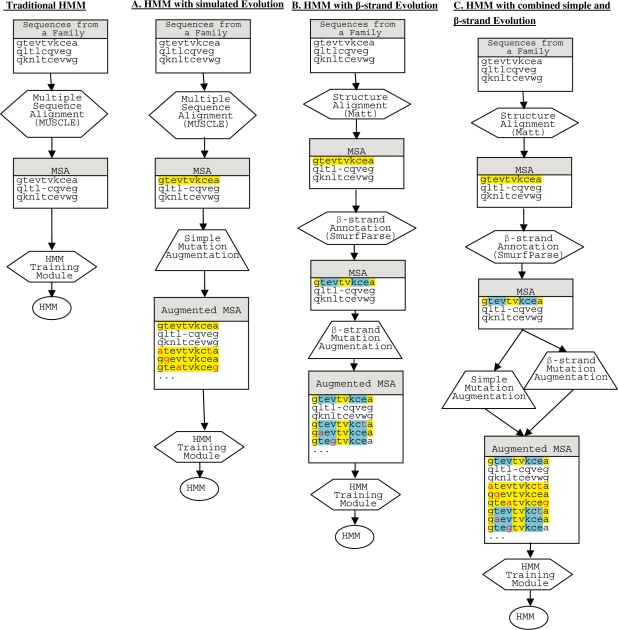
One of the most successful methods to date for recognizing protein sequences that are evolutionarily related, has been profile hidden Markov models. However, these models do not capture pairwise statistical preferences of residues that are hydrogen bonded in beta-sheets. We thus explore methods for incorporating pairwise dependencies into these models.
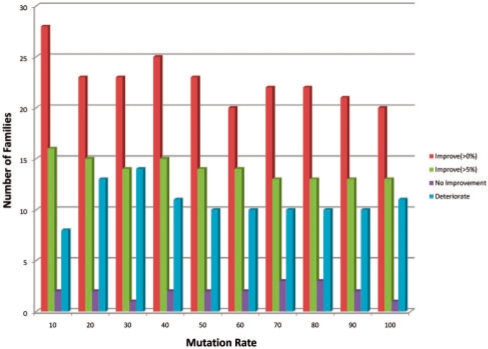
We consider the remote homology detection problem for beta-structural motifs. In particular, we ask if a statistical model trained on members of only one family in a SCOP beta-structural superfamily, can recognize members of other families in that superfamily. We show that HMMs trained with our pairwise model of simulated evolution achieve nearly a median 5% improvement in AUC for beta-structural motif recognition as compared to ordinary HMMs.
All datasets and HMMs are available at: http://bcb.cs.tufts.edu/pairwise/.
迄今为止,用于识别进化相关蛋白质序列的最成功方法之一是轮廓隐马尔可夫模型。然而,这些模型无法捕获β-折叠中氢键结合的残基的成对统计偏好。因此,我们探索了将成对相关性纳入这些模型的方法。
我们考虑了β-结构基序的远程同源检测问题。具体来说,我们询问一个仅在 SCOP β-结构超家族中的一个家族成员上训练的统计模型,是否可以识别该超家族中的其他家族成员。我们表明,与普通隐马尔可夫模型相比,使用我们的模拟进化成对模型训练的隐马尔可夫模型在β-结构基序识别方面的 AUC 几乎提高了 5%。
所有数据集和隐马尔可夫模型均可在以下网址获得:http://bcb.cs.tufts.edu/pairwise/。