Department of Pathobiology, University of Guelph, Guelph, Ontario, Canada.
PLoS One. 2010 May 24;5(5):e10795. doi: 10.1371/journal.pone.0010795.
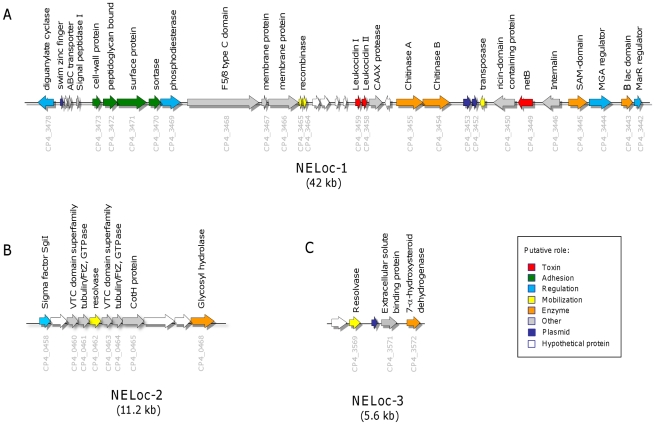
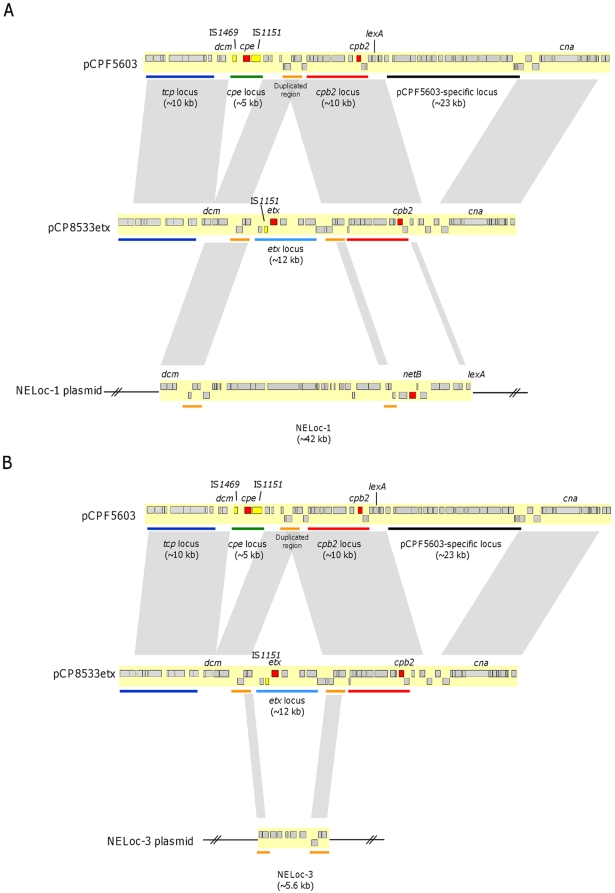
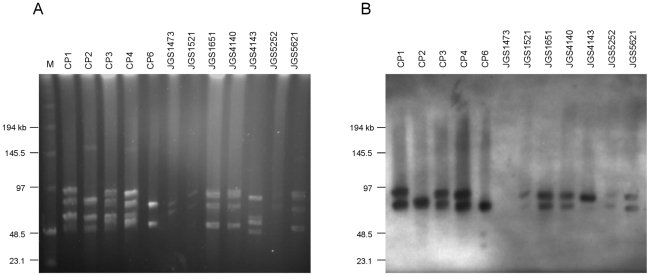
Type A Clostridium perfringens causes poultry necrotic enteritis (NE), an enteric disease of considerable economic importance, yet can also exist as a member of the normal intestinal microbiota. A recently discovered pore-forming toxin, NetB, is associated with pathogenesis in most, but not all, NE isolates. This finding suggested that NE-causing strains may possess other virulence gene(s) not present in commensal type A isolates. We used high-throughput sequencing (HTS) technologies to generate draft genome sequences of seven unrelated C. perfringens poultry NE isolates and one isolate from a healthy bird, and identified additional novel NE-associated genes by comparison with nine publicly available reference genomes. Thirty-one open reading frames (ORFs) were unique to all NE strains and formed the basis for three highly conserved NE-associated loci that we designated NELoc-1 (42 kb), NELoc-2 (11.2 kb) and NELoc-3 (5.6 kb). The largest locus, NELoc-1, consisted of netB and 36 additional genes, including those predicted to encode two leukocidins, an internalin-like protein and a ricin-domain protein. Pulsed-field gel electrophoresis (PFGE) and Southern blotting revealed that the NE strains each carried 2 to 5 large plasmids, and that NELoc-1 and -3 were localized on distinct plasmids of sizes approximately 85 and approximately 70 kb, respectively. Sequencing of the regions flanking these loci revealed similarity to previously characterized conjugative plasmids of C. perfringens. These results provide significant insight into the pathogenetic basis of poultry NE and are the first to demonstrate that netB resides in a large, plasmid-encoded locus. Our findings strongly suggest that poultry NE is caused by several novel virulence factors, whose genes are clustered on discrete pathogenicity loci, some of which are plasmid-borne.
A型产气荚膜梭菌可引起禽类坏死性肠炎(NE),这是一种具有重要经济意义的肠道疾病,但也可以作为正常肠道微生物群的一员存在。最近发现的一种形成孔的毒素 NetB 与大多数(但不是全部)NE 分离株的发病机制有关。这一发现表明,引起 NE 的菌株可能具有其他不在共生型 A 分离株中存在的毒力基因。我们使用高通量测序(HTS)技术生成了七个不相关的 C. perfringens 禽类 NE 分离株和一个来自健康鸟类的分离株的基因组草图序列,并通过与九个公开可用的参考基因组进行比较,鉴定了其他新的与 NE 相关的基因。三十一个开放阅读框(ORF)是所有 NE 株所特有的,形成了三个高度保守的 NE 相关基因座的基础,我们将其命名为 NELoc-1(42kb)、NELoc-2(11.2kb)和 NELoc-3(5.6kb)。最大的基因座 NELoc-1 由 netB 和 36 个额外的基因组成,包括那些预测编码两种白细胞毒素、一种内膜蛋白和一种蓖麻毒素结构域蛋白的基因。脉冲场凝胶电泳(PFGE)和 Southern 印迹显示,NE 株各自携带 2 到 5 个大质粒,NELoc-1 和 -3 分别位于大小约为 85kb 和 70kb 的不同质粒上。这些基因座侧翼区域的测序显示与 C. perfringens 先前表征的可接合质粒具有相似性。这些结果为禽类 NE 的发病机制提供了重要的见解,并且首次证明 netB 位于一个大型、质粒编码的基因座中。我们的研究结果强烈表明,禽类 NE 是由几种新的毒力因子引起的,其基因聚集在离散的致病性基因座上,其中一些位于质粒上。