Department of Pathology, Unit of Molecular Pathology, VU University Medical Center, PO box 7057, 1007 MB Amsterdam, the Netherlands.
BMC Cancer. 2010 Jun 9;10:271. doi: 10.1186/1471-2407-10-271.
Activation of telomerase resulting from deregulated hTERT expression is a key event during high-risk human papillomavirus (hrHPV)-induced cervical carcinogenesis. In the present study we examined hTERT promoter activity and its relation to DNA methylation as one of the potential mechanisms underlying deregulated hTERT transcription in hrHPV-transformed cells.
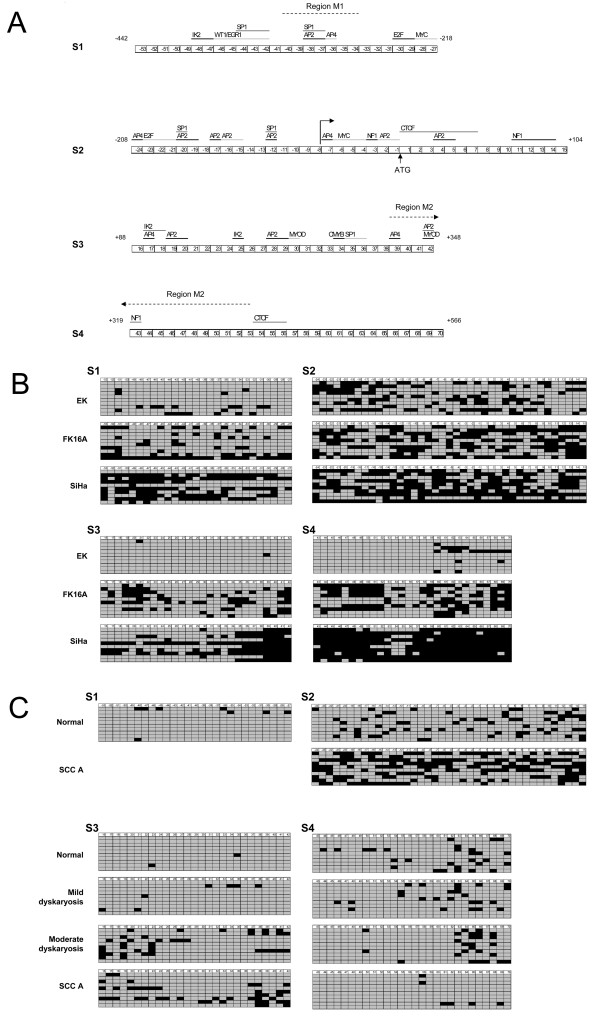
Using luciferase reporter assays we analyzed hTERT promoter activity in primary keratinocytes, HPV16- and HPV18-immortalized keratinocyte cell lines and cervical cancer cell lines. In the same cells as well as cervical specimens we determined hTERT methylation by bisulfite sequencing analysis of the region spanning -442 to +566 (relative to the ATG) and quantitative methylation specific PCR (qMSP) analysis of two regions flanking the hTERT core promoter.
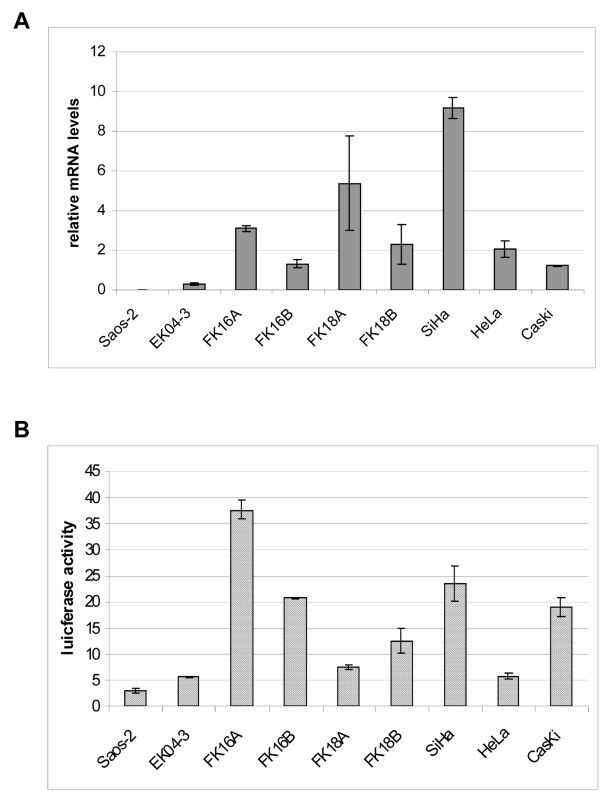
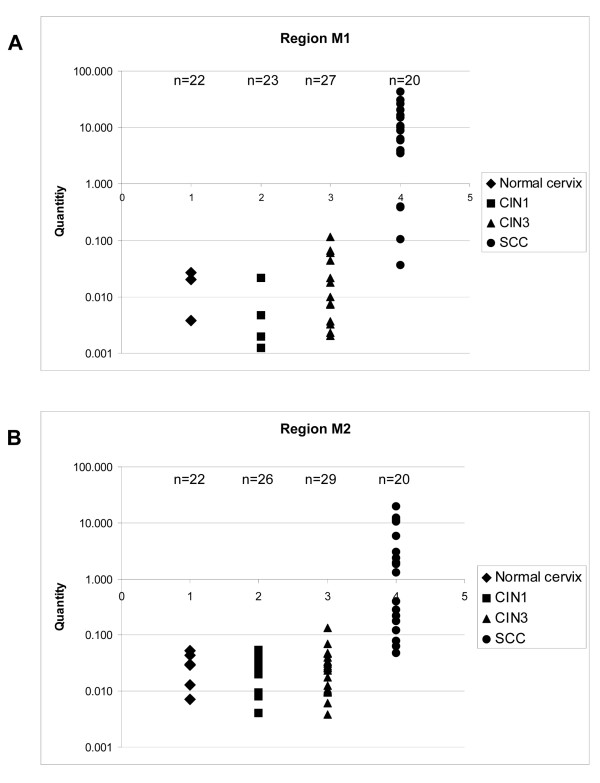
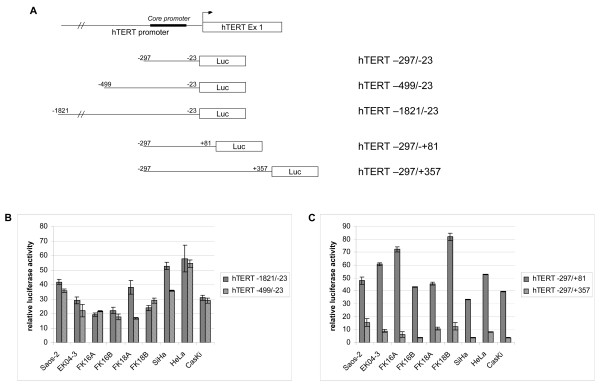
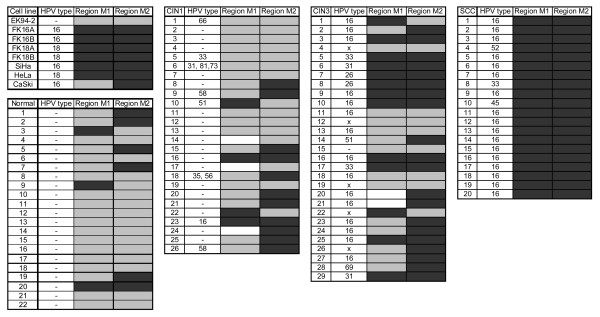
We found that in most telomerase positive cells increased hTERT core promoter activity coincided with increased hTERT mRNA expression. On the other hand basal hTERT promoter activity was also detected in telomerase negative cells with no or strongly reduced hTERT mRNA expression levels. In both telomerase positive and negative cells regulatory sequences flanking both ends of the core promoter markedly repressed exogenous promoter activity.By extensive bisulfite sequencing a strong increase in CpG methylation was detected in hTERT positive cells compared to cells with no or strongly reduced hTERT expression. Subsequent qMSP analysis of a larger set of cervical tissue specimens revealed methylation of both regions analyzed in 100% of cervical carcinomas and 38% of the high-grade precursor lesions, compared to 9% of low grade precursor lesions and 5% of normal controls.
Methylation of transcriptionally repressive sequences in the hTERT promoter and proximal exonic sequences is correlated to deregulated hTERT transcription in HPV-immortalized cells and cervical cancer cells. The detection of DNA methylation at these repressive regions may provide an attractive biomarker for early detection of cervical cancer.
端粒酶的激活是高危型人乳头瘤病毒(hrHPV)诱导宫颈癌发生的关键事件,这归因于 hTERT 表达失控。本研究旨在探讨 hTERT 启动子活性及其与 DNA 甲基化的关系,这是 hTERT 转录失控的潜在机制之一,而 hTERT 转录失控发生在 hrHPV 转化细胞中。
利用荧光素酶报告基因检测,我们分析了原代角质形成细胞、HPV16 和 HPV18 永生化角质形成细胞系和宫颈癌细胞系中的 hTERT 启动子活性。在相同的细胞以及宫颈标本中,我们通过跨越 -442 至 +566(相对于 ATG)的区域的亚硫酸氢盐测序分析和 hTERT 核心启动子侧翼的两个区域的定量甲基化特异性 PCR(qMSP)分析来确定 hTERT 甲基化。
我们发现,在大多数端粒酶阳性细胞中,hTERT 核心启动子活性的增加与 hTERT mRNA 表达的增加相一致。另一方面,在端粒酶阴性细胞中,也检测到基础 hTERT 启动子活性,但 hTERT mRNA 表达水平较低或显著降低。在端粒酶阳性和阴性细胞中,核心启动子两端的调节序列均显著抑制外源性启动子活性。通过广泛的亚硫酸氢盐测序,与 hTERT 表达较低或显著降低的细胞相比,在 hTERT 阳性细胞中检测到 CpG 甲基化的强烈增加。随后对更大一组宫颈组织标本进行 qMSP 分析显示,在 100%的宫颈癌和 38%的高级别癌前病变中分析的两个区域均发生甲基化,而在 9%的低级别癌前病变和 5%的正常对照中发生甲基化。
hTERT 启动子和近端外显子中转录抑制序列的甲基化与 HPV 永生化细胞和宫颈癌细胞中 hTERT 转录失控相关。在这些抑制区域检测到 DNA 甲基化可能为宫颈癌的早期检测提供有吸引力的生物标志物。