Department of Basic Pharmaceutical Sciences, University of Louisiana at Monroe, Monroe, Louisiana 71209, USA.
Mol Cancer. 2010 Jun 11;9:145. doi: 10.1186/1476-4598-9-145.
Drug resistance is the outcome of multiple-gene interactions in cancer cells under stress of anticancer agents. MDR1 overexpression is most commonly detected in drug-resistant cancers and accompanied with other gene alterations including enhanced glucosylceramide synthase (GCS). MDR1 encodes for P-glycoprotein that extrudes anticancer drugs. Polymorphisms of MDR1 disrupt the effects of P-glycoprotein antagonists and limit the success of drug resistance reversal in clinical trials. GCS converts ceramide to glucosylceramide, reducing the impact of ceramide-induced apoptosis and increasing glycosphingolipid (GSL) synthesis. Understanding the molecular mechanisms underlying MDR1 overexpression and how it interacts with GCS may find effective approaches to reverse drug resistance.
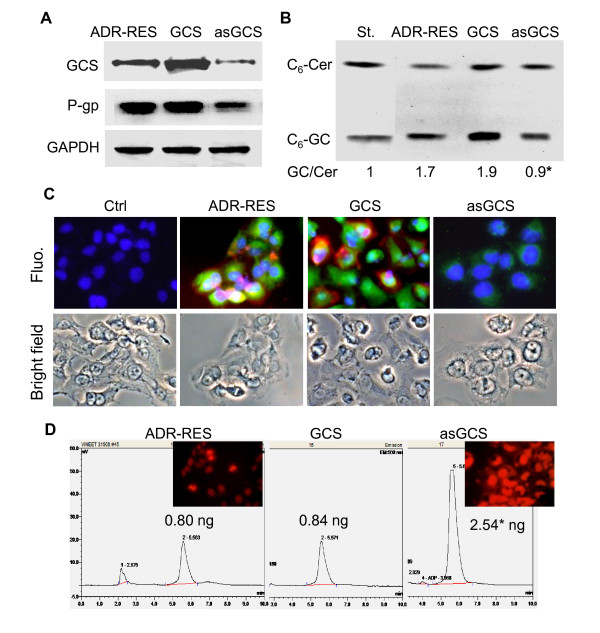
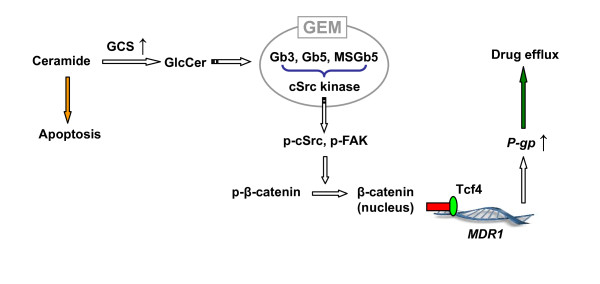
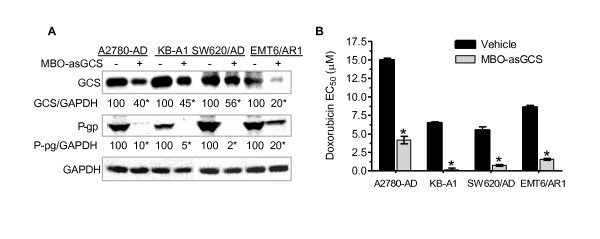
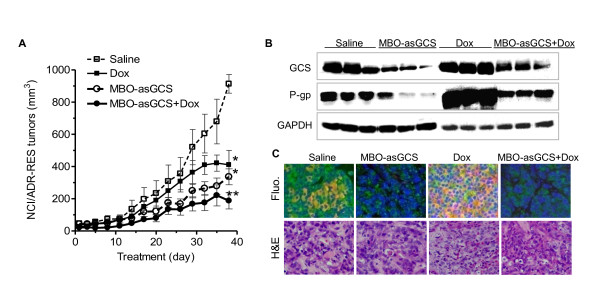
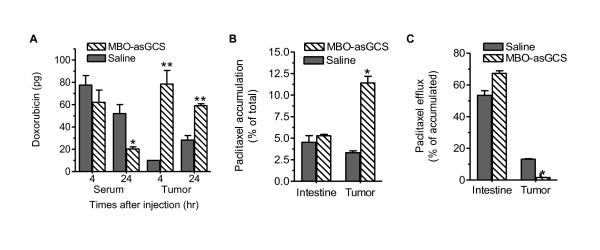
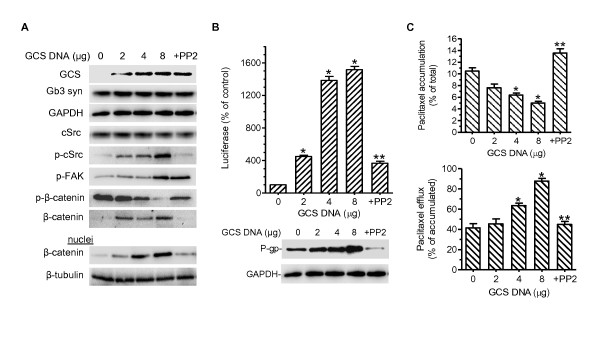
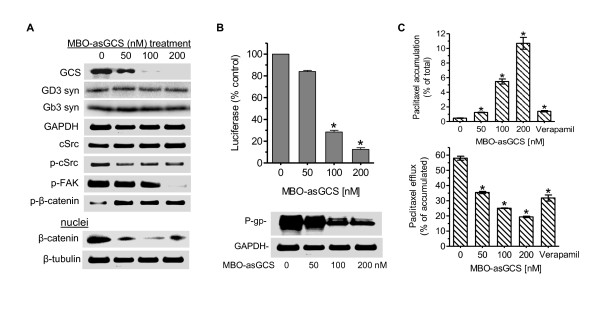
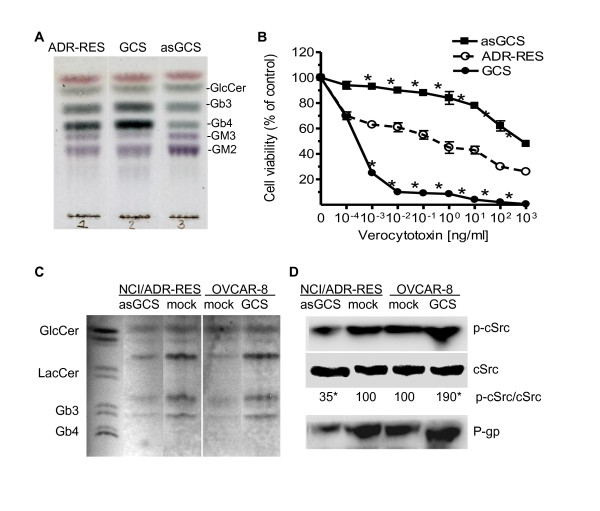
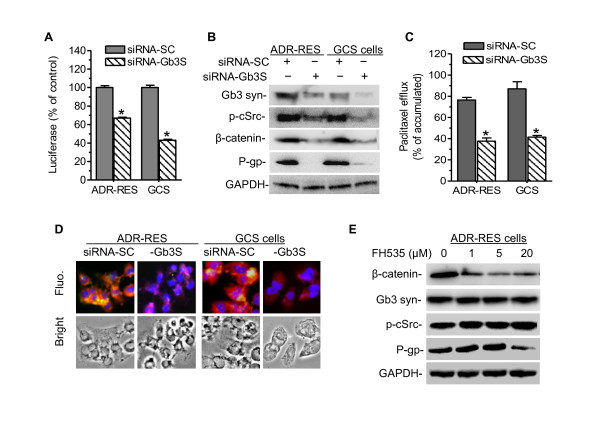
MDR1 and GCS were coincidently overexpressed in drug-resistant breast, ovary, cervical and colon cancer cells; silencing GCS using a novel mixed-backbone oligonucleotide (MBO-asGCS) sensitized these four drug-resistant cell lines to doxorubicin. This sensitization was correlated with the decreased MDR1 expression and the increased doxorubicin accumulation. Doxorubicin treatment induced GCS and MDR1 expression in tumors, but MBO-asGCS treatment eliminated "in-vivo" growth of drug-resistant tumor (NCI/ADR-RES). MBO-asGCS suppressed the expression of MDR1 with GCS and sensitized NCI/ADR-RES tumor to doxorubicin. The expression of P-glycoprotein and the function of its drug efflux of tumors were decreased by 4 and 8 times after MBO-asGCS treatment, even though this treatment did not have a significant effect on P-glycoprotein in normal small intestine. GCS transient transfection induced MDR1 overexpression and increased P-glycoprotein efflux in dose-dependent fashion in OVCAR-8 cancer cells. GSL profiling, silencing of globotriaosylceramide synthase and assessment of signaling pathway indicated that GCS transfection significantly increased globo series GSLs (globotriaosylceramide Gb3, globotetraosylceramide Gb4) on GSL-enriched microdomain (GEM), activated cSrc kinase, decreased beta-catenin phosphorylation, and increased nuclear beta-catenin. These consequently increased MDR1 promoter activation and its expression. Conversely, MBO-asGCS treatments decreased globo series GSLs (Gb3, Gb4), cSrc kinase and nuclear beta-catenin, and suppressed MDR-1 expression in dose-dependent pattern.
This study demonstrates, for the first time, that GCS upregulates MDR1 expression modulating drug resistance of cancer. GSLs, in particular globo series GSLs mediate gene expression of MDR1 through cSrc and beta-catenin signaling pathway.
在抗癌药物的压力下,癌细胞中多种基因的相互作用导致了耐药性。多药耐药 1 基因(MDR1)过度表达最常发生在耐药性癌症中,并伴有其他基因改变,包括增强的葡萄糖神经酰胺合酶(GCS)。MDR1 编码的 P-糖蛋白将抗癌药物排出细胞外。MDR1 的多态性破坏了 P-糖蛋白拮抗剂的作用,并限制了临床试验中耐药逆转的成功。GCS 将神经酰胺转化为葡萄糖神经酰胺,减少神经酰胺诱导的细胞凋亡的影响,并增加糖鞘脂(GSL)的合成。了解 MDR1 过度表达的分子机制以及它与 GCS 的相互作用方式,可能会找到逆转耐药性的有效方法。
在耐药性乳腺癌、卵巢癌、宫颈癌和结肠癌细胞中,MDR1 和 GCS 同时过度表达;使用新型混合骨架寡核苷酸(MBO-asGCS)沉默 GCS 可使这四种耐药细胞系对阿霉素敏感。这种敏感性与 MDR1 表达的降低和阿霉素积累的增加有关。阿霉素处理诱导肿瘤中 GCS 和 MDR1 的表达,但 MBO-asGCS 处理消除了耐药性肿瘤(NCI/ADR-RES)的“体内”生长。MBO-asGCS 抑制 MDR1 和 GCS 的表达,并使 NCI/ADR-RES 肿瘤对阿霉素敏感。MBO-asGCS 处理后,肿瘤中 P-糖蛋白的表达及其药物外排功能降低了 4 倍和 8 倍,尽管这一处理对正常小肠中的 P-糖蛋白没有显著影响。GCS 瞬时转染以剂量依赖性方式诱导 OVCAR-8 癌细胞中 MDR1 过度表达和增加 P-糖蛋白外排。糖鞘脂谱分析、神经节苷脂合成酶沉默和信号通路评估表明,GCS 转染显著增加了 GSL 富集微域(GEM)上的神经节苷脂 Gb3 和 Gb4,激活了 cSrc 激酶,降低了β-连环蛋白磷酸化,并增加了核β-连环蛋白。这继而增加了 MDR1 启动子的激活及其表达。相反,MBO-asGCS 处理以剂量依赖性方式降低了 Gb3 和 Gb4、cSrc 激酶和核β-连环蛋白,并抑制了 MDR1 的表达。
本研究首次表明,GCS 通过 cSrc 和β-连环蛋白信号通路上调 MDR1 表达,调节癌症的耐药性。糖鞘脂,特别是神经节苷脂,通过 cSrc 和β-连环蛋白信号通路调节 MDR1 的基因表达。