Department of Orthopaedic Surgery, Cappagh National Orthopaedic Hospital, Finglas, Dublin, Ireland.
BMC Musculoskelet Disord. 2010 Jun 14;11:119. doi: 10.1186/1471-2474-11-119.
Supervised preoperative muscle strengthening programmes (prehabilitation) can improve recovery after total joint arthroplasty but are considered resource intensive. Neuromuscular electrical stimulation (NMES) has been shown to improve quadriceps femoris muscle (QFM) strength and clinical function in subjects with knee osteoarthritis (OA) however it has not been previously investigated as a prehabilitation modality.
This pilot study assessed the compliance of a home-based, NMES prehabilitation programme in patients undergoing total knee arthroplasty (TKA). We evaluated its effect on preoperative and postoperative isometric quadriceps femoris muscle (QFM) strength, QFM cross-sectional area (CSA) and clinical function (subjective and objective). Seventeen subjects were recruited with 14 completing the study (NMES group n = 9; Control group n = 5).
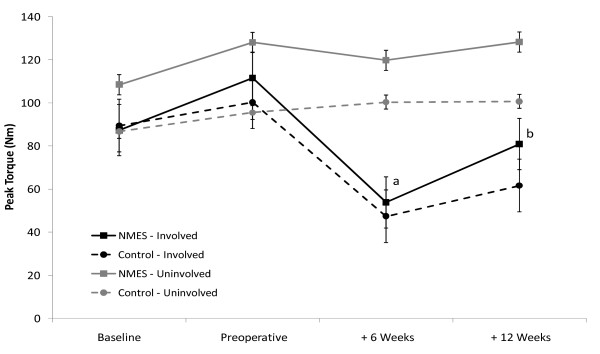
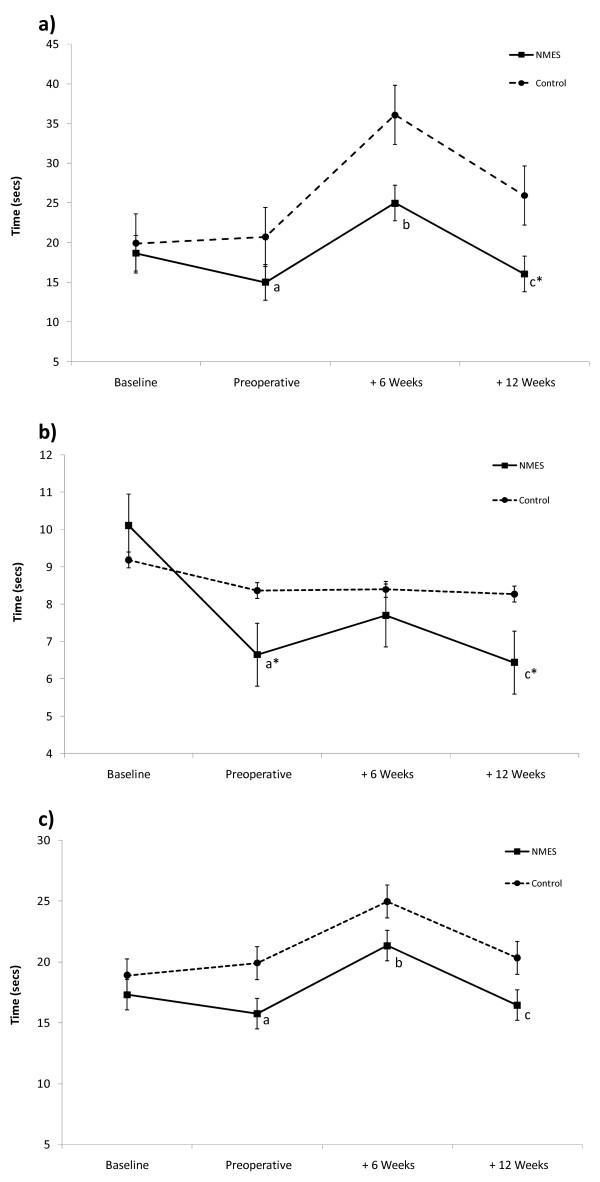
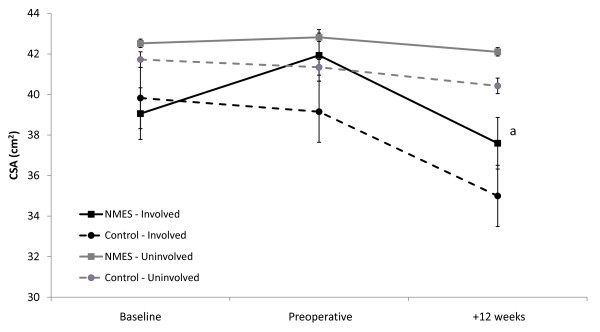
Overall compliance with the programme was excellent (99%). Preoperative QFM strength increased by 28% (p > 0.05) with associated gains in walk, stair-climb and chair-rise times (p < 0.05). Early postoperative strength loss (approximately 50%) was similar in both groups. Only the NMES group demonstrated significant strength (53.3%, p = 0.011) and functional recovery (p < 0.05) from 6 to 12 weeks post-TKA. QFM CSA decreased by 4% in the NMES group compared to a reduction of 12% in the control group (P > 0.05) at 12 weeks postoperatively compared to baseline. There were only limited associations found between objective and subjective functional outcome instruments.
This pilot study has shown that preoperative NMES may improve recovery of quadriceps muscle strength and expedite a return to normal activities in patients undergoing TKA for OA. Recommendations for appropriate outcome instruments in future studies of prehabilitation in TKA have been provided.
有监督的术前肌肉强化方案(康复)可以改善全关节置换术后的恢复,但被认为是资源密集型的。神经肌肉电刺激(NMES)已被证明可以改善膝关节骨关节炎(OA)患者的股四头肌(QFM)力量和临床功能,但尚未作为康复手段进行研究。
本研究评估了一种基于家庭的 NMES 康复方案在全膝关节置换术(TKA)患者中的依从性。我们评估了其对术前和术后等长股四头肌(QFM)力量、QFM 横截面积(CSA)和临床功能(主观和客观)的影响。共招募了 17 名受试者,其中 14 名完成了研究(NMES 组 n = 9;对照组 n = 5)。
方案总体依从性极好(99%)。术前 QFM 力量增加了 28%(p > 0.05),与步行、爬楼梯和起身时间的增加有关(p < 0.05)。两组术后早期的力量损失(约 50%)相似。只有 NMES 组在 TKA 后 6 至 12 周表现出显著的力量(53.3%,p = 0.011)和功能恢复(p < 0.05)。与对照组相比,NMES 组术后 12 周 QFM CSA 减少了 4%,而对照组减少了 12%(p > 0.05)。客观和主观功能结果仪器之间只有有限的关联。
本研究表明,术前 NMES 可能改善 OA 患者 TKA 后股四头肌力量的恢复,并加快其恢复正常活动的速度。为 TKA 康复研究中适当的结果工具提供了建议。