Department of Surgery, Duke University Medical Center, Durham, North Carolina, USA
PLoS One. 2010 Jun 10;5(6):e11022. doi: 10.1371/journal.pone.0011022.
SOX2 (Sry-box 2) is required to maintain a variety of stem cells, is overexpressed in some solid tumors, and is expressed in epithelial cells of the lung.
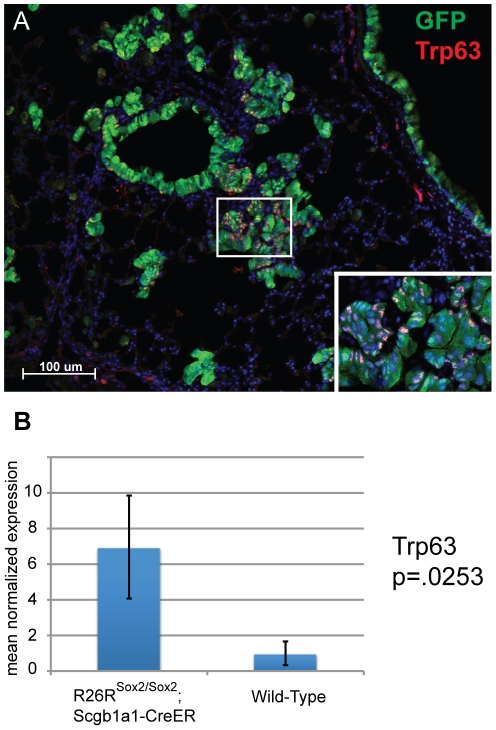
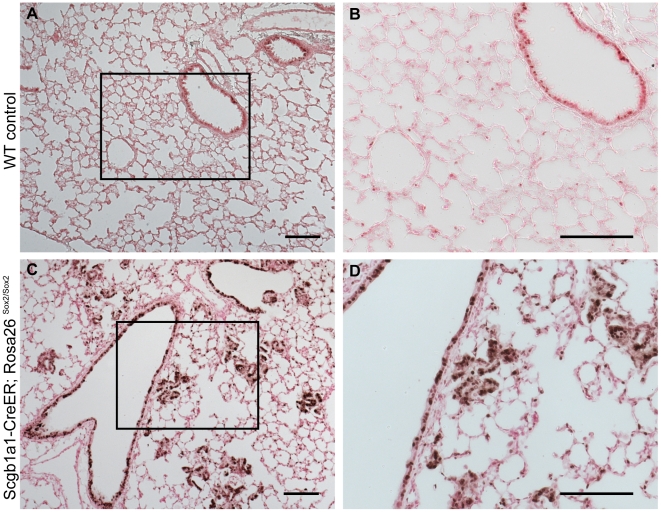
METHODOLOGY/PRINCIPAL FINDINGS: We show that SOX2 is overexpressed in human squamous cell lung tumors and some adenocarcinomas. We have generated mouse models in which Sox2 is upregulated in epithelial cells of the lung during development and in the adult. In both cases, overexpression leads to extensive hyperplasia. In the terminal bronchioles, a trachea-like pseudostratified epithelium develops with p63-positive cells underlying columnar cells. Over 12-34 weeks, about half of the mice expressing the highest levels of Sox2 develop carcinoma. These tumors resemble adenocarcinoma but express the squamous marker, Trp63 (p63).
These findings demonstrate that Sox2 overexpression both induces a proximal phenotype in the distal airways/alveoli and leads to cancer.
SOX2(性别决定区 Y 框 2)是维持多种干细胞所必需的,在一些实体肿瘤中过度表达,并在肺部的上皮细胞中表达。
方法/主要发现:我们表明,SOX2 在人类鳞状细胞肺癌肿瘤和一些腺癌中过度表达。我们已经生成了在发育中和成年期肺上皮细胞中 Sox2 上调的小鼠模型。在这两种情况下,过表达导致广泛的增生。在终末细支气管中,发展出类似于气管的假复层上皮,柱状细胞下有 p63 阳性细胞。在 12-34 周内,表达 Sox2 最高水平的小鼠中有一半发展为癌。这些肿瘤类似于腺癌,但表达鳞状标志物 Trp63(p63)。
这些发现表明 Sox2 的过表达既诱导了远端气道/肺泡的近端表型,又导致了癌症。