Chemical Ecology, Department of Plant Protection Biology, Swedish University of Agricultural Sciences, Alnarp, Sweden.
PLoS One. 2010 Jun 10;5(6):e11063. doi: 10.1371/journal.pone.0011063.
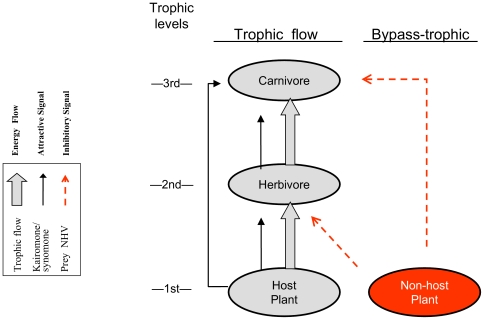
Insect predators and parasitoids exploit attractive chemical signals from lower trophic levels as kairomones to locate their herbivore prey and hosts. We hypothesized that specific chemical cues from prey non-hosts and non-habitats, which are not part of the trophic chain, are also recognized by predators and would inhibit attraction to the host/prey kairomone signals. To test our hypothesis, we studied the olfactory physiology and behavior of a predaceous beetle, Thanasimus formicarius (L.) (Coleoptera: Cleridae), in relation to specific angiosperm plant volatiles, which are non-host volatiles (NHV) for its conifer-feeding bark beetle prey.
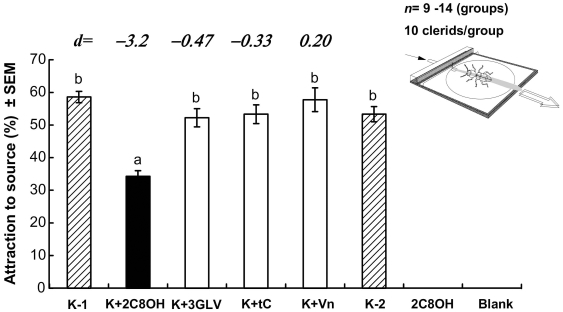
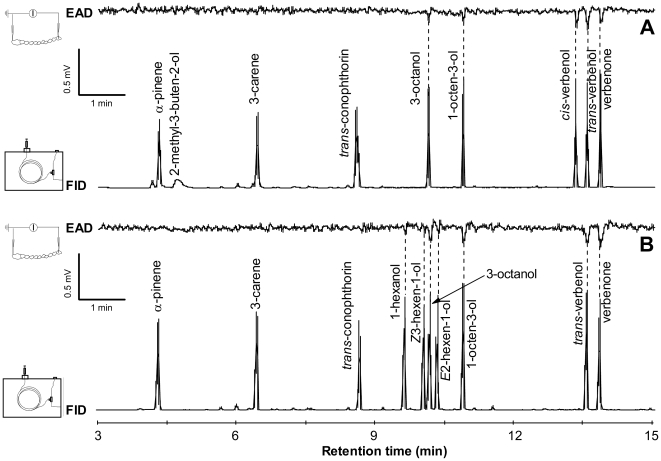
METHODOLOGY/PRINCIPAL FINDINGS: Olfactory detection in the clerid was confirmed by gas chromatography coupled to electroantennographic detection (GC-EAD) for a subset of NHV components. Among NHV, we identified two strongly antennally active molecules, 3-octanol and 1-octen-3-ol. We tested the potential inhibition of the combination of these two NHV on the walking and flight responses of the clerid to known kairomonal attractants such as synthetic mixtures of bark beetle (Ips spp.) aggregation pheromone components (cis-verbenol, ipsdienol, and E-myrcenol) combined with conifer (Picea and Pinus spp.) monoterpenes (alpha-pinene, terpinolene, and Delta(3)-carene). There was a strong inhibitory effect, both in the laboratory (effect size d = -3.2, walking bioassay) and in the field (d = -1.0, flight trapping). This is the first report of combining antennal detection (GC-EAD) and behavioral responses to identify semiochemical molecules that bypass the trophic system, signaling habitat information rather than food related information.
CONCLUSIONS/SIGNIFICANCE: Our results, along with recent reports on hymenopteran parasitoids and coleopteran predators, suggest that some NHV chemicals for herbivores are part of specific behavioral signals for the higher trophic level and not part of a background noise. Such bypass-trophic signals could be of general importance for third trophic level players in avoiding unsuitable habitats with non-host plants of their prey.
昆虫捕食者和寄生蜂利用来自下一个营养级的有吸引力的化学信号作为信息素来定位其草食性猎物和宿主。我们假设,来自非猎物和非栖息地的特定化学线索,这些线索不属于食物链的一部分,也被捕食者所识别,并会抑制对猎物/宿主信息素信号的吸引力。为了检验我们的假设,我们研究了捕食性甲虫 Thanasimus formicarius(L.)(鞘翅目:象甲科)的嗅觉生理学和行为,该甲虫与特定的被子植物挥发物有关,这些挥发物是非其针叶林食树皮甲虫猎物的植物挥发物(NHV)。
方法/主要发现:通过气相色谱法与触角电位检测(GC-EAD)相结合,对象甲科的一小部分 NHV 成分进行了嗅觉检测。在 NHV 中,我们鉴定出两种具有强烈触角活性的分子,即 3-辛醇和 1-辛烯-3-醇。我们测试了这两种 NHV 的组合对已知信息素引诱剂(如树皮甲虫(Ips spp.)聚集信息素成分(顺式马鞭草醇、ipsdienol 和 E-香芹醇)与针叶树(云杉和松树 spp.)单萜(α-蒎烯、松油烯和 Delta(3)-蒈烯)的组合对 clerid 行走和飞行反应的潜在抑制作用。在实验室(效果大小 d = -3.2,行走生物测定)和野外(d = -1.0,飞行诱捕)都有强烈的抑制作用。这是首次报道结合触角检测(GC-EAD)和行为反应来识别绕过营养系统的半化学分子,这些分子传递的是栖息地信息,而不是与食物相关的信息。
结论/意义:我们的结果,以及最近关于膜翅目寄生蜂和鞘翅目捕食者的报告,表明一些用于草食动物的 NHV 化学物质是更高营养级特定行为信号的一部分,而不是背景噪音的一部分。这种绕过营养的信号对于避免其猎物的非宿主植物的不合适栖息地的第三营养级参与者可能具有普遍重要性。