Harding Stephen J, Browne Gareth J, Miller Bryan W, Prigent Sally A, Dickens Martin
Department of Biochemistry, Henry Wellcome Building, University of Leicester, Leicester, UK.
Biochim Biophys Acta. 2010 Sep;1802(9):733-40. doi: 10.1016/j.bbadis.2010.06.005. Epub 2010 Jun 13.
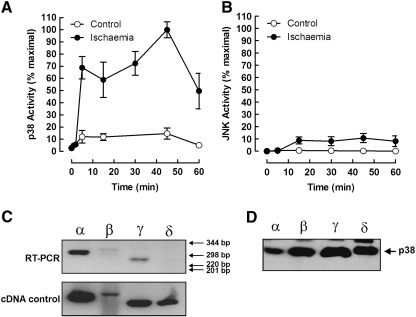
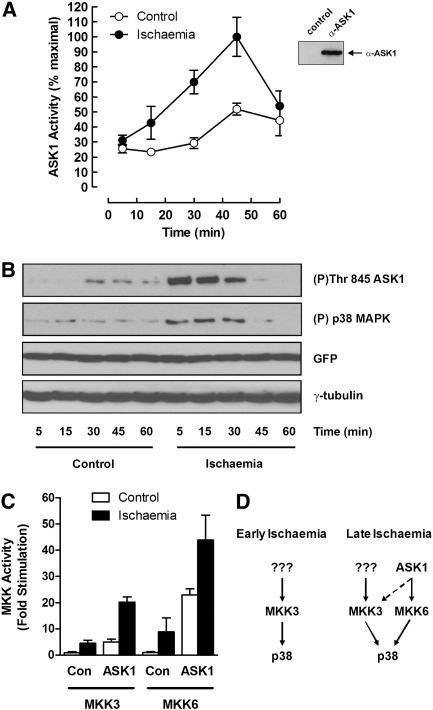
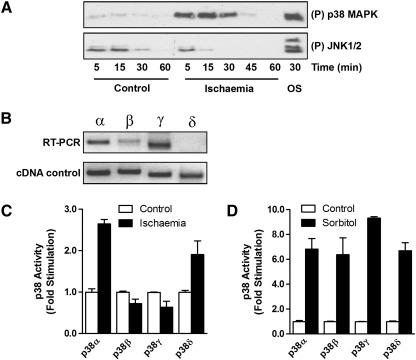
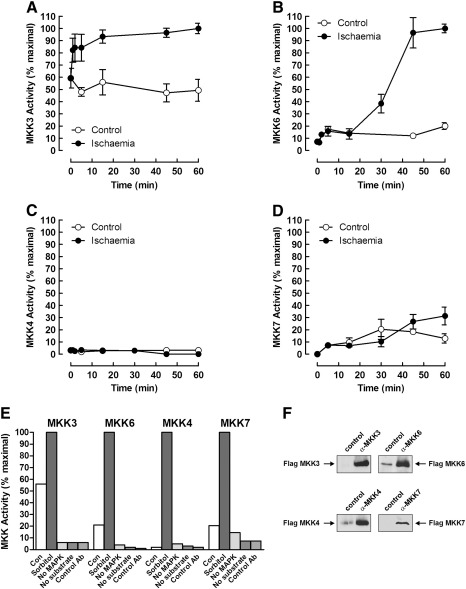
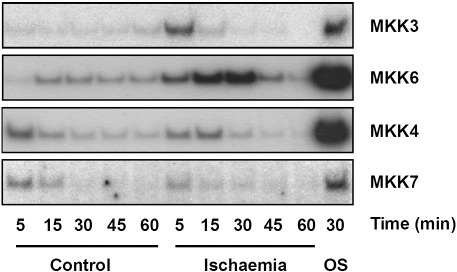
p38 MAPK is activated potently during cardiac ischaemia, although the precise mechanism by which it is activated is unclear. We used the isolated perfused rat heart to investigate the signalling pathways activated upstream of p38 during global cardiac ischaemia. Ischaemia strongly activated p38alpha but not the JNK pathway. The MAPKKs, MKK3, MKK4 and MKK6 have previously been identified as potential upstream activators of p38; however, in the ischaemic perfused heart, we saw activation of MKK3 and MKK6 but not MKK4. MKK3 and MKK6 showed different temporal patterns of activity, indicating distinct modes of activation and physiological function. Consistent with a lack of JNK activation, we saw no activation of MKK4 or MKK7 at any time point during ischaemia. A lack of MKK4 activation indicates, at least in the ischaemic heart, that MKK4 is not a physiologically relevant activator of p38. The MAPKKK, ASK1, was strongly activated late during ischaemia, with a similar time course to that of MKK6 and in ischaemic neonatal cardiac myocytes ASK1 expression preferentially activated MKK6 rather than MKK3. These observations suggest that during ischaemia ASK1 is coupled to p38 activation primarily via MKK6. Potent activation of ASK1 during ischaemia without JNK activation shows that during cardiac ischaemia, ASK1 preferentially activates the p38 pathway. These results demonstrate a specificity of responses seldom seen in previous studies and illustrate the benefits of using direct assays in intact tissues responding to physiologically relevant stimuli to unravel the complexities of MAPK signalling.
p38丝裂原活化蛋白激酶(MAPK)在心脏缺血期间被强烈激活,但其具体激活机制尚不清楚。我们使用离体灌注大鼠心脏来研究在全心缺血期间p38上游被激活的信号通路。缺血强烈激活p38α,但不激活JNK通路。丝裂原活化蛋白激酶激酶(MAPKKs),即MKK3、MKK4和MKK6,先前已被确定为p38的潜在上游激活剂;然而,在缺血灌注心脏中,我们观察到MKK3和MKK6被激活,而MKK4未被激活。MKK3和MKK6表现出不同的时间活性模式,表明其激活模式和生理功能不同。与JNK未被激活一致,我们在缺血期间的任何时间点都未观察到MKK4或MKK7被激活。MKK4未被激活表明,至少在缺血心脏中,MKK4不是p38的生理相关激活剂。丝裂原活化蛋白激酶激酶激酶(MAPKKK),即凋亡信号调节激酶1(ASK1),在缺血后期被强烈激活,其时间进程与MKK6相似,并且在缺血新生心肌细胞中,ASK1的表达优先激活MKK6而非MKK3。这些观察结果表明,在缺血期间,ASK1主要通过MKK6与p38的激活相关联。缺血期间ASK1的强烈激活而JNK未被激活表明,在心脏缺血期间,ASK1优先激活p38通路。这些结果证明了先前研究中很少见到的反应特异性,并说明了在对生理相关刺激作出反应的完整组织中使用直接检测方法来揭示MAPK信号复杂性的益处。