Department of Experimental VeterinarySciences, University of Padua, Italy.
Eur J Histochem. 2010 Apr 14;54(2):e16. doi: 10.4081/ejh.2010.e16.
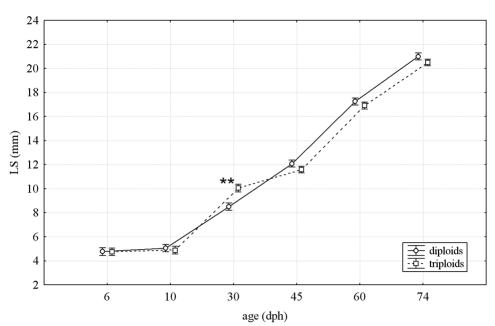
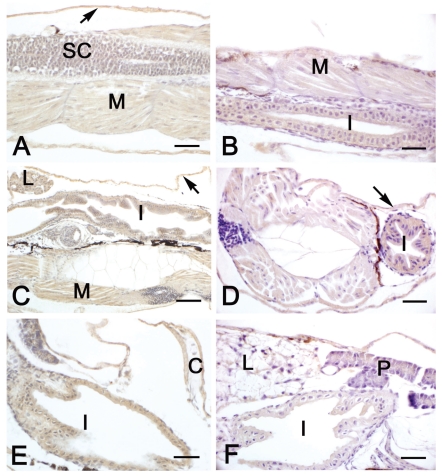
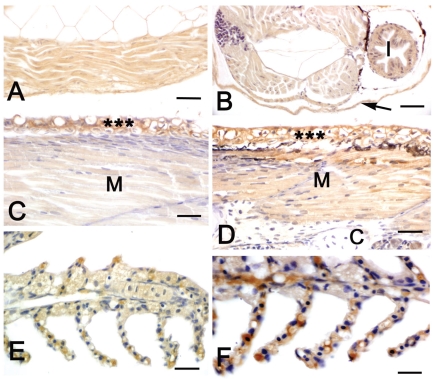
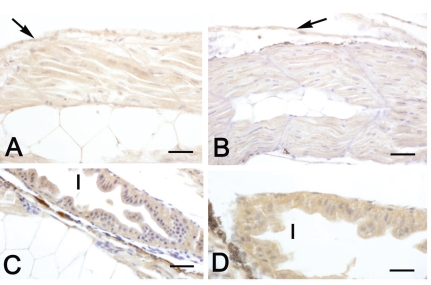
The cellular localization of IGF-I, IGF-II and MSTN proteins was investigated during ontogenesis of triploid sea bass (Dicentrarchus labrax) by an immunohistochemical approach. The results were compared with those observed in diploids. IGF-I immunostaining was mainly observed in skin, skeletal muscle, intestine and gills of both diploids and triploids. From day 30 of larval life, IGF-I immunoreactivity observed in skeletal muscle, intestine, gills and kidney was stronger in triploids than in diploids. At day 30, triploids exhibited a standard length significantly higher than the one of diploids. Although IGF-II and MSTN immunoreactivity was detectable in different tissues and organs, no differences between diploids and triploids were observed. The spatial localization of IGF-I, IGF-II and MSTN proteins detected in this study is in agreement with previous findings on the distribution of these proteins in diploid larvae and fry. The highest IGF-I immunoreactivity observed in triploids suggests a possible involvement of ploidy in their growth performance.
采用免疫组织化学方法研究了三倍体鲈鱼(Dicentrarchus labrax)个体发生过程中 IGF-I、IGF-II 和 MSTN 蛋白的细胞定位。并将结果与二倍体观察到的结果进行了比较。IGF-I 免疫染色主要在皮肤、骨骼肌、肠和鳃中二倍体和三倍体中均可观察到。从幼虫 30 天开始,三倍体骨骼肌、肠、鳃和肾脏中的 IGF-I 免疫反应性强于二倍体。在第 30 天,三倍体的标准体长明显高于二倍体。虽然 IGF-II 和 MSTN 免疫反应性可在不同的组织和器官中检测到,但在二倍体和三倍体之间未观察到差异。本研究中检测到的 IGF-I、IGF-II 和 MSTN 蛋白的空间定位与这些蛋白在二倍体幼虫和鱼苗中的分布的先前研究结果一致。三倍体中观察到的 IGF-I 免疫反应性最强,表明多倍体可能参与了它们的生长性能。